


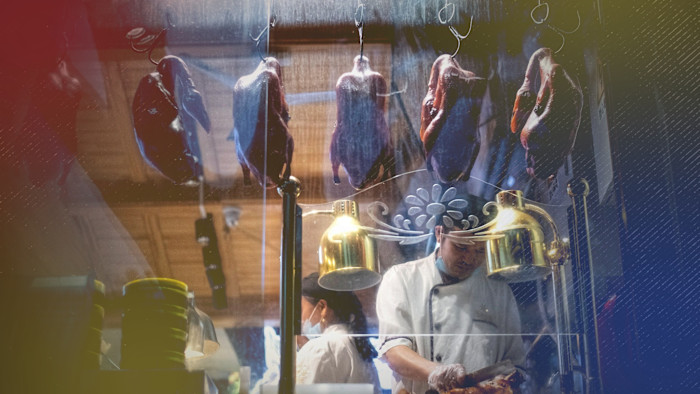
Brussels’ decision to target one of China’s most famous dishes, Peking duck, for an anti-dumping campaign was a cue for Chinese propagandists to engage in one of their favourite pastimes: EU bashing.
“Why is ‘European duck’ so afraid of ‘Peking duck’?” said the Communist Party’s nationalist tabloid, the Global Times, referring to EU accusations this month that Peking duck, the meat used in the dish, was fattened up with state subsidies in China before being dumped in Europe. The paper said Europe’s ducks were let down by the bloc’s “high energy costs and fragile supply chains”.
As the EU battles China’s growing trade surplus, Beijing is resorting to what analysts say is a time-tested playbook — attacking Brussels, which sets trade policy for the bloc and wields its collective power, while individually courting many of the more vulnerable 27 member states. In the first half of this year China’s trade surplus with the EU, which hit €360bn in 2025, rose another 24 per cent year-on-year.
Beijing is also quietly leveraging relations with countries adjacent to the bloc, such as the UK and Morocco, to gain access to the EU single market, and is seeking to influence European companies with large operations in China, analysts say.
“We are 28 voices in Europe — 27 member states plus the European Union — and it has always been a favourite pastime of the Chinese leaders to divide and conquer us. And it always works,” said Joerg Wuttke, a partner at consultancy DGA Group.
But analysts believe that growing Chinese surpluses might finally force Europe to call time on this tactic or risk full deindustrialisation.
The EU’s trade commissioner Maroš Šefčovič agreed with Chinese commerce minister Wang Wentao in June to consultations covering four areas: trade and investment balancing, export controls, intellectual property rights and WTO reform. Šefčovič set a deadline of October for “tangible results” on China’s surplus with the bloc.
“Despite a three-month trade truce, the growing surplus keeps the risk of a China-EU trade conflict elevated,” said Larry Hu, chief China economist at Macquarie.
At a recent event in Beijing, a senior European diplomat praised the tone of the talks as “better than they have been in months if not years”.
But in return, Beijing has its own demands. These include reducing tariffs on Chinese electric vehicle imports and scrapping controls on exports of chip-manufacturing machines from the Netherlands’ ASML to China.

Relations with Brussels also remain severely strained.
EU leaders last July were forced to travel to Beijing to see President Xi Jinping for the 50th anniversary of bilateral relations, even though it was nominally China’s turn to visit Brussels. They held uncomfortable talks with Xi about the surplus and Ukraine.
By contrast, since then, Beijing has laid out the red carpet for visits by German Chancellor Friedrich Merz and Spain’s Prime Minister Pedro Sánchez among others.
The foreign affairs ministry in Beijing insisted China and Europe were “partners not rivals”. “China has always supported the process of European integration and is committed to developing relations with EU institutions and member states on a comprehensive, balanced, equal and mutually beneficial basis,” it said.
At the corporate level, though, many EU companies are suffering from China’s export controls on rare earths introduced last year during the trade war with the US.
“Most of the time over the past year, relations between China and the European Union have not been so good but China always has some more confidence about its independent relations economically with the member states,” said Cui Hongjian, director of the Center for the European Union and Regional Development Studies, at Beijing Foreign Studies University.
He said there were “roughly three groups” in the EU: France, Italy and a couple of others that were more protectionist, Spain and some others that wanted more co-operation with China, and then a majority that were trying to find “a balance between those two groups”.
Željana Zovko, a centre-right member of the European parliament’s trade committee, says member states “are scared” of China. While they united to deal with US President Donald Trump’s tariffs, they will not do so against Beijing because they are too dependent on it for renewable technology, critical minerals and cheap inputs. “We are stupid” for allowing such over-reliance, she said. “We have not had a clear position towards China as we did with the US,” she added.
By contrast, Beijing has also become more assertive after seeing off the US in last year’s trade war, diplomats say.
“They are so confident now,” said the senior European diplomat in Beijing.
“We’re so weak vis-à-vis China,” said Marie-Sophie Dibling, a trade lawyer at Cassidy Levy Kent in Brussels. “They toy with member states. They know exactly how to do things, they have this retaliation threat every time.”
China could also directly target European companies in its market, said DGA’s Wuttke.
“If you want to be competitive in chemistry, you have to be in China, because that’s where the engineers are. That’s where the innovation is. And if you want basically to unlearn how to build cars and learn how to build mobile phones on wheels, you have to be in China,” he said, referring to electric vehicles.
“So they force the entire supply chain . . . to be more Chinese and all of a sudden you have Chinese companies with German labels on them.”

Another area that China can leverage is its trading relationships with countries on the EU’s periphery.
China’s commerce minister Wang spent three days in London in July following his visit to Brussels, holding what UK officials said were “extraordinarily constructive” talks, especially on investment.
The cumulative stock of Chinese investment in the UK reached nearly €85bn by 2025, more than the next two largest EU recipients combined, according to data compiled by the consultancy Rhodium Group.
The UK has previously diverged from the EU on trade policy with China, not levying tariffs on Chinese EVs, for example, while Brussels has imposed tariffs of up to 45 per cent.
But Sam Goodman, senior policy director at the hawkish China Strategic Risks Institute, said that the UK government was also seeking to deepen trade ties with Brussels.
“Given the historic interlinked industrial supply chains between the UK and EU and the aspiration in London for an ambitious reset in relations [after Brexit], it’s hard to see how the UK will not eventually fall into line with the EU’s economic security policies towards Beijing,” he added.

There are already some signs of movement. The UK has matched the EU’s decision to double steel tariffs and halve tariff-free quotas to tackle a global glut of the metal, mostly from China.
Brussels is also contending with a surge of Chinese investment in North African countries that have free trade agreements with the EU.
Morocco has been the largest recipient, with some $6bn announced since the pandemic, according to Rhodium Group data — mostly in auto-industry supply chains that also serve EU companies manufacturing in Morocco.
Last year the European Commission ruled that aluminium wheels shipped from Morocco were “unfairly subsidised” by Rabat and by Beijing through its Belt and Road Initiative, a strategic overseas investment programme.
Ultimately, however, Beijing’s strategy will be to wait while the EU’s member states squabble over how to deal with the surpluses, analysts say.
“Beijing has learnt that Europe may complain, but it can be coerced into delay,” said Andrew Small of the European Council on Foreign Relations.
Data visualisation by Haohsiang Ko
