


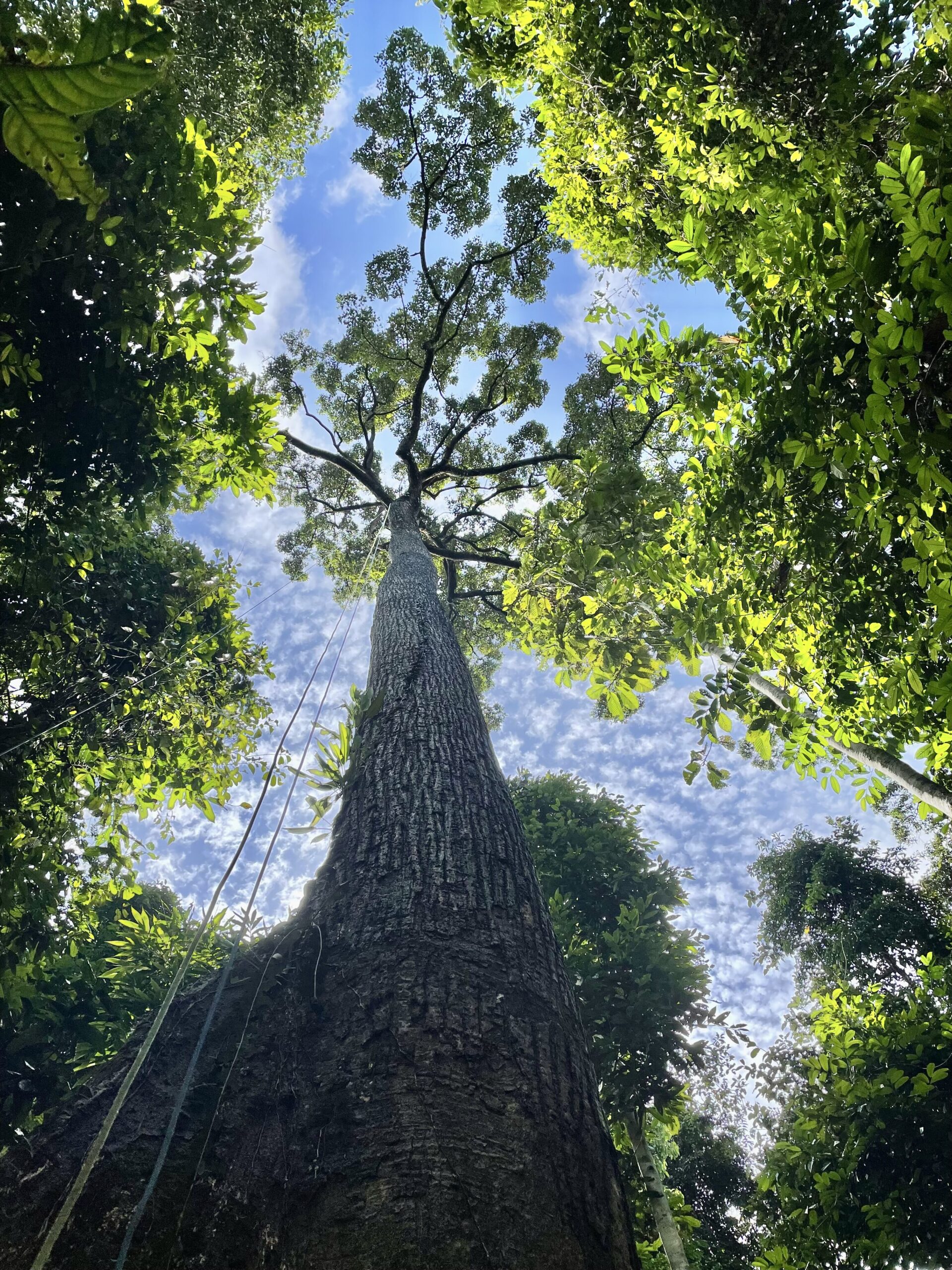
Giant tropical trees in Malaysian Borneo pump water to their highest branches just as easily as to their lower-most branches, a new study says.
Researchers say this suggests tall trees are not more vulnerable to drought than shorter trees, as was previously believed.
For decades, scientists have hypothesized that as trees become taller, the effects of gravity and the longer paths that water needs to travel hinder their growth.
In this latest study, researchers examined 38 trees of five species from the Dipterocarpaceae family in Malaysia’s Kabili-Sepilok Forest Reserve in northeastern Borneo. The trees, including keruing putih (Dipterocarpus caudiferus), kapur (Dryobalanops lanceolata) and meranti pepijat (Rubroshorea johorensis), ranged from 7-71 meters (23-233 feet) tall. Dipterocarps are the tallest flowering trees in the world, and dominate Southeast Asian rainforests.
Specialist climbers scaled each tree to collect branches from different parts of the canopy. The researchers then measured several traits of the vessels inside the wood that carry water, as well as of the wood and leaves of the branches.
The analysis shows that the tall trees use two primary mechanisms to compensate for their heights: vessel widening and leaf adjustments.
As trees grow taller, they grow much wider water-carrying vessels at the base of the trunk than those found in shorter trees, which significantly reduces resistance to water flow.
Leaves at the top of the canopy also adjust their osmotic potential, or the levels of dissolved substances in their cells, which allows them to hold more water even under extremely low pressure created by gravity at those heights, the researchers say.
“The really surprising thing is that we were not expecting them to adjust to being taller,” study lead author Paulo Bittencourt, from Cardiff University in the U.K., told Mongabay in a video call. “We were expecting they would be more vulnerable as they grow taller, that they would have more issues keeping their leaves hydrated … It was exactly the opposite of what we actually expected.”
The study finds these adaptations help the tall trees remain resilient even during environmental extremes. By tracking trunk growth during the intense El Niño linked drought in 2023 and 2024, researchers found that the tallest trees suffered no greater decline in growth than smaller trees.
Bittencourt said existing models for climate-change forecasting often assume that tall trees are the first to die during droughts owing to a failure to move enough water. But the study’s findings suggest tall trees may be more robust than previously thought, he added.
The study notes that the tallest 1% of trees, while few in number, store more than half of all aboveground forest carbon.
“It really tells us that we need to go back to the field and we need to properly study tropical forests,” Bittencourt said.
Banner image: A 57-meter (187-foot) tall Dipterocarp tree with a double-rope technique rigged for canopy access. Image courtesy of Palasiah Jotan.
