


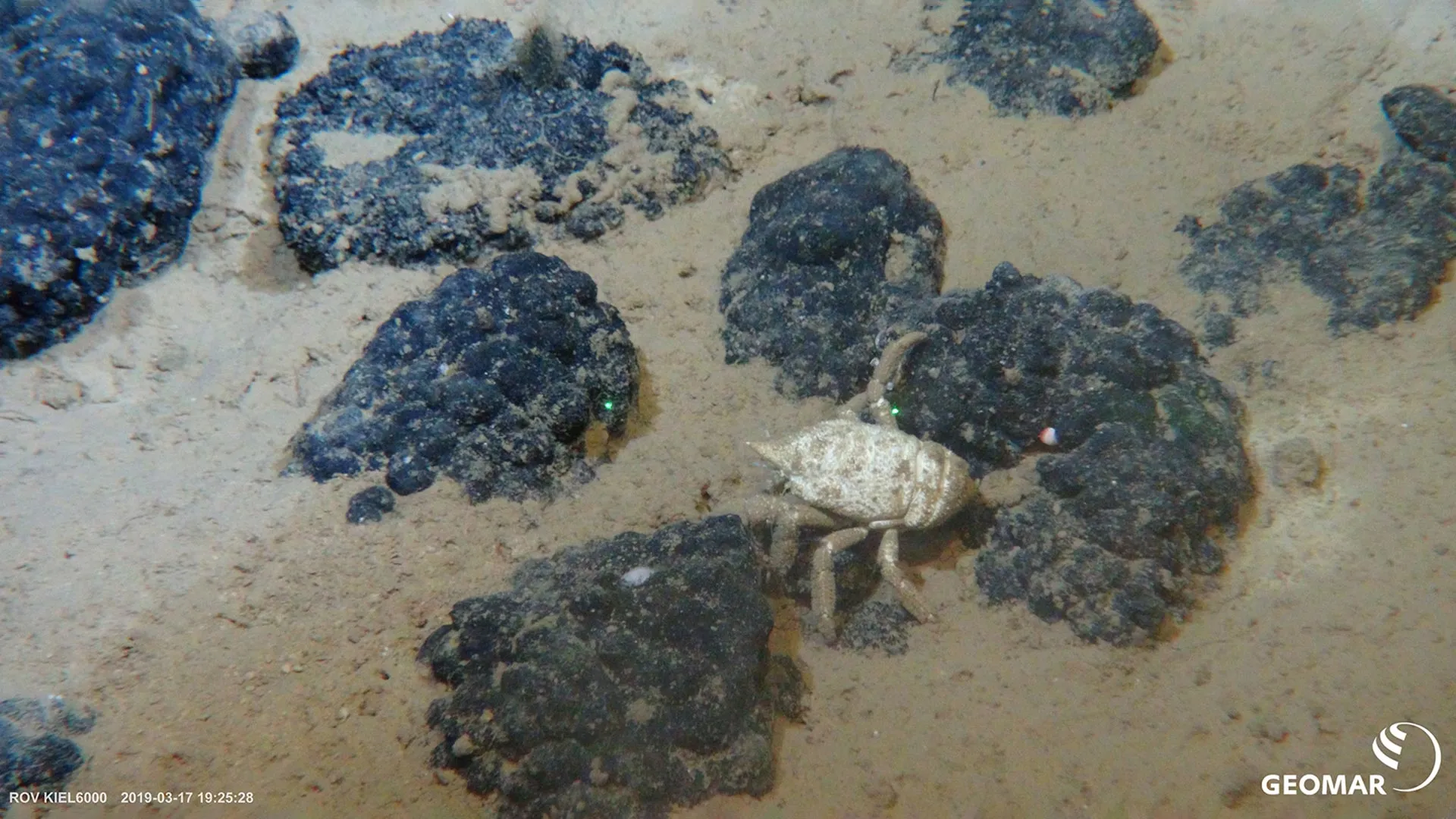
Deep beneath the Pacific Ocean, scientists have uncovered a surprising world of tiny animals living inside metal-rich rocks that take millions of years to form. These rocks, known as polymetallic nodules, contain miniature cracks and cavities that provide shelter for creatures smaller than a millimeter.
Although they may look like ordinary stones, these nodules offer something unusual in the deep ocean. They create hard surfaces in an environment dominated by soft mud, while their internal spaces provide additional habitats for marine life.
Polymetallic nodules are dark, roughly fist-sized formations made largely of iron and manganese oxides. They grow at an extraordinarily slow pace, often adding only a few millimeters over a million years. Found at ocean depths ranging from 4,000 to 6,000 meters, they can remain on the seafloor for millions of years.
Researchers set out to investigate the tiny organisms living within these ancient formations and determine how important the nodules are to deep-sea biodiversity.
Dr. Tanja Stratmann, a deep-sea ecologist and one of the study’s three lead authors, explains: “In our study we show that the sizes of cracks inside the nodules are large enough to provide home to animals that are smaller than a millimeter in size.”
Hundreds of Tiny Animals Found Inside a Single Rock
To explore these hidden habitats, the research team collected nodules from the Clarion-Clipperton Zone, a vast region of the central Pacific Ocean. They used specialized sampling equipment, including box corers that collect sections of the seafloor and remotely operated diving robots capable of working at extreme depths.
Back in the laboratory, the researchers carefully opened the nodules and extracted the tiny animals concealed within their cracks and crevices.
The results revealed an unexpectedly rich community of marine life. Across 244 nodules, the team identified 4,139 individual animals. Each nodule contained an average of 17 animals, but one particularly crowded specimen sheltered an astonishing 245 individuals.
The discovery shows that these rocks are more than simple surfaces where marine organisms can attach themselves. Their intricate internal structures create three-dimensional living spaces, allowing animals to inhabit protected areas within the nodules themselves.
Dr. Coral Diaz-Recio Lorenzo explains: “The crevices in the polymetallic nodules function as small shelters and provide home to animals that we do not encounter in the soft sediment of the seafloor.”
Hidden Ecosystems Unlike Those on the Surrounding Seafloor
Although the nodules contained fewer animals than the surrounding muddy sediment, their contribution to deep-sea life was still substantial.
For roundworms (nematodes), the number living inside the nodules amounted to approximately 10% of the number found in the surrounding sediment. For tiny crustaceans (copepods), the figure was about 25%.
However, the most important finding was not simply how many animals the researchers discovered. It was how different the communities inside the rocks were from those living in the nearby mud.
Genetic analyses revealed that the animals inhabiting the nodules formed distinctive communities. Remarkably, these communities remained highly similar across locations separated by large distances (up to 1,000 km), even though they differed significantly from the organisms found in the surrounding seafloor sediment.
This suggests that polymetallic nodules support specialized habitats that are not easily replaced by other parts of the deep ocean. Their cracks and cavities offer living conditions that certain organisms appear to depend on.
Deep-Sea Mining Could Destroy These Ancient Habitats
The findings raise serious concerns about the potential environmental consequences of deep-sea mining.
Polymetallic nodules contain economically valuable metals, including nickel, cobalt, and copper. These resources have attracted interest in industrial mining operations that would collect the nodules directly from the ocean floor.
However, removing the rocks would also eliminate the miniature habitats they contain, along with the animals living inside them.
One example is Thurammina sp. 1, a single-celled organism found particularly frequently within the nodules. This species appears especially well adapted to the sheltered spaces inside the rocks, making it an example of the specialized life that could be threatened by their removal.
The problem is that these habitats cannot quickly recover. Because polymetallic nodules require millions of years to develop, new ones would not form within a human lifetime. Mining could therefore eliminate ecosystems that would take geological timescales to replace.
Prof. Sabine Gollner warns: “Our findings point out that commercial mining may result in an irreversible loss of undescribed and unique biodiversity associated to nodules. This needs to be considered in environmental management of deep-sea mining.”
Scientists Race to Understand What Could Be Lost
The discovery highlights an often overlooked aspect of ocean conservation. Protecting deep-sea ecosystems requires more than safeguarding large, visible animals. It also means considering the microscopic and nearly microscopic organisms that inhabit specialized environments hidden within the seafloor.
An important question remains unanswered: If deep-sea mining destroys these nodule communities, could some species disappear entirely?
Researchers still need to determine whether organisms that depend on the nodules also inhabit other parts of the ocean. If certain species are restricted to these habitats, removing the nodules could potentially contribute to their global extinction.
Understanding where these animals live and how widely they are distributed will be essential for identifying areas that need protection and evaluating the potential ecological damage caused by deep-sea mining.
To investigate further, Dr. Tanja Stratmann is currently participating in an international research expedition to the Clarion-Clipperton Zone, where scientists are continuing to study the ecosystems associated with polymetallic nodules.
This expedition and other follow-up investigations are independently funded through the JPIOcean projects MiningImpact 2 and 3.
The findings reveal that even a single rock on the deep ocean floor can support a surprisingly complex community of life. As interest in harvesting the ocean’s mineral resources grows, scientists are working to understand these hidden ecosystems before habitats that took millions of years to form are permanently lost.
