


Unlock the Editor’s Digest for free
Roula Khalaf, Editor of the FT, selects her favourite stories in this weekly newsletter.
Security researchers have attacked Google’s new AI-powered image editing tool, arguing it will accelerate the spread of disinformation by making it easier to fabricate convincing satellite imagery.
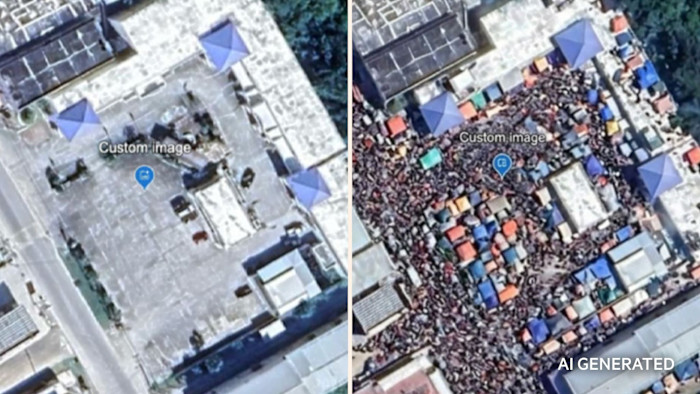
The company on Thursday announced that it had integrated its Nano Banana image-generation model into Google Earth, allowing users to “type whatever you want to see” and “virtually reimagine anywhere in the world”.
The system lets users manipulate satellite imagery with AI-generated objects and scenes. Users on X quickly demonstrated the feature by sharing images they said showed a fabricated bomb crater in Gaza, nuclear power plants in Iran and a car crash on a street in Amsterdam.
Open-source intelligence (Osint) experts who use Google Earth to verify information from hard-to-access areas, including war zones, warned that the tool could undermine one of the most widely used reference points for authenticating imagery.
“Google Earth has served for decades as the dated reference layer journalists and investigators check suspicious imagery against; building a generative tool into that same benchmark corrupts the very measure used to debunk fakes,” said Sam Stockwell, senior research associate at the Alan Turing Institute.
“The fake is now being made inside the thing people use to check whether pictures are real,” said Henk van Ess, an Osint expert and author of the Digital Digging newsletter, who shared the altered Google Earth images on X.
Google’s announcement comes as concerns grow over the spread of AI-generated images on social media, making it far easier for individuals and governments to fabricate evidence and distribute it to millions of people worldwide.
In March, as war raged across the Middle East, AI-altered satellite images circulated on X purporting to show damage to an American radar system in Qatar following an Iranian drone strike.
Another apparently AI-generated post claimed to show the Islamic republic’s late supreme leader being pulled out of rubble, while a further AI-enhanced post exaggerated the scale of damage to a US military base in Iraq.
Brady Africk, a research analyst at the American Enterprise Institute, said Google’s tool went further than previous image generators because it is integrated into Google Earth.
“These fakes are anchored to real satellite images, removing some of the tell-tale signs of AI generation like mismatched terrain and scale,” he said.
Google did not immediately respond to a request for comment but has previously said every image created with the Nano Banana tool in Google Earth includes a watermark that can be identified by its Gemini AI model.
However Africk cautioned this would not be sufficient to prevent people from being deceived. “Few people check whether an image is AI-generated as they scroll past or share it.”
Graphics by Jana Tauschinski
