


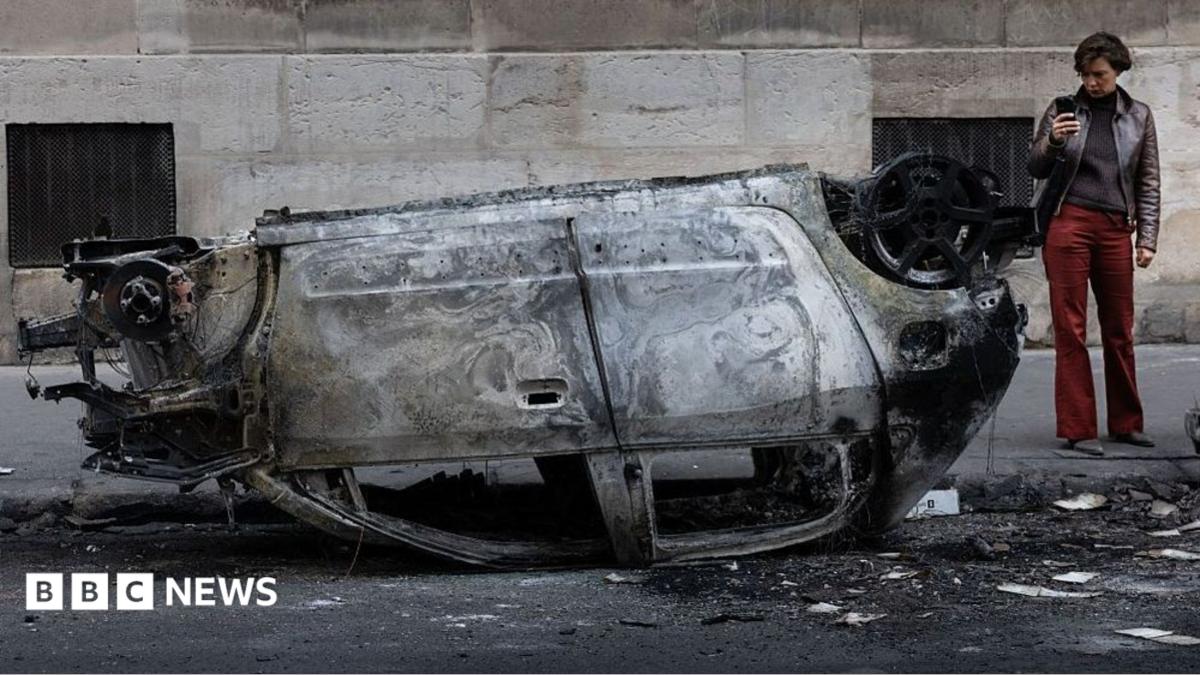
In Saint-Denis suburb on Monday, I met Lisa Cordat, of the FSE student union. She told me that students had organised themselves for demos via social media messaging or through student-led organisations. She said it was “insulting” to suggest they were being manipulated or “told to do this, or do that” by politicians.
“Student anger comes from the ground up,” says Lisa.
But there is also a palpable frustration amongst many in France at what they see as the politicisation of Saturday’s violence. Lina, who is 25, told me: “Politicians are hunting for scapegoats but don’t ask why it all happened. The root causes of Saturday. We feel scared and abandoned.”
France’s leading politicians have indulged in a festival of finger-pointing since Saturday.
The presidential election here in six months’ time is hotly contested and the volatility on French streets funneled immediately into France’s already febrile politics.
Mélenchon, currently running in second place in most polls, ahead of centrist candidates, accused France’s centrist prime minister of being “responsible for the chaos” either due to “incompetence or a worst-case strategy.”
Mélenchon went on to apparently imply Lecornu may have allowed the violence to unfold, so as to position itself as a “party of order”, after Saturday’s lawlessness, “that would make people forget his failure in public finances”.
France is struggling with spiralling public debt and government borrowing costs.
As for intelligence failures on Saturday, President Macron has demanded explanations and a new policing strategy. France’s interior minister admitted there were not enough officers on the streets, despite the nationwide protests being publicised well in advance.
Following accusations of heavy-handedness at earlier demos, the police seemed very much out of their depth this weekend.
Of all the presidential hopefuls, it would seem Marine Le Pen of the anti-immigration National Rally party gains most politically from Saturday’s shocking scenes.
She is already way ahead in opinion polls. Le Pen chose to launch a presidential-looking video address to the nation via social media on Sunday. Dressed formally, behind a large desk and in front of a French flag, she blamed Jean-Luc Mélenchon by name for his associates who “look to throw the country into chaos,” she said.
She also accused the Macron government of “running out of steam”, meaning that France was “taken hostage between violence and powerlessness”.
She ended her video by reminding French voters they would have the opportunity to “choose a different path” in six months’ time.
Le Pen’s party promotes a law and order, closed-border message and, like US President Donald Trump and US Vice President JD Vance, has blamed migrants, amongst others, for the chaos in France on Saturday. French authorities have not implicated migrants in the violence.
One teacher called Mar complained that Saturday’s violence “suits politicians’ purpose. It distracts from weeks of legitimate protests for better public services”, she said.
“Politicians aren’t listening to what the students need, or what teachers need or what the French people want. They’re using the violence to election-campaign to become president and to try to make their opponents look bad.”
