


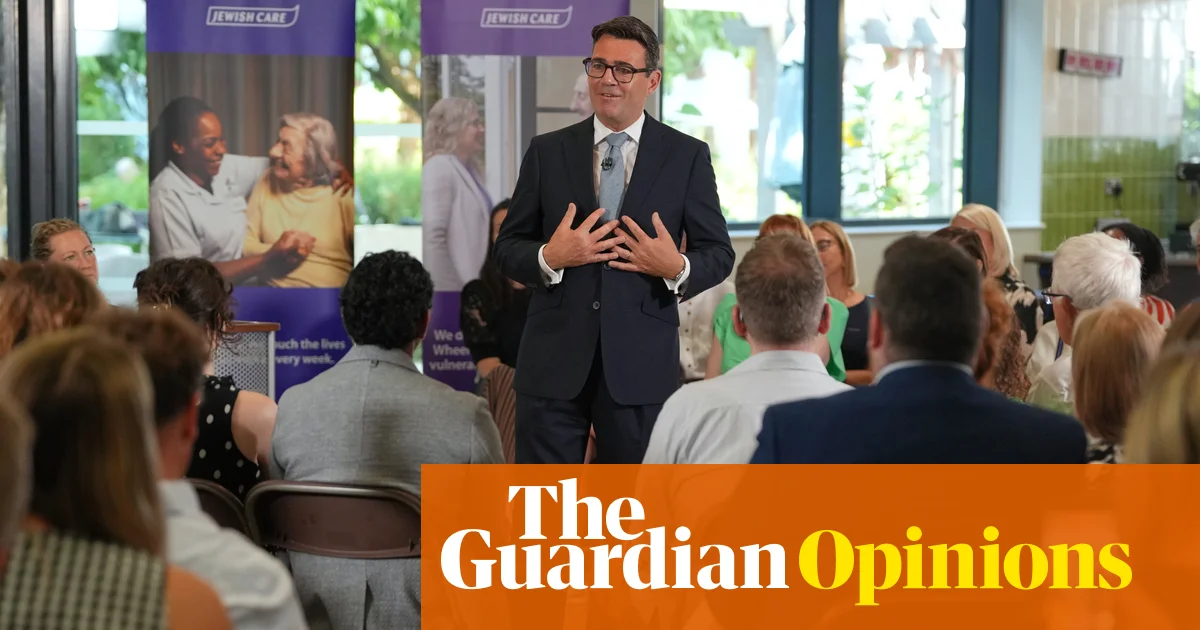
Here is rare clearcut proof of the power of political persuasion. Party conference speeches, the lifeblood of political obsessives, rarely reach the public beyond a brief news clip. But this time was different. Andy Burnham’s speech spun the dial on public opinion on several political hot potatoes, defining who he is.
The pensions triple lock, which guarantees that pensions rise faster than average incomes, has been a no-go electoral minefield despite a groundswell of economists (and even a Times leader) calling for reform to prevent pensions skyrocketing. Touching this live rail was an act of bravery – or recklessness.
Polls over the years strongly supported the lock: a Persuasion UK poll this week found 65% in favour of keeping it, more among over-65s. A Times YouGov poll this month went as high as 93% of pension-age people defending it. So the sudden change in public opinion after the speech has been astonishing. YouGov now reports that 48% support the Burnham plan, with just 28% against. Survation finds 64% backing it with only 15% against. The magic was linking reform of the lock with creating a national care service. Never mind that it barely begins to cover the cost, it makes an emotional link between the two policies.
I can’t think of any other conference speech that reversed public opinion on such a sensitive policy. Kemi Badenoch’s Tories protested that it was just “robbing Peter to pay Paul”, while Nigel Farage’s party vowed, “Reform UK will always protect our pensioners and maintain the triple lock.” Both are out of touch with the public (at least, for now).
But this is only week one on a long and winding journey to 2030, when plans for the triple lock and a national care service have appeared in the next Labour manifesto – and fickle voters have reelected a Labour government. When the world so often turns upside down in the blink of an eye (Burnham keeps reminding himself he is the seventh PM in a decade), 2030 can feel light years away.
We don’t yet know what a national care service is. But the most moving and easiest to implement promise in Burnham’s speech is to improve the lives and status of care workers like those he watched looking after his father: “Caring for other people’s parents on poverty pay, but doing it with huge skill, humour and humanity.” He pledged, “I promise you, I won’t leave this job without doing everything I can to change things for you.” Starmer’s fair-pay agreement for care workers is already on its way, to be agreed between trade unions and employers. Yvette Cooper, the health secretary, this week announced the first national pension scheme for care workers. Next, they need training, pay and career ladders the same as NHS healthcare assistants, merging the two together.
But the rest of Burnham’s “landmark policy as significant as the creation of the NHS itself” looks perplexingly difficult. He promised “care that is about people, not profit”, but Margaret Thatcher privatised care, breaking it into fragments by denying central funds to any council keeping its own service. There are now about 19,000 organisations providing adult care in England, some big, most small, some good, some pretty terrible, some voluntary, many understaffed. In theory, they are inspected by the regulator, but the Care Quality Commission, knowing the shortage of beds and services, sets a low bar in standards. Could that be in-sourced?
But here’s the biggest conundrum of all. Who pays for social care goes right to the heart of social justice and fair taxation. Currently, most people in England already have their care paid for by the state, because they have less than £23,250 in savings and no property that is not lived in by a partner. But 23% of people in England who get at-home care and 37% of those in residential care are self-funders. Between them, they pay £14bn a year. Burnham seemed to imply they would be relieved of that burden, NHS style – but if so, that would be a whopping £14bn given to better-off elderly people, paid for by taxpayers. That’s unthinkably expensive and unfair to younger working people, a generation with less income and less property. So it won’t and shouldn’t happen.
Instead, as hastily explained afterwards, self-payers will only get their care paid for, but they will still pay for their bed and board in care homes – as in Scotland, where standard weekly costs of about £1,000 are mitigated by the state contributing £260 for care. Burnham said that people should no longer lose their homes to pay care costs; they still do in Scotland.
after newsletter promotion
And rightly. Only 21% of people think the state should pay for it all, regardless of the recipient’s wealth, according to a King’s Fund survey. Keeping an empty home to pass on as inheritance is not something the state should subsidise, when every spare penny is needed to pay for better social care. More than 400,000 are on official care waiting lists in England, while Age UK says 2 million older people have unmet care needs, putting a huge burden on families. Burnham himself talked of the miserably inadequate 15-minute homecare visits. Meanwhile, the NHS desperately needs a better care service to save the 13,000 beds a day filled with those waiting for a care package.
At any one time, few people use social care, so few understand the system, according to the King’s Fund. Simon Bottery, who leads its work on adult social care, says, “Frailty and dementia in later life are issues that most people just don’t want to think about until they really need to.” But it’s about to become a hot political battleground, with its fiendish complexities and its difficult moral and political choices.
When problems look insoluble, the last five prime ministers have summoned the great troubleshooter Louise Casey. She reports next year on what should be done. With the political right preparing for war, her job is to find answers acceptable enough to most. But that’s unlikely to include a carbon copy of the free NHS, nor should that be on the table.
-
Polly Toynbee is a Guardian columnist
-
Do you have an opinion on the issues raised in this article? If you would like to submit a response of up to 300 words by email to be considered for publication in our letters section, please click here.
