


‘If it’s the Tin Man, then I suppose I’ll vote for Nigel,” says a Clacton resident, a retiree on a slow stroll towards the seafront, when I ask whom she will vote for in the forthcoming byelection. “I would sooner have Farage than the Tin Man!” As political slogans go, it is as good as any.
The sun is beating down, but the sky is hazy, which accurately describes the mood of this constituency since the Reform UK leader quit as MP for Clacton on 7 July, forcing a byelection that sent shock waves through Westminster and confusion through Clacton. I am spending a couple of days here with the photographer Andy Hall, traversing the coast between Jaywick to the west and Walton-on-the-Naze to the east. An incessant wind is blowing from the North Sea, sending waves crashing on to Clacton beach. Nicky Friday, who at 11am is already handing out 99s from her aptly named kiosk, Seabreeze, isn’t exactly exercised by the Reform UK leader’s latest gambit. “This is going to sound terrible, but I’m so busy running this business and working here,” she says. “I don’t really do politics.”
During summers past, many of us were like Friday. The warmer months during the UK parliament’s recess are known as the silly season because usually nothing political happens, leaving journalists to chase flights of fancy. The most famous summer story from this constituency is perhaps that of the lion that was reportedly on the loose in St Osyth in August 2012, which was later scaled down to an admittedly large pet cat. That was until Farage decided to “spend the summer arguing with a bin”, as the then chancellor, Rachel Reeves, put it.
Count Binface (AKA the satirist Jon Harvey) has contested high-profile elections since running against Boris Johnson in 2019. His election would be fanciful, but not unprecedented: in 2002, a monkey was elected mayor of Hartlepool when Stuart Drummond, who worked as the local football mascot, H’Angus the Monkey, promised among other things free bananas for schoolchildren. Binface is promising to “build at least one affordable house”. All in all, 34 candidates are contesting the seat – including Laurence Fox, three candidates from the Monster Raving Loony party and the leader of the Everyone is God party, which preaches sex positivism and criminalising rudeness.
-
Billy Ball, the co-owner of Clacton Pier, which offers classic seaside pastimes including a helter-skelter
When asked recently what he had done for Clacton, Farage replied that he had done his best to “put it on the map”. Clacton’s other celebrity, its 155-year-old pier, may beg to differ. “Clacton didn’t exist before tourism,” says Billy Ball, 45, the managing director of Clacton Pier, which he bought alongside his brother, Elliot, in 2009. “The first building in the town was the pier. The only way to get here was by steam. The railway came many, many years later.”
The Balls are from a long line of fairground folk. Their grandfather moved to Clacton in the 1940s, while his grandma’s brothers knew another Billy, Billy Butlin, whose resort may also have something to say about putting Clacton on the map. Once the railways were built in England, the seaside offered a quick fix to industrialised city life dominated by work. Londoners flocked here for cheap, instant thrills, which were plentiful: the bandstand to the east of the pier; the pierrot troupes that used to play on the West beach.
In his office above the main entertainment space of the pier, Ball tells me there were once four theatres on here, while the nightclub was the main draw in the raving 90s. Today, the site is teeming with choice: a bowling alley, a bar, a pub, a mini golf course, a soft play centre, a helter-skelter. It looks like the Balls have used every inch every of space to help turn a profit. “Our biggest achilles heel was the size and scale of this pier, because there’s so much to maintain out over the North Sea. But it’s also one of our biggest attributes, because it allows us to put all of these different offerings in place.”
Ball says he has had interactions with all three MPs who have served Clacton during their stewardship of Clacton Pier, but “the only one that reached out to us on day one was Nigel Farage”. The less charitable might suggest Farage saw Clacton’s biggest tourist attraction as something he could use politically, but Ball was impressed by his public backing of seaside slot machines.
-
At its peak, Butlin’s welcomed 6,000 new guests a week. Photograph: Science & Society Picture Library/Getty Images
Outside on the pier, feelings are a little different. Ashley, a teaching assistant on an end-of-term trip with pupils from her school in north Essex, gives me her take on the byelection: “I don’t agree with it. Clacton should be famous in its own right for what it has to offer. And it has a lot to offer and people do love coming here.” She feels as though Clacton is being used. “And then the whole country is, by all these politicians, and they don’t mean what they say …”
Clacton has come a long way from the years when Butlin’s welcomed 6,000 new guests every week at its peak in the 1950s, with more than 1,000 staff; schoolboys earned money by carrying luggage to and from the station. Most visitors stayed at least a week back then, but now the hotels are clinging on for dear life. If the quality of the offering can improve, Ball thinks, then so will the scale.
I walk down a sidestreet just minutes away from the Wetherspoons pub, where an Australian news crew is loitering, and am alarmed at the site of a burnt-out building and the shell of a van in the road. The building over the road has been smashed up by vandals. On the fencing that surrounds it is scrawled: “IT’S TIME TO TAKE OUT THE TRASH: VOTE BINFACE.”
“The van has been there for three weeks,” says Carol Pickett, 66, who runs the hotel next door to the burnt-out building. “It doesn’t look good, does it, to holidaymakers walking down there?” She grew up in Enfield, north London, but had fond memories of family visits as a kid and ended up moving here. Times were good until the past few years, when trade dropped off a cliff. The “No vacancies” sign outside is there to deter drunk people who miss the last train, she says; the hotel isn’t full by any means. “People coming from London walk through the square and it’s full of druggies and people fighting – it’s not a good advert, is it?”
She says Farage has been conspicuous by his absence during his time as MP. “He’s never been and visited any of these small businesses down here,” she says. Not even for a pint? “I probably wouldn’t give him one now. It’s too late!”
‘If he’s willing to go on Cameo and say whatever you like for 80 quid, what’s he going to do for £5m?” asks Peter Hoare, referring to Christopher Harborne’s gift to Farage that caused the scandal that led to Farage resigning and triggering the byelection to “let the people of Clacton decide”. Hoare, 50, runs the World Food Aid charity shop in the centre of town and lives in a flat just off the beach. We walk to the shore and look up the coast, towards the next settlement, Holland-on-Sea, where a boat carrying six people arrived last month – the first small‑boat crossing ever reported in Farage’s constituency.
Despite the low level of migration here, immigration is the most widely responded to of Farage’s policies – you might say it’s his only policy. Hoare grew up in Leytonstone, east London. “I loved walking around the streets on Saturday morning and smelling the different dishes cooking in different houses,” he says. Hoare told me when I first met him in 2024 that moving to Clacton was a culture shock; it is still one of the least ethnically diverse parliamentary constituencies in England. But there is, he says, “a growing community of different nationalities”, particularly in the centre of town. “I think a lot of people do notice it, as primarily Clacton is still a 96% white population. There has always been that divisiveness about immigration and ‘the boat people’, which I think Farage has been great at exploiting.”
Hoare’s family is divided when it comes to their politics: “Dad, Conservative; brother, a Reform supporter; I’ve always been Labour. But we can have a good conversation about our politics without it descending into name-calling.” The rise of Reform UK worries Hoare. The party has swept through Essex county council and Hoare fears the care support for his mother, who has cerebral palsy, may be affected if it forms the next government.
In Jaywick, the settlement south-west of Clacton, 36% of people have a disability, more than twice the average in England. Many of the houses here were built as holiday chalets and are hard to maintain at the mercy of the North Sea. “It gets terribly damp,” says Linda, 76, who bought her property with money received after an industrial accident. She greets us with a smile in the sunshine outside her property alongside her husband, Roy, 70. “In the winter, it’s the coldest place you could ever live and, in the summer, it can be really, really hot. Sometimes you can have a back door open, a front door open and still two or three fans going, which eats up your electricity.”
Jaywick became notorious in the 2010s when the Channel 5 documentary series Benefits By the Sea turned deprivation statistics into extreme, gratuitous, cartoonish television that focused its narrative exclusively on addiction, criminality and destitution. More recently, TikTok content creators have been coming to film videos with titles such as “The UK’s worst seaside town” and “The worst town in England” for clicks. Jaywick’s plight highlights a political culture that has tolerated decline – and media that tolerate mocking those afflicted by the decline – without attempting to solve any of the problems, show any responsibility or even exhibit kindness.
But while the media often lament how little Jaywick has, they often miss what it has in abundance. “People in Jaywick are really friendly, if you get to know the right ones,” says Linda, who has just come back from bingo at the recreation hall. “They’re smashing.” There is such energy, drive and purpose from people here, against the odds. Attempting to harness this is Sunspot, a community hub and event space with a brief to include affordable business units, a covered market, a cafe, public toilets and meeting rooms alongside a community garden and a bus shelter. It was commissioned by Tendring district council and completed by the architectural firm HAT Projects in 2023.
-
The Sunspot community hub in Jaywick includes market stalls (where Robert, top, sells shoes) and the Rainy Bakes cafe run by Mark Hammond and Lorraine Wildes
The jewel in the crown of Sunspot is Rainy Bakes, a thriving cafe, bakery and dessert parlour run by Lorraine Wildes, 63, and her partner, Mark Hammond, 58. Before Sunspot opened, she was a part-time cook in a care home and did a bit of baking on the side. When a shop became available, Wildes got a levelling-up grant to buy her ice-cream machine and a few other items. They have since moved into a bigger unit and business is going from strength to strength, doubling as a community hub where older residents can come to have a chat every Tuesday and a place young people can meet for a milkshake.
I meet Robert, 59, who is selling secondhand shoes in the market outside Sunspot. He moved here from London 10 years ago because he thought the sea air would be better for his son. Robert has debilitating asthma, uses a mobility scooter and is recovering from a stroke. He says politicians “come out with all the same stuff”; Andy Burnham “might be all right”, while he wonders what Farage has done for Jaywick, but he says he met him once and he “was a polite man. But then they’re all polite.”
What does he want from politicians? “More housing,” he says. “I was homeless myself; I know what it’s like in London.” It shocks him to see the amount of homeless people on the streets in the capital today. “It’s so crowded,” he says. “You think to yourself: come on, council, help them out.”
Homelessness is never far from the conversation in Jaywick. It isn’t a theoretical problem that needs to be dealt with, but often a part of people’s lives, their history, with the relative affordability of Jaywick offering a second chance. “You don’t get moved off the beaches,” says Hammond at Rainy Bakes, who was also formerly homeless. He says that tents are always going up on the beach, particularly in dry and fine weather. “We had a gentleman, he was there for three weeks. I used to charge his power pack for his phone.” Hammond arranged for him to have a shower on the premises of Sunspot and money was raised to feed him hot meals. “You’d never know he was homeless.”
Hammond says he likes Farage for “his graft” and was impressed by him when he visited the cafe in 2024: “He came in to us and I leaned forward and I said to him: ‘I’ve got 36 flavours of milkshake,’” he says, referring to the times Farage has been attacked with one of the drinks. “And he went: ‘I don’t want a fucking milkshake.’”
-
Hana Loftus, an architect at the firm that designed Sunspot, with Danell Dreelan, who lives in Jaywick’s Brooklands estate
“Jaywick is an amazing community,” says Hana Loftus, 45, the co-director of HAT Projects. She is an architect and writer who is undertaking a project about Jaywick as it approaches its centenary. “So many people here, they’re like: ‘Don’t call us deprived. We love where we live. We love it here. The community’s great, the beach is amazing, all my friends and family are here.’”
Loftus meets us for dinner at Pera, a recently opened Turkish restaurant that rivals anything in north London. We talk about how the resort of Jaywick was the project of the property developer Frank Stedman, whose vision of a great housing estate by the sea came up against the realities of drainage (this was marshland, after all), which shifted the emphasis from houses to holiday chalets. It grew in popularity as a rival to Butlin’s in Clacton and provided an interesting contrast: a collection of bungalows owned by holidaymakers as opposed to a camp with a high turnover of visitors making short lets.
When long holidays at the British seaside were overtaken in the 1970s by the foreign package holiday, Butlin’s evaporated, but Jaywick survived and eventually became a residential area. That decade, it fought for its survival after a compulsory purchase order was sought by Clacton urban district council to knock down the Brooklands estate, where most of the chalet-style housing is, but the Freeholders Association took them on and won. Instead of being allowed to raze Jaywick, the council was forced to modernise parts of it.
Since then, the residents say they have fought for everything, coming to the conclusion that if something needs to be done, they had better do it themselves. They raised money for their own sea wall. “That fight is sort of baked into the place, as a kind of memory,” says Loftus. “People basically still think that the authorities would like to raze Jaywick off the face of the Earth.”
-
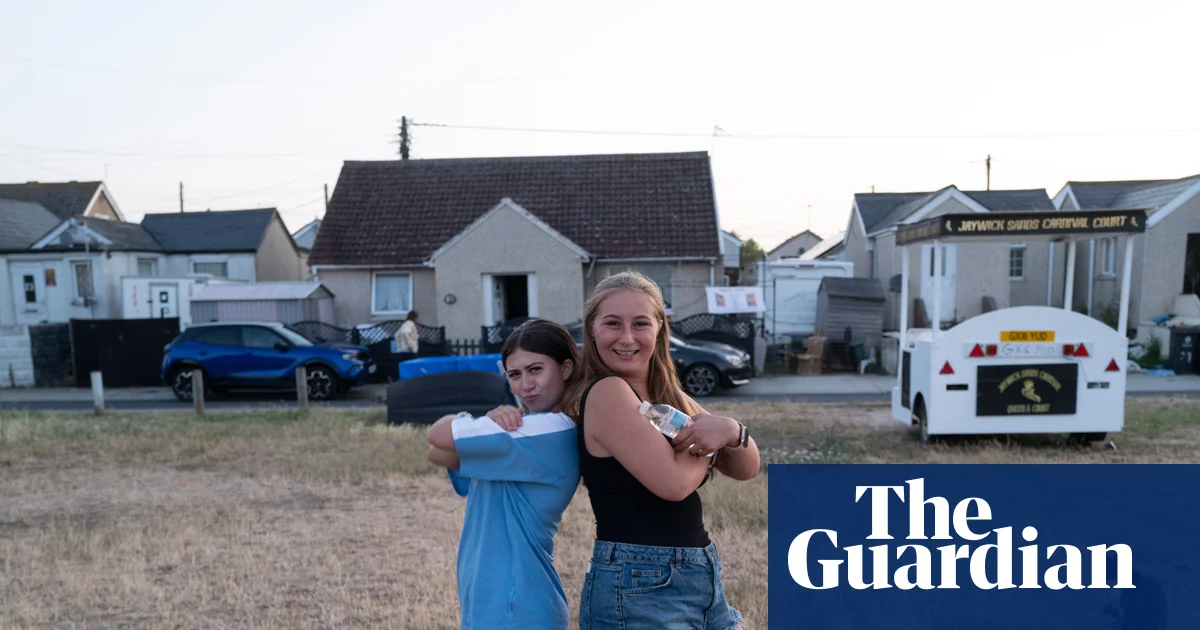
(Top) Lacey Mills, left, a princess at Jaywick’s inaugural carnival, with the junior queen, Ellie Riley; (bottom) Mill and Riley with Dreelan, whose daughter, Bobbie-Jean Halls Smith, organised the carnival
Loftus takes us to meet Danell Dreelan, 40, who lives in the heart of the Brooklands estate, Brooklands Gardens; this was where much of Benefits By the Sea was filmed. She moved to Jaywick in 2009 from Edmonton, north London, when her mum and dad bought a series of houses on her street. Today, she works as a cleaner at a community centre and volunteers at the Never Say Die pub on a Sunday. She is up to her eyeballs helping her daughter, Bobbie-Jean Halls Smith, 19, who is organising Jaywick’s first carnival with Dreelan’s younger sister, 23-year-old Destiny, and is also the carnival’s queen.
The carnival is a way to fight back against assumptions about Jaywick, she says. “A lot of girls from here get treated like crap because they’re from Jaywick,” says Dreelan. “If you ask, 80% of the females here will never put Jaywick on their CV.” Lacey Mills, 18, a carnival princess, arrives with the junior queen, Ellie Riley, 20. Mills says the carnival has helped her confidence after she was bullied at school. “We’re all over TikTok. We’re all over social media. We’re all over BBC News,” says Halls Smith. “Hopefully, the stories [about the carnival] they’re going to show on TikTok or Facebook are going to be good.”
We talk as the sun recedes and dusk becomes night. Dreelan’s nine-year-old son, Sonny, was born prematurely with a serious congenital heart condition. Destiny and Halls Smith started a charity, Sonny’s Army, when they were only 16 and 12 respectively, to raise money for families in a similar situation. Bobbie-Jean says Farage doesn’t see this side of the Brooklands; she says he should come to the carnival’s events so he can “meet the people, but he doesn’t do that. He’s not taking the time to actually get to know the way it works here.”
I can’t make the carnival on the Saturday, so I call Dreelan the week after to see how it went. It was “nothing short of crazy”, she says. Every business from Rainy’s to the Never Say Die did a roaring trade and Dreelan ended the day standing on a chair in the pub singing Freed from Desire into a microphone surrounded by joyous residents. At the end of our conversation, it occurs to me I haven’t asked her yet if she is going to vote in the byelection. “I’m going to ignore it,” she says. She tells me of the time during the 2024 general election campaign when she met Farage in the pub and asked him a question. “‘How are you going to make the future voters, being children now, believe in what you’re going to do?’ He looked at me and went: ‘I’ll get back to you.’”
On my second day here, the wind has died down. The Clacton-based historian Sarah Elizabeth Cox, 39, is talking over a coffee about her forthcoming book on Victorian boxers, which includes Billy Ball’s great-grandfather Alf. She moved here in December 2022 when she was sick of house-hopping after 10 years in London. She chose Clacton to be closer to her nephew and then ended up having a child herself.
One of the things she loves about it are the long walks all the way to Walton, where her dad, Geoff Cox, used to come on caravan holidays as a child. Geoff, 74, is a journalist who worked on the local paper in Luton from the age of 17. He and his wife, Anne, moved to a cul-de-sac in Frinton-on-Sea, the resort next to Walton, to be near their grandchildren. It took him a long time to meet his neighbours. “They are friendly,” he says. “They’re just very, very reserved people.” They bought a bungalow, but Geoff says many of his neighbours are widows who live in large four-bedroom houses, far bigger than they need.
If Clacton is kiss me quick and better days and Jaywick is courage against a tide of assumptions, Frinton is lawns, clubs and carefully attended manners. Much more than the physical boundary of a nature reserve and a golf club separates Clacton and Frinton. Cox lives 15 minutes away from her parents in Frinton, but a world apart: “I live in a 1960s block of flats called Marine Court and there’s a 1960s block of flats also called Marine Court in Frinton, right on the coast.” She paid £187,000 for hers in 2022, while a comparably sized flat in Frinton’s version could fetch about £350,000. “I would say my view is probably better,” she says.
After finishing our coffee, we head for the taxi rank. Cab drivers are often portrayed in the media as salt-of-the-Earth Reform UK voters, but judging from the evidence of Clacton this weekend, only one in four cabbies will vote Farage. Terry Chapman, a driver in his 70s, isn’t a fan. “I think it will be a low turnout and I think Farage will win a lower majority,” he says. He is thinking of voting Binface, “to take the mickey”.
When we arrive in Frinton, the seafront is teeming with people enjoying the sun and the tide is coming in quickly. Kay has brought her family and friends to a beach hut they have rented for the day, travelling from the heart of Constable country near Dedham, which sounds idyllic until she tells me she has come to the seaside as the River Stour is filled with sewage. They usually come to Frinton, or up to Southwold in Suffolk, or north Norfolk (but never Jaywick, perish the thought). Kay says she has no thoughts about the election, “other than wanting to vomit” at the prospect of another Farage show.
As we head west along the coast, we meet David Ketterer, 82, a retired recruiter who has lived in Frinton for 44 years. He says Farage has been “forced into” the byelection. His wife, Toni, agrees. “The Guardian,” says Ketterer. “Everyone’s been against him!” What about GB News or the Daily Mail, I ask. Surely he still has a few supporters? “Yeah, but that’s it,” he says.
Ketterer says he was a Conservative right up until Thatcher: he thinks she should never have spent the North Sea oil money on lowering taxes. He says Norway was much more sensible in setting up sovereign wealth funds. But isn’t Farage a bit like Thatcher, with his plans of privatisation? “It’s an alternative thing and I’m old enough to say: let’s try an alternative,” says Ketterer.
It helps that the Ketterers have met Farage – at the tennis club. “He has charisma, which none of the others have,” says David. That is surely selling Count Binface short? Do you know anyone who may vote for Farage’s main challenger? “They’re saying they are. But they won’t,” says Toni. “Nobody in their right mind would vote for a rubbish bag!”
We walk along the prom. The sun is high and the people we speak to are giving Farage a little more heat. “He’s either got to come clean and say that he did make a mistake and stay as an MP, or just clear off completely,” says Paul Andrews, 80, a retired engineer who is sunning himself by his hut with his wife, Lynn. “But I don’t like what he says anyway, to be honest … And Farage is saying an awful lot of stuff. And there’s no way he’s going to be able to do what he says.”
Despite this summary, Andrews says he still voted for Farage in 2024. “What is the alternative?” says Lynn. “It’s true,” Paul agrees. “There’s no alternative, is there?” They used to like Burnham, “but we’ve gone off him big time”, says Lynn. They don’t like the idea of No 10 North, for a start. “Up until a couple of weeks ago, he wasn’t even an MP!” They would never vote Labour, anyway, certainly not since the party brought in 20% VAT for private schools, they say.
I meet Alan Sainty, 69, a semi-retired painter and decorator who is enjoying the sunshine outside his beach hut, having drinks with his wife and their friends. He was born in Walthamstow, east London, before moving to Frinton as an adult. His dad worked at the Ford factory in Dagenham. “My dad was 96 when he died last year. He always told me to vote Labour. But Labour went all skewwiff when Tony Blair came in. So I’ve never voted Labour since.”
Instead, it is “Nigel Farage all day long”, he says. “He’s been persecuted by the establishment.” It is not as if Sainty isn’t aware of his limitations as an MP. He met him and asked him: “‘Where’s your £5m security?’ And he said it’s not here. I said: ‘But you’ve got that donation allegedly for you as an MP.’ But I won’t vote for anyone else.”
Many of the people I speak to here think Farage is something to aspire to – he’s successful, he doesn’t mind making money. Would Farage’s financial affairs and any wrongdoing affect Sainty voting for him in future? “Listen, they’re all the same, right? Let’s see what he can do.” If he doesn’t become our next prime minister, Sainty suggests, the country is done for. “Starmer’s done nothing for us at all, has he?” Is Burnham any good? “Nah, not for me.” He isn’t keen on taking No 10 up north, either. He isn’t that keen on any politicians. “Listen, I’m nearly 70 years of age. What has anyone done all my life?”
Have you ever had a political hero? “Political hero? No, not really … Definitely not Thatcher, because she took away the unions.”
Sainty voted for Brexit, then Johnson; he says Farage is the last throw of the dice simply because, as he sees it, nothing else has worked. He mentions the high rent of his pride-and-joy beach hut and the fact that bored kids break into it from time to time without any repercussions from the police.
This sense of a society adrift after so many years in the economic doldrums is crucial when reading politics in the UK today. To sum up why he thinks Farage may be the best choice for the future of the country, he says: “Someone’s got to do something.”
