


The White House has defended three taxpayer-funded advertisements featuring President Donald Trump by comparing them to ads that were paid for by past presidential administrations. But some legal experts have said the Trump White House commercials are political messages intended to influence the 2026 midterms and may violate U.S. laws, including a prohibition against using federal funds for propaganda.
The White House described its ads as “public service announcements” in a Sept. 25 press release pushing back on criticism. It said, “The announcements are very clearly not campaign ads; President Trump is not on the ballot and there is no call to action. Instead, the announcements are a reminder for Americans to love their country and know why it’s worth defending — at home, at the border, and abroad.”
The release went on to say that “[a]dministrations of both parties have used public service announcements to explain policy and make the case for the nation’s direction,” citing examples of ads from the George W. Bush, Obama and Biden administrations, among others.
A legal expert we consulted did not see a correlation.
“I just think you’re not going to find any comparison at all,” Richard Painter, a corporate law professor and former White House ethics lawyer for George W. Bush, told us in an interview. Painter said the Trump White House ads are “so clearly propaganda,” which generally refers to government communications intended to manipulate or influence public opinion.
John G. Geer, a professor of political science at Vanderbilt University and author of “In Defense of Negativity: Attack Ads in Presidential Campaigns,” also told us, “I just think that the ads are different enough so that I personally don’t buy the argument” that the ads from the Trump administration and recent presidents are all the same. He said his perception is that the Trump White House ads are more political. “We’ll see what the courts say,” he said — if a lawsuit brings the matter to the judiciary.
Later, we’ll go over the cited examples of federally funded ads that were run under Presidents Bush, Barack Obama and Joe Biden.
The first Trump White House message to air includes images of Trump as he says, “Together we will defeat communism, socialism, and Marxism in America. America will never be a communist country.” Viewers repeatedly hear the words “love me,” which are lyrics from a JMSN song of the same name. Near the end of that 30-second spot, Dana White, the UFC CEO, compliments Trump and talks about him “fighting so hard for the country he loves.”
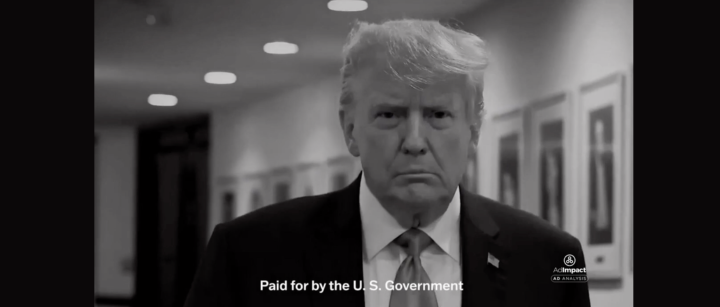
The third ad, in black and white, shows Trump walking and staring into the camera as he says in a voiceover, “we will demolish the deep state,” “expel the warmongers from our government,” “drive out the globalists,” and “cast out the communists, Marxists and fascists.” The ad ends with: “We will rout the fake news media, and we will liberate America from these villains once and for all.” The video is almost identical to an ad from Trump’s 2024 presidential campaign.
The second ad, a minute long, features video and audio from Trump’s July 3 speech from a site near Mount Rushmore, as the president says, “We are the freest people on Earth, and by the grace of God, the United States of America is the most successful, most accomplished, most exceptional nation ever to exist in human history.” The ad ends with him saying, “This is only the beginning of the golden age of America.”
All three ads were released on or after Sept. 23 and include a “Paid for by the U.S. Government” disclaimer. The ads have aired on broadcast and/or streaming platforms, including during Sunday political talk shows and college and NFL football games.
“Our tax dollars are hard at work. And, we believe, probably illegally so,” Painter and three other ethics experts wrote in a Sept. 28 piece in the online publication the Contrarian. For the post, Painter was joined in criticizing the Trump White House ads by Norman L. Eisen, former White House special counsel to Obama; Virginia R. Canter, former White House associate counsel to Obama and President Bill Clinton; and Christopher J. Swartz, who worked for the Office of Government Ethics across multiple administrations and was briefly acting chief of the Ethics Law and Policy Branch in 2025, during Trump’s second term.
“These videos are not ‘public service announcements’ as the White House claims,” the authors wrote. “They are clear attempts to boost Republicans’ chances in the impending midterm elections given their sagging poll numbers. The timing, content, and format of the videos all suggest they are covert attempts directed at the success of the Republican party.”
The White House said “Trump is not on the ballot” this November, but the president has told wavering Republican voters to pretend he is. The legal experts also noted in their piece that two of the White House ads highlighting Trump include references to defeating communism or communists, which is what Trump regularly calls democratic socialists running for Congress. (We’ve written that democratic socialists and communists do not have the same political or economic ideology, and democratic socialists make up a small minority of congressional candidates.)
“Even during the height of the McCarthy era and the Cold War, the United States government never came anywhere close to making an ad like this,” the experts said, adding that under the Hatch Act, a federal employee other than the president or vice president “may not use his official authority or influence for the purpose of interfering with or affecting the result of an election.” The statute would apply to other federal employees who participated in making or disseminating the ads, the experts said.
Also, annual appropriations bills passed by Congress have long included language prohibiting taxpayer funds from being used for “publicity or propaganda purposes within the United States.”
A few Republicans have spoken out against the Trump White House ads as well. “I like the message, but it shouldn’t be paid for with taxpayer dollars,” Senate Majority Leader John Thune told reporters about the ads on Sept. 28. The day prior, on CBS’ “Face the Nation,” Sen. John Kennedy of Louisiana said, “I don’t think any public official, including President Trump … should spend public money on private ads for themselves.”
A federal worker who violates the Hatch Act could face penalties such as “removal from federal service, reduction in grade, debarment from federal employment for a period not to exceed 5 years, suspension, reprimand, or a civil penalty not to exceed $1,000,” according to the U.S. Office of General Counsel.
In addition, Citizens for Responsibility and Ethics in Washington has written that the Government Accountability Office previously found that using federal funds for unauthorized publicity or propaganda violates the Antideficiency Act, which, “in severe cases,” could lead to administrative penalties, or a fine of up to $5,000 or up to 2 years in prison.
Painter told us that Congress could also ask to be reimbursed for an improper use of taxpayer funds. The ads combined have cost at least $2.5 million, according to the ad-tracking service AdImpact.
Obama Administration Ads/Outreach
One of the examples the White House cited under Obama sparked controversy, and the Government Accountability Office determined the public outreach campaign had violated federal laws. The other example is similar to ads run under Trump, promoting the open enrollment period for Affordable Care Act insurance plans.
Under Obama, the Environmental Protection Agency in 2014 and 2015 used a public outreach campaign through social media to encourage support for its proposed rule on clean drinking water. The New York Times called it “a campaign that tests the limits of federal lobbying law.” The effort was aimed at ginning up support during a public comment period on the proposed rule, which concerned EPA regulation of water sources.
The EPA argued that it wasn’t violating the Anti-Lobbying Law because its outreach didn’t tell the public to contact or lobby Congress.
But in December 2015, the GAO concluded that the EPA had violated federal laws prohibiting the agency from spending federal dollars for “publicity or propaganda purposes” and prohibiting the use of federal appropriations for “indirect or grassroots lobbying in support of or opposition to pending legislation.”
In particular, the GAO faulted the EPA for using a social media tool that resulted in some messages not identifying the EPA as the source of the information. Instead, to some members of the public, “it appeared that their friend independently shared a message of his or her support for EPA and clean water,” GAO said, calling this “covert propaganda.” (The messages shared through people’s social media accounts said, “Clean water is important to me. I support EPA’s efforts to protect it for my health, my family and my community.”)
GAO said that the violation of grassroots lobbying occurred when the EPA’s blog posts linked to outside groups, whose pages included prompts to contact Congress in support of EPA’s proposed rule.
The Trump White House also pointed to the Obama administration running TV ads about HealthCare.gov, the website people use to sign up for Affordable Care Act health plans, during the open enrollment periods in 2015 and 2016. The ads didn’t feature the president, but rather everyday people talking about how they had signed up for low-cost insurance.
In one spot, run in November 2015, a woman who’s going for a run says that her premium was $22 a month and that signing up was “very easy.” A guy who appears to be going to a university says he got “exactly the kind of coverage I wanted at the price I wanted,” with the words “$57/month” on screen. A woman and her child are shown with the words “$405/month family of 4.” The ad then says that “most people who sign up on HealthCare.gov qualify for financial help to make coverage more affordable.” It ends by encouraging people to “sign up by Dec. 15.” The ad says at the bottom that it is “sponsored by the U.S. Department of Health & Human Services.”
Another example from 2015 similarly says that most people can get financial help with their premiums.
The Obama administration also ran ads in the run up to the 2016 open enrollment period, which began Nov. 1 — meaning that those ads ran shortly before and after that year’s presidential election. One example from November 2016 is similar to the 2015 ads, showing various people and saying that most people signing up “can find plans for $50-$100/mo. with financial help.”
One could argue that Obama, who signed the Affordable Care Act into law in 2010, had a vested political interest in getting people to sign up and having the program succeed. But the Trump administration also has run ads to inform the public about the open enrollment periods. Like the Obama-era ads, these three examples from late 2025 featured people talking about how they easily enrolled in an insurance plan, and the ads said that “4 out of 5 customers can find a health plan for $21 or less per month with financial help.”
Biden Administration Ads
As the Trump administration pointed out, the Biden administration also used taxpayer dollars for an ad campaign using television, digital, radio and print spots to encourage people in early 2021 during the COVID-19 pandemic to get vaccinated.
The Trump press release said the Biden administration “poured hundreds of millions of dollars” into an ad campaign “to drive a nationwide public health message.”
But as the Washington Post story the press release links to explains, the campaign used a $250 million contract that the Trump administration signed with consultancy Fors Marsh the previous year. According to the article, “Officials have said they held the campaign until vaccines were widely available to maximize its impact.”
Ironically, numerous Democrats expressed concern in September 2020 after the Trump administration hired Fors Marsh for a campaign from HHS that sought to “defeat despair, inspire hope and achieve national recovery” amid the pandemic.
In a Sept. 11, 2020, letter to HHS, Democratic Rep. Frank Pallone, then chair of the Energy and Commerce Committee, wrote, “Among other things, the Committee is concerned that HHS may use more than a quarter-billion dollars in taxpayer funds on private communications consultants charged with distorting the facts and misleading the public about the Trump Administration’s failed response to the COVID-19 pandemic.”
A letter from three other Democratic leaders in the Senate similarly stated, “We have grave concerns that, rather than focus on planning and executing a national strategy to contain the coronavirus, the Trump Administration is using a quarter of a billion dollars in taxpayer money to fund what appears to be a political propaganda campaign just two months before a presidential election.”
Under Biden, the “We Can Do This” campaign directed by Fors Marsh sought to appeal to “a group known as the ‘movable middle’ — people who were hesitant but not necessarily opposed to getting vaccinated — with highly customized, science-based communications and messages of empowerment,” according to the consultancy.
The ads featured images of Americans and encouraged people to visit the Centers for Disease Control and Prevention’s website or vaccines.gov for more information.
At the time, Trump was also encouraging people to get vaccinated. At the Conservative Political Action Conference on Feb. 28, 2021, Trump boasted that his administration had helped deliver the vaccine in “record time” and later said, “So, everybody go get your shot.”
“I encourage them to take it,” Trump told Fox News’ Sean Hannity in April 2021.
George W. Bush Administration Ads
The Trump administration also pointed to a controversial $9.5 million ad campaign produced by the George W. Bush administration in 2004 touting the prescription drug benefits in the Medicare Prescription Drug, Improvement, and Modernization Act of 2003.
The TV ad and flyers claimed the law, which passed largely along partisan lines, provided the same Medicare with “more benefits.”
At the time, Democratic Sen. Frank Lautenberg criticized the ad as “a propaganda effort with taxpayer dollars.”
At least one network, CBS, pulled the ad while the General Accounting Office (later renamed the Government Accountability Office) — at the request of Lautenberg and other Democrats — investigated whether it violated prohibitions on federal funds being used for “publicity or propaganda” purposes. Democrats argued the ad was inaccurate and was intended to promote the reelection of Bush that year.
The GAO concluded that while the TV ad and accompanying flyers contained “notable omissions and other weaknesses,” they were “not so partisan as to be unlawful.”
By way of omissions, Anthony H. Gamboa, general counsel of the GAO, said that the ad failed to note that people might be charged $30 for the new drug discount cards “and that savings may vary across covered drugs.” He further criticized the flyer’s indication that beneficiaries would pay a premium of “about $35 a month” for the prescription drug benefit, when in fact that was an estimated average.
“The omissions notwithstanding, we do not find the content of the flyer and its cover letter or the advertisements to be purely partisan in violation of the publicity or propaganda prohibition,” Gamboa wrote.
“This is not to say that the content is totally free of political tone,” he added. “Without a doubt, the future of the Medicare program is the subject of ongoing and highly spirited discussion and debate at the national level. In this context, the references in the flyer and print and television advertisements to ‘Same Medicare. More Benefits’ and ‘preserve and strengthen’ may appear to some as an attempt to persuade the public to the Administration’s point of view regarding the newly enacted benefit.”
Nonetheless, he wrote, the “publicity or propaganda prohibition, however, does not bar materials that may have some political content or express support for a particular view. … The content of these publications does not constitute a purely partisan message.”
Two months later, however, GAO said during the course of its investigation, “we learned that the Centers for Medicare & Medicaid Services … had prepared as part of this campaign video news releases or VNRs, including a news story for television broadcast, to provide information to the television medium.” Because the prepackaged stories did not note they had been prepared by CMS, the GAO concluded their use ”violated the restriction on using appropriated funds for publicity or propaganda purposes.”
The White House further noted that in 2002, the Bush administration paid more than $3 million for two Super Bowl ads that said buying illegal drugs could help support terrorists; it also created anti-drug YouTube ads in 2006.
Editor’s note: FactCheck.org does not accept advertising. We rely on grants and individual donations from people like you. Please consider a donation. Credit card donations may be made through our “Donate” page. If you prefer to give by check, send to: FactCheck.org, Annenberg Public Policy Center, P.O. Box 58100, Philadelphia, PA 19102.
