


Unlock the Editor’s Digest for free
Roula Khalaf, Editor of the FT, selects her favourite stories in this weekly newsletter.
Europe faces a shortage of homegrown rocket launchers by the end of the decade, the head of the European Space Agency has warned, as growing demand to launch new satellites into space outpaces the region’s independent capabilities.
ESA’s expectation “today [is] that Europe has a shortage of launchers around the 2030 timeframe,” said director-general Josef Aschbacher, in a frank acknowledgment of the scale of Europe’s challenge in catching up with their main competitors, the US and China.
The agency was in the process of assessing the scale of Europe’s requirements over the coming years, Aschbacher told the FT in an interview.
“If we add up all the satellites that need to be launched from current and planned constellations and missions . . . we see that there’s a peak of launch requirements around 2029, 2030, 2031,” he said.
The US and China have launched hundreds of satellites in the past five years and invested billions of dollars into developing defence and space capabilities. Elon Musk’s SpaceX launched 170 rockets last year, while Europe launched just eight. Musk has transformed the market with reusable rockets that have cut costs.
Aschbacher said he planned to raise the issue with ESA’s member states to “ensure that we can launch our satellites with European launchers”.
Europe plans to launch a range of satellites and other missions over the coming years for its satellite networks, including ones for the Iris² multi-orbit constellation, the Galileo navigation system and Copernicus, the world’s largest Earth observation network.
At the same time, several countries, including Germany, have proposed their own national constellations of satellites. ESA is also building satellites for some of the national defence ministries, including for Greece, Spain and Poland.
Yet Europe’s ability to deliver on these ambitious plans faces an uphill battle, with sceptics warning that structural reform, including to its procurement model, is urgently needed.
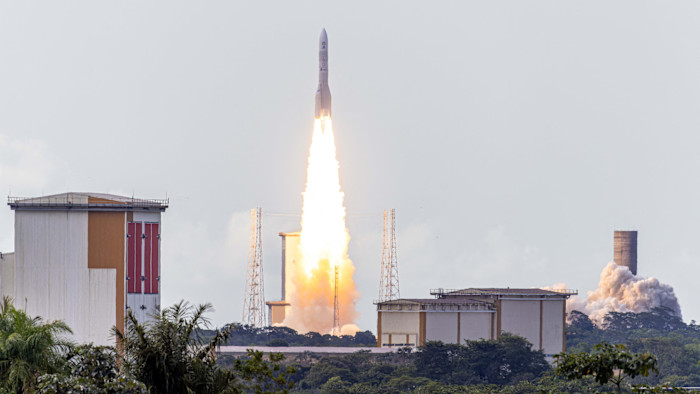
The region’s flagship heavy-lift rocket manufacturer, Ariane, has been plotting a comeback after production delays meant its latest model, the Ariane 6, was not ready to take on new cargo after the final flight of its predecessor in 2023. That led to a year-long gap during which Europe was forced to rely on SpaceX instead.
Europe finally regained sovereign access to space in July 2024 with the launch of Ariane 6 and, in December of that year, the return of the smaller, Italian, Vega-C rocket to flight.
Aschbacher said he strongly believed Europe would be able to bridge the expected shortages.
ESA, he said, had asked European launchers to come back in the coming months with estimates of what it could cost to expand their programmes, in Ariane 6’s case, from the current nine to 10 a year it is building up to, to about 15.
ESA was having similar discussions about Vega C, he said. This would feed into decisions over where ESA might put extra money to try to bridge the shortages and invest for the next decade.
“The time horizon is 2035 — the decisions we are making now [will be] triggered by those reflections,” he said.
