


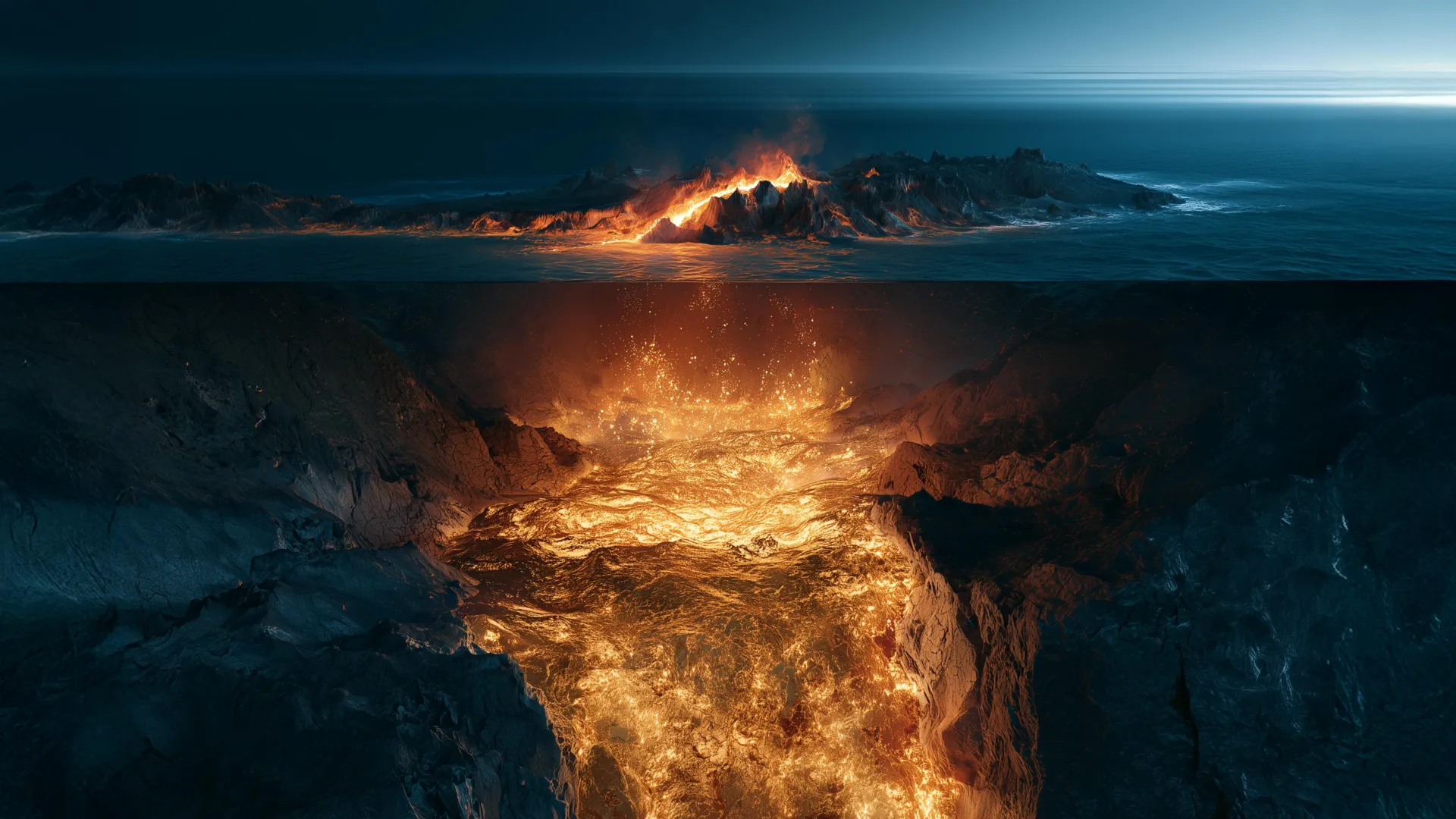
Earth’s hidden “gold kitchen” may be operating far beneath the ocean floor. Island arcs, chains of volcanoes that develop above subduction zones where one oceanic plate descends beneath another, are often unusually rich in gold. Scientists have debated for years why these regions become so enriched.
New research led by Dr. Christian Timm, a marine geologist at GEOMAR Helmholtz Centre for Ocean Research Kiel, offers a deeper explanation.
“Our research shows that hydrous mantle melting beneath island arcs is a key driver of gold enrichment,” says Timm. “In these settings, the mantle behaves like a multi-stage melting system that progressively concentrates gold.”
Volcanic Glass Preserves Ancient Magma
To investigate how gold and other noble metals behave during mantle melting beneath submarine subduction zones, the researchers studied 66 volcanic glass samples collected from the seafloor along the Kermadec island arc and the neighboring Havre Trough north of New Zealand.
Volcanic glass forms when underwater lava cools extremely quickly. This rapid cooling locks in much of the magma’s original chemical composition, giving scientists a valuable record of the conditions deep below the seafloor.
The most revealing samples were so-called primitive glasses. These preserve the chemistry of the original magma before crystallization changes its composition.
“When we analyzed these samples, we found that their gold concentrations are often several times higher than those of comparable magmas from mid-ocean ridges,” says Timm. “This raised the key question: which processes are responsible for this enrichment?”
The researchers measured gold at extremely low concentrations and compared it with other chalcophile (“sulfur-loving”) elements, including silver, copper, selenium and platinum. Because these elements respond in similar ways during melting, their chemical patterns can reveal what was happening inside the mantle.
Chemical Clues Point to Repeated Melting
The results indicate that the mantle beneath the Kermadec island arc melts in the presence of water and at relatively high temperatures, above the sulfide liquidus. At this point, sulfide minerals can begin to break down completely. Under these conditions, the magma retains silver-to-copper ratios that resemble those found in the mantle.
The team also detected original gold concentrations of up to six nanograms per gram of rock. Although that amount may sound tiny, it is unusually high for mantle-derived magma. The samples also contained gold-to-copper ratios well above those measured in fertile mantle and primitive mid-ocean ridge basalts.
According to the researchers, these chemical signals are best explained by a mantle source that had already been depleted by earlier melting and was later melted again.
The main process enriching these magmas with gold appears to be high-degree, multi-stage melting of a water-rich and oxidized mantle.
Despite the elevated values, the rocks do not contain enough gold to be commercially mined. Economically useful deposits would require concentrations several orders of magnitude higher.
Water Helps the Mantle Melt
The researchers originally suspected that water released from the descending plate might directly control how much gold entered the magma. The new data suggest a more complicated process.
“We initially assumed that water released from the subduction zone directly controlled gold enrichment,” says Timm. “However, our data show that water mainly facilitates mantle melting. The key factor for high gold concentrations is the high – and in part repeated – degree of melting.”
Water therefore appears to act mainly as a trigger that helps mantle rock melt more extensively. The stronger and more repeated the melting becomes, the more effectively gold can be transferred into the magma.
Gold’s chemical location inside the mantle is also important.
“Gold in the mantle is commonly bound in sulfide minerals,” explains Timm. “At high degrees of melting, these minerals break down, releasing their gold completely into the melt.”
This means gold can remain trapped during limited melting. Once melting becomes intense enough to destroy the sulfide minerals, however, the stored gold is released and enters the rising magma.
“Our results demonstrate that gold enrichment is not the result of a single melting event, but of multiple stages,” Timm adds. “Only repeated melting allows gold to become strongly concentrated in the magma.”
The Beginning of Gold’s Geological Journey
The findings improve scientists’ understanding of gold-rich deposits associated with intra-oceanic island arcs such as the Kermadec Arc. They show that repeated, water-assisted mantle melting strongly influences how much gold is carried upward by magma.
The results also move part of the explanation for gold deposits deeper into the planet. Processes near the surface still determine whether concentrated deposits eventually form, but the chemical history of the mantle beneath subduction zones may establish the starting conditions long before the magma rises.
The same mechanism could help explain why hydrothermal sulfide deposits along submarine island arcs often contain unusually large amounts of gold. These deposits form when hot, mineral-rich fluids circulate through volcanic regions beneath the ocean.
“The mechanism we identify could contribute to the elevated gold contents observed in hydrothermal systems in subduction zones,” says Timm. “However, this link still needs to be investigated further.”
“We are effectively looking at the first step in the life cycle of gold,” concludes Timm. “It begins with the transfer of gold from the mantle into a melt that eventually forms volcanoes. The alchemy starts long before the metal reaches the surface.”
