


Unlock the White House Watch newsletter for free
Your guide to what Trump’s second term means for Washington, business and the world
Donald Trump has summoned oil groups to the White House on Tuesday as high petrol and diesel prices, triggered by his war in Iran, push up inflation across the US ahead of midterm elections.
Marathon Petroleum, Phillips 66, Chevron, Delek US Holdings, PBF Energy and Valero Energy are among the companies called to the meeting to discuss refining capacity and prices, according to people with knowledge of the event.
With less than three months until November’s midterm legislative elections, the US president is under increasing political pressure over an affordability crunch, with a recent FT poll showing voters now believe they are worse off under Trump.
Oil supply disruption caused by the Iran war and a loss of global refining capacity following Ukrainian drone attacks on Russian plants have helped keep average US petrol prices above $4 per gallon in August, an almost 30 per cent increase over the past year.
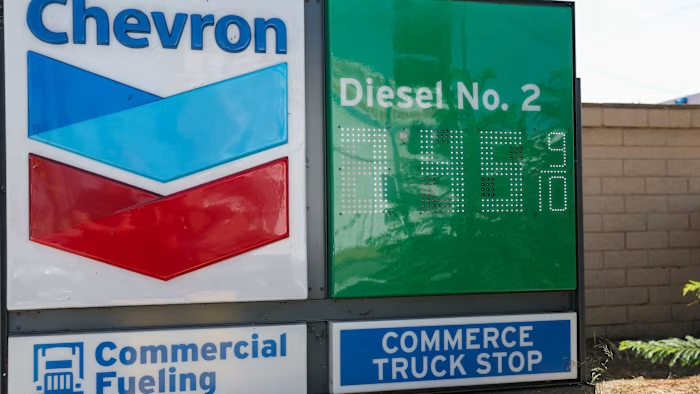
The price of diesel, critical to US industry and agriculture, is closing in on all-time highs of $5.80 per gallon.
“The president will meet with industry leaders to collaborate on the best ways to increase refining capacity, further unleash American energy dominance across the entire supply chain and bring down prices for the American people,” said White House spokesperson Taylor Rogers.
The summons to the refiners come as they post record profits, with the gap between the cost of diesel and crude oil, known as the “crack spread”, soaring to $100 a barrel.
In June, Trump accused Big Oil of price gouging and called for a justice department investigation over high petrol prices.
Crude prices rose again on Monday, with Brent settling about 2.7 per cent higher, at $90.49 per barrel, after the US and Iran exchanged more fire on Sunday and Trump on Monday vowed to hit the country “hard” with more strikes.
Tom Kloza, chief energy adviser at Gulf Oil, said he expected Trump to try to talk down fuel prices but warned that this could spark a backlash in the US oil sector.
“The president has been very successful, perhaps by accident, but certainly very successful in talking down the price of crude oil,” said Kloza. “If not for those verbal interventions on Truth Social, we’d be looking at triple-digit crude prices.”
“Whether they want to burn bridges with an industry that has been very pro-Trump, that’s a different matter,” he added.
Despite the White House meeting, analysts said the administration had little leeway to influence domestic fuel prices, with oil groups already operating plants flat out and deferring maintenance of facilities to keep churning out fuel.
As of the week ending August 21, US refinery utilisation had been at or above 95 per cent for 12 consecutive weeks, the longest streak since 2000, according to US Energy Information Administration data.
Some analysts warned the stretched system left the market vulnerable to more disruption and further price increases unless Trump ended his confrontation with Iran. Refineries near the Gulf of Mexico, for instance, could suffer an outage due to a hurricane, driving prices higher, analysts said.
“Seasonal stocks of diesel and home heating oil are at historic lows, while planned maintenance at several major refineries — including the sprawling St John refinery in north-east Canada — are likely to pull prices up even higher, absent de-escalation in the Middle East,” said political risk consultants Eurasia Group in a recent note.
Joe DeLaura, a global energy strategist at Rabobank, said Trump could consider banning fuel exports from the US.
“He’s got to do something to get gasoline prices down but he is also not going to just walk away from the war,” said DeLaura. “It is the only card to pull.”
A Brown University tracker shows that since the conflict began in late February, Americans have paid $51.9bn more for gas than they would have done if prices had remained at their prewar level. They have also paid an extra $43.1bn for diesel.
Brown University estimates the cost of the fuel price surge for the average American household at $725.25 and rising.
“As consumers, Americans are paying higher prices [for] gasoline and diesel,” said Jeff Colgan, a professor of political science at Brown. “As voters, we’ll find out how they like that in November.”
