


When Zack Polanski addressed his campaigners flush with victory after the Gorton and Denton byelection in February, he declared: “Labour’s electoral stranglehold is over.” The election of Hannah Spencer as the new Green MP for the Greater Manchester seat was a seismic victory, he continued: “I said we were here to replace Labour and this is what replacing looks like.”
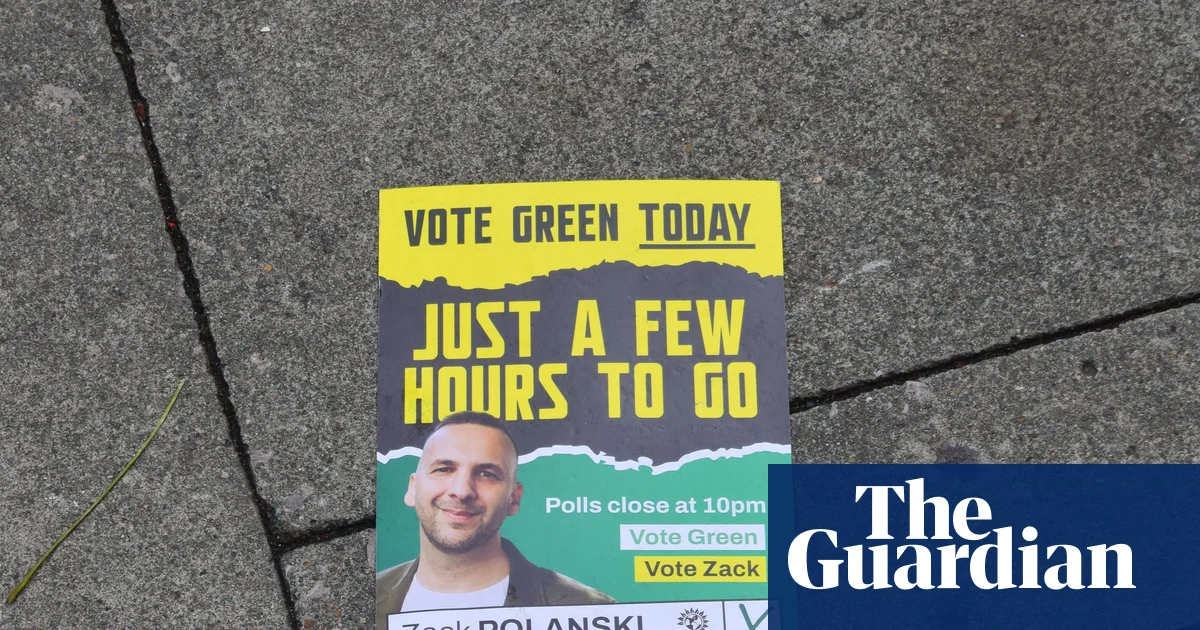
But in the wake of Polanski’s defeat in the Holborn and St Pancras byelection on Thursday, and a calamitous row over the party’s stance on Zionism, the debate around what, or who, could be replaced has shifted to Polanski himself.
On Friday the leader of the Green party in England and Wales was defiant after losing to Labour’s Sagal Abdi-Wali, who took 45% of the vote, to Polanski’s 33%. Asked what was going wrong in his party, which has fallen from highs of 21% in some polls after the victory in Gorton and Denton to around 10-11%, Polanski, responded: “If things are going wrong by the fact that we just tripled our vote share and had our second best byelection result in Green party history, you know what? I’ll take that.” While emphasising that Green members would ultimately decide who they wanted as leader, he said: “Of course I can carry on.”.
That the last few months have been difficult for the Greens – and Polanski in particular – is beyond doubt. Polanski himself is, according to new polling from More in Common, now less popular with voters than Nigel Farage, and is the least popular major UK party leader, falling by four points to a -28 net approval.
His standing, bruised by a series of controversies over a failure to pay council tax and the sharing of a post criticising police, has been further damaged by a controversial motion that was adopted at the Green party conference in Brighton last weekend, equating Zionism, the movement for a Jewish state, with racism. Polanski’s decision to abstain from the debate and the vote to instead campaign in the Holborn and St Pancras byelection, was condemned by his detractors, but also, more significantly, criticised by senior figures in his own party.
The former Green leader Caroline Lucas told BBC Newsnight on Thursday that Polanski “should have been there and he should have voted”. Asked if he should stand down, she said: “I think let’s just see what happens in the coming days and weeks. Obviously he has been completely taken up with this byelection.” Following his defeat she appeared to temper her position, saying Polanski had “transformed the party” and she hoped he would now “help resolve huge issues we face and transform our internal structures”.
On Friday, pressure mounted, as the leader of the Jewish Greens, Vivien Lichtenstein, called for Polanski to step down, saying it was a “big mistake” for him not to have spoken and voted for amendments stating that any future structure of a Palestinian state should be decided by Palestinians, rather than impose a one-state system.
But there was bullishness among the Polanski faithful, with Greens Organise, the leftwing faction that backed his leadership bid, saying he should stay on. A statement from the group said that “not all growth and success is linear, there will be ups and downs; the real test for a political organisation is how we deal with failure”. It added: “We have reshaped the British political landscape. The Green party can still become the ecosocialist party we need. Zack is still the leader who can get us there.”
Green party supporters pointed out that the party achieved a 13-point swing from Labour in Holborn and St Pancras, traditionally a safe Labour seat. The Camden councillor Hamza Chowdhury – who was overlooked as the candidate in the constituency in favour of Polanski – went as far as saying the result was “a huge win for the Green party and the wider movement”.
Polanski supporters point out that since he was elected leader in September 2025, the party has quadrupled its membership to more than 230,000. As well as the winning of its first ever seat in the north of England, he presided over the Greens’ best-ever performance in May’s local and mayoral elections, including gaining their first-ever directly elected mayoralty, in Hackney, east London.
Nonetheless, the result in north London exposed the dual challenge Polanski now faced, said Luke Tryl, the director of More in Common. At the same time as the replacement of Keir Starmer with Andy Burnham had brought disillusioned progressives back to Labour, Polanski had become a more polarising figure.
after newsletter promotion
A series of missteps, starting when he shared a social media post critical of police after the Golders Green stabbings, had damaged his popularity with the wider UK public, added Tryl. “It was just one of those moments which gave soft Green supporters pause for thought. Similarly, many people don’t vote directly on something like the Zionism is racism motion, but it adds to that sense of ‘oh, I thought these were nice guys who were focused on the environment’.”
The result in north London was a “good one” for Labour, he added, despite the drop in its majority. While governing parties usually get hit hard in byelections, the drop in Holborn was below the average for defending a seat at byelections in any postwar parliament, he noted.
But Labour hopes of the death of the Green party were likely to have been exaggerated. “I think writing off the Greens is premature,” he said. “Burnham has managed, for now, to unite the left, but a lot of big decisions, including on North Sea oil drilling and, more importantly, the budget, are coming down the line.”
As for Polanski, the path towards rebuilding the popularity that saw him win the support of young voters desperate for hope and change would lie in a return to his original economic messaging around “rip-off Britain” and generational fairness, rather than divisive internal battles, said James Baggaley from UCL’s Policy Lab. “The question for the Greens and Polanski now is: do they want to reassure voters on questions of antisemitism and also get back to what they were actually winning on, which was the economy?”
