


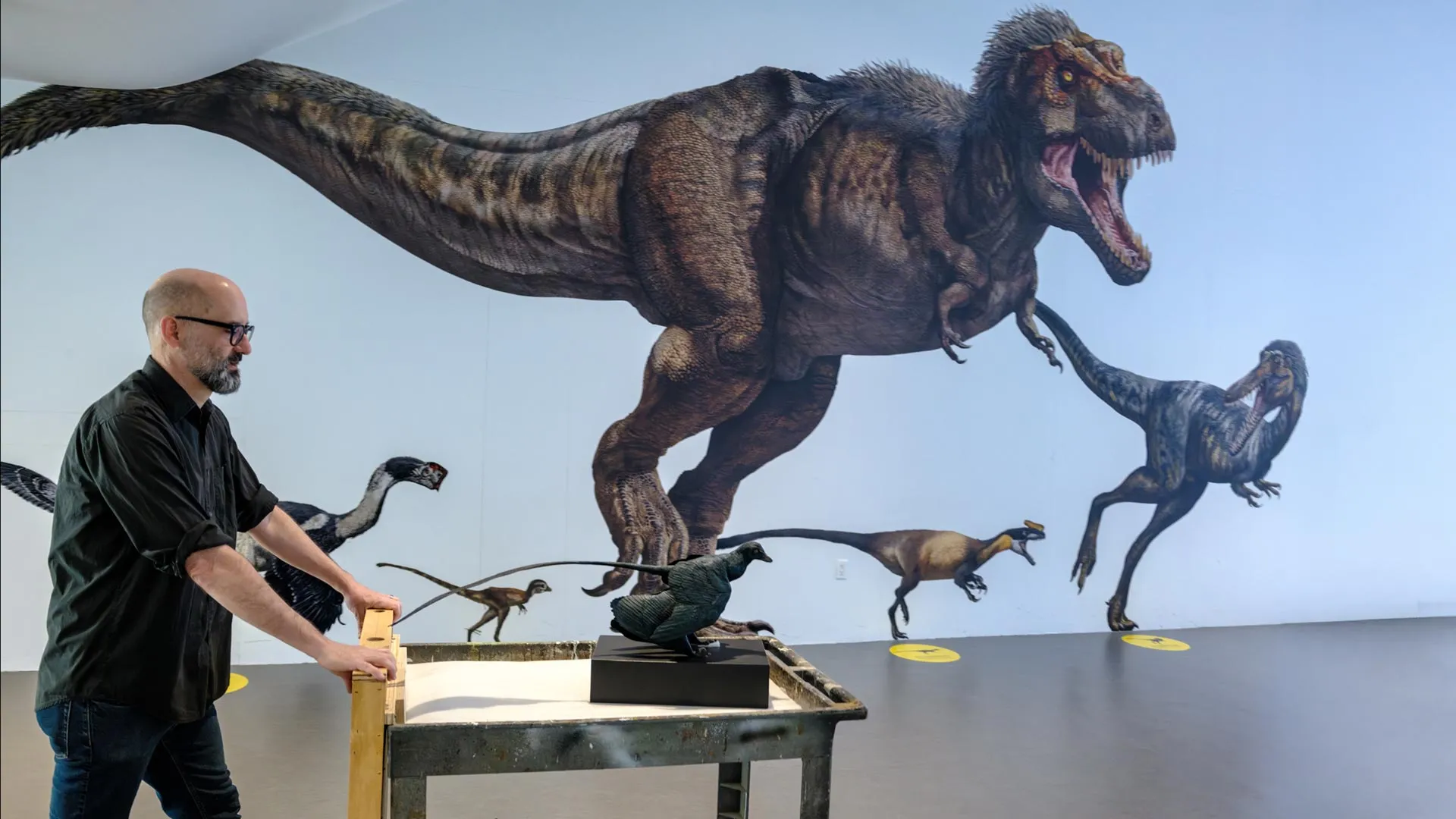
Dinosaurs are often remembered for their enormous size. Tyrannosaurus rex was an imposing predator, while dinosaurs such as Apatosaurus reached truly massive proportions. Yet new research suggests that one of the most intriguing questions about dinosaur evolution lies at the opposite end of the size spectrum: Why did dinosaurs apparently never become extremely small?
In a study published in the journal Evolution, researchers from the American Museum of Natural History and Princeton University used mathematical models to examine how body size evolved among vertebrates. Their results show that energy use and physiology can account for the range of sizes seen in mammals, birds, and turtles. Those same factors, however, cannot explain why even the smallest dinosaurs other than birds remained relatively large.
The researchers instead suggest that ecology may have imposed a lower size limit on dinosaurs. In particular, competition with early small mammals could have prevented dinosaurs from moving into the mouse-sized and sparrow-sized niches that are filled by many vertebrates today.
“Everyone loves a giant dinosaur,” said study co-author Roger Benson, the Macaulay Curator of Dinosaur Paleobiology at the Museum. “But we decided to look at the other end of the scale. The absence of tiny dinosaurs may be just as interesting as the existence of giant ones. We already knew that dinosaurs prevented mammals from evolving to large sizes before the end-Cretaceous mass extinction. Here we suggest that mammals in turn prevented dinosaurs from evolving to small sizes.”
Dinosaurs Had a Surprising Lower Size Limit
The contrast between dinosaurs and many modern animals is striking. The largest dinosaurs exceeded 80 tons, yet the smallest known dinosaurs outside the bird lineage weighed close to one pound (approximately 450 grams), roughly comparable to a large rabbit.
That is more than 200 times heavier than the bee hummingbird, the smallest bird in the world, which weighs only 1.75 grams. The Etruscan shrew, the smallest mammal, weighs about 1.8 grams. An even more extreme example comes from reptiles: the dwarf gecko weighs just 0.15 grams.
Tiny animals are also extremely common in modern ecosystems. About 75 percent of living mammal species and 90 percent of living bird species are smaller than the smallest known dinosaurs outside the bird lineage.
“Small animals dominate modern ecosystems,” said Stephanie Lechki, the lead author of the study and a postdoctoral fellow at Princeton University. “If we want to understand how today’s biodiversity evolved, we need to understand why tiny dinosaurs appear to have been missing.”
Could Tiny Dinosaur Fossils Simply Be Missing?
One obvious possibility is that very small dinosaurs existed but have not yet been discovered. Small animals are generally more difficult to find in the fossil record because their fragile bones are less likely to survive the fossilization process.
Benson and Lechki, however, argue that this explanation does not fit the available evidence. Fossil sites containing dinosaurs also frequently preserve animals that were much smaller, including mammals, lizards, amphibians, and other vertebrates.
If dinosaurs as small as mice had been widespread, researchers would expect at least some of their fossils to have turned up alongside these other tiny animals.
Instead, the fossil evidence indicates that genuinely tiny dinosaurs outside the bird lineage were either extremely uncommon or may not have existed at all.
Mathematical Models Reveal a Dinosaur Puzzle
To understand what might have prevented dinosaurs from becoming smaller, the researchers turned to mathematical models designed to predict how natural selection influences body size. The models incorporate aspects of animal physiology related to energy intake and reproduction.
The underlying idea is that evolution should tend to favor body sizes that allow animals to convert available energy into offspring efficiently.
When the researchers applied this framework to different vertebrate groups, it successfully reproduced the body size patterns seen in mammals, birds, and turtles. It was less successful for snakes, lizards, and crocodilians.
Dinosaurs presented an even greater problem. Even when the researchers tested a wide variety of possible physiological conditions, the models still could not account for why most dinosaurs outside the bird lineage were considerably larger than expected.
That result suggests that dinosaur size was not controlled by physiology alone. Ecological pressures, including competition, predation, and access to different ecological niches, probably helped determine how small these dinosaurs could become.
How Birds Escaped the Dinosaur Size Constraint
The findings may also help explain a major turning point in vertebrate evolution: the rise of birds.
Birds evolved from dinosaurs, but modern birds can reach sizes far below those known for dinosaurs outside the bird lineage. Soon after birds first appeared during the Early Cretaceous, they evolved body sizes much smaller than those achieved by any other dinosaur group.
According to the researchers, physiology by itself cannot account for this rapid move toward miniature bodies either.
Instead, they suggest that powered flight transformed the ecological possibilities available to early birds. Once birds could fly, they gained access to habitats and ways of life that were unavailable to their terrestrial dinosaur relatives. That shift may have allowed them to escape the ecological forces that had previously prevented dinosaurs from evolving much smaller bodies.
“The ability to fly may have opened entirely new ways of life,” Lechki said. “Once birds entered those new ecological niches, they were free to evolve body sizes that had simply not been possible for other dinosaurs.”
A Small Mystery With Big Implications
Further research could help clarify the ecological pressures that favored some body sizes while effectively excluding others.
Understanding those forces could reveal why dinosaurs were able to evolve into some of the largest animals ever to walk the planet while seemingly being unable to occupy the smallest size classes that are so common among animals today.
“We have this unusual situation where the ancestors of dinosaurs could be tiny. The living descendants of dinosaurs — birds — they can be tiny. But dinosaurs themselves seemed to be forbidden from being tiny,” Benson said. “And we don’t really understand that yet, but it’s a question we should continue to explore if we really want to understand dinosaurs and their fascinating biology.”
