


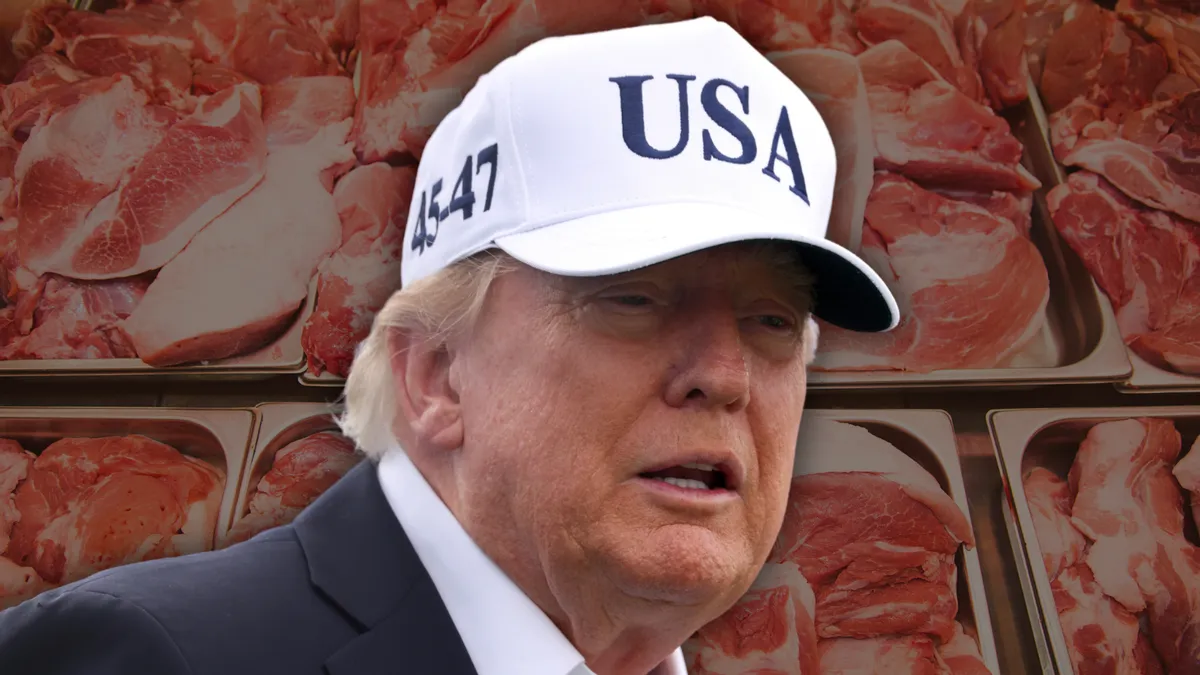
In an August 2026 meeting between U.S. President Donald Trump and Joesley Batista, the owner of Brazilian multinational meat-processing company JBS, Batista asked Trump to lower tariffs on Brazilian beef, then Trump decided to allow 660 million pounds of tariff-free imported beef, that Europe had banned, into the United States, with JBS buying it all, suggesting the beef would come from Brazil.
In August 2026, Trump expanded a U.S. beef import quota by roughly 660 million pounds. The European Union did also adopt restrictions on Brazilian beef in summer 2026.
The quota expansion of roughly 660 million pounds was not specifically for Brazilian or JBS beef, according to a presidential proclamation. It was not possible to rule out the prospect that, despite not being mentioned in the proclamation, JBS or Brazilian beef could be the main or sole beneficiaries of the expansion. It is also imprecise to say the imported beef would be tariff-free.
The Wall Street Journal reported that JBS controlling shareholder Joesley Batista asked Trump to lower tariffs on Brazilian beef. It was not possible for Snopes to independently verify this report.
The suggestion appeared to be that the imported products would come from Brazil despite the European restrictions on Brazilian beef, and that JBS would benefit from the reduced tariffs.
One Instagram post (archived) featuring the rumor describes JBS as the “primary beef supplier” for McDonald’s, Burger King, Sysco, Walmart’s Great Value brand and Kroger private-label products. Its caption reads, in part:
The owner of JBS met privately with Trump in the Oval Office, and discussed lowering the import tax on Brazilian beef.
The next day, Trump opened the border to 660 million pounds of tariff-free imported beef. JBS is the world’s largest meat processing company. Their headquarters are in Brazil.
The EU banned Brazilian beef after Brazil couldn’t prove their cattle met antibiotic safety rules. China rejected beef from Argentina after it was lab tested to contain a drug linked to cancer.
Versions of the rumor also spread on TikTok, Facebook and Threads, and readers contacted us to ask whether the elements of the claim were true.
In short, the claim contains a mixture of accurate, false and unconfirmed information.
In August 2026, Trump did expand a U.S. beef import quota by roughly 660 million pounds, and the European Union did adopt restrictions on Brazilian beef. However, that expansion was not specifically for Brazilian or JBS beef, according to a proclamation Trump signed in August 2026, and it is imprecise to say the imported beef would be tariff-free. The Wall Street Journal also reported that Batista, JBS’ controlling shareholder, asked Trump to lower tariffs on Brazilian beef, but it was not possible for Snopes to independently verify that report.
Trump expanded beef imports in August 2026
On Aug. 26, 2026, Trump signed a proclamation temporarily increasing the amount of lean beef trimmings that could enter the U.S. under an existing tariff-rate quota by 300,000 metric tons. That increase equals roughly 660 million pounds.
Describing the imports as “tariff-free,” however, is imprecise. Under a tariff-rate quota, a set amount of a product can enter at a lower tariff, while imports above that amount face a higher tariff. The White House said Trump’s measure increased the amount of beef eligible for the lower tariff rate rather than eliminating duties for beef altogether.
Moreover, the proclamation did not explicitly say the beef would come from Brazil. It allocated the additional quota to “other countries or areas” and directed U.S. Customs and Border Protection to ensure that “all eligible countries have full access” on a first-come, first-served basis. JBS is also not mentioned in the proclamation.
However, i
Did JBS co-owner meet Trump?
Batista and his brother, Wesley Batista, are JBS’ “ultimate controlling shareholders,” according to the company’s filings with the U.S. Securities and Exchange Commission. As of March 18, 2026, the brothers held about 86% of the company’s voting power.
Citing anonymous sources, The Wall Street Journal reported (
However, the policy was not implemented immediately. Trump formally expanded the quota on Aug. 26, and the first tranche opened on Sept. 1.
Reuters later reported the Journal’s account but said it could not independently verify it. Snopes also was unable to independently verify the report, given it was based on anonymous sources.
We contacted JBS via email to confirm whether Batista met with Trump and, if so, what was discussed. We will update this story if we receive a response.
Snopes also reached out to the White House with similar questions and to ask how much beef would come from JBS or Brazil. Replying via email, a spokesperson said the tariff-rate quota expansion was not the result of a single conversation (emphasis ours):
President Trump’s action to address a short-term supply crunch in the beef market was the result of a long policy planning and coordination process involving domestic stakeholders; this action was not done as the result of any one conversation. At the same time, the Trump Administration continues to work with American farmers and ranchers to grow America’s cattle herd, which is currently at a multi-decade low.
JBS has ties to some named companies
JBS does have documented relationships with several companies named in the social media posts, but it was not possible to confirm that it is the primary beef supplier for all of them, as of September 2026.
For instance, a 2017 JBS report (Page 87) says its Seara division supplied 75% of McDonald’s hamburger requirements in Brazil at the time and listed McDonald’s and Burger King among its global customers. A 2020 JBS sustainability report (Page 76) also says Friboi, a JBS beef brand, received Burger King’s Best Supplier Award that year.
There is also evidence of relationships with Sysco and Kroger. Sysco
But those sources do not show that, as of September 2026, JBS was the primary beef supplier for all the companies listed in the social media posts. McDonald’s, for example,
Walmart also disputed the post’s description of JBS as a supplier of its ground beef. Annie Walker, director of Walmart U.S. communications for food and U.S. manufacturing, said via email, “We do not source ground beef from JBS.”
Snopes contacted JBS, McDonald’s, Burger King, Sysco and Kroger to clarify their current supplier relationships. We will update this article if we receive responses.
EU did restrict Brazilian beef
The posts were also broadly correct that the EU restricted Brazilian beef. On June 4, 2026, the European Commission adopted a regulation changing the list of countries authorized to send certain animal products to the EU under rules concerning the use of antimicrobial medicines. The changes took effect Sept. 3, 2026.
The regulation says Brazil was previously authorized for bovine products, among other categories, but that the commission did not receive information guaranteeing Brazil had implemented the measures needed to comply with the antimicrobial requirements by Sept. 3. Brazil’s authorization for bovine products was therefore removed.
Importantly, the regulation does not say Brazilian beef tested positive for unsafe antibiotic residues. Rather, it says Brazil did not provide enough information to show it met the EU requirements laid out above, which a European Commission spokesperson confirmed via email. The spokesperson said Brazilian exports could resume once the country meets those requirements.
Brazil’s government also said the restrictions concerned new rules governing the use of antimicrobial medicines, adding that Brazilian authorities are continuing engagement with European officials.
Snopes contacted Brazil’s Ministry of Agriculture for additional context on the restrictions and will update this story if we receive a response.
China case unrelated to Brazil
Chinese authorities did suspend (Page 1921) the export authorization of one Argentine beef plant, ArreBeef, after detecting the antibiotic chloramphenicol in a shipment in March 2026, as Snopes previously reported.
As we previously reported, that incident was separate from Trump’s August import plan. The president’s Aug. 26 proclamation does not assign the additional 300,000 metric tons to Argentina, Brazil or any other individual country.
