


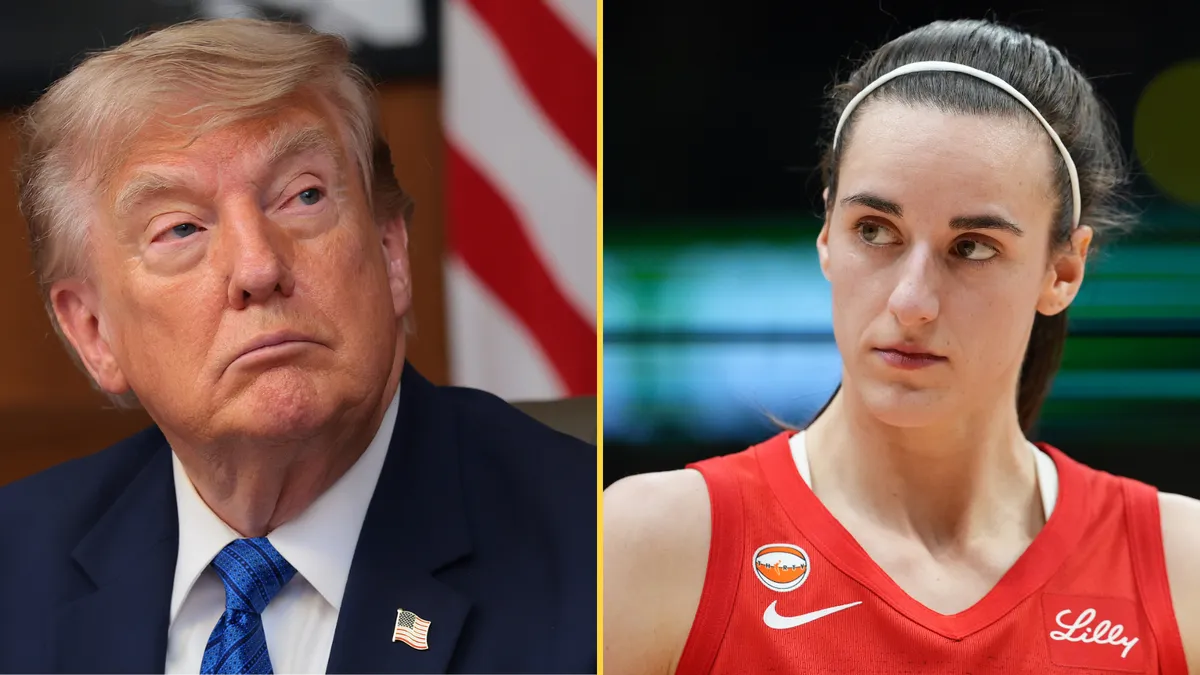
WNBA star Caitlin Clark responded with an uplifting message after U.S. President Donald Trump attacked her for being “too woke,” as claimed online in the summer of 2026.
In August 2026, a rumor spread on Facebook that Trump verbally “attacked” WNBA star Caitlin Clark, calling her “too woke,” and that she responded with an uplifting speech about building stronger communities, creating opportunities for future generations and treating people with dignity.
For example, one Facebook post (archived) described Clark producing her alleged speech in front of an unnamed “packed arena.” The post read
BREAKING: Trump attacks Caitlin Clark — and gets a response he won’t soon forget
Donald Trump thought he could score easy political points by targeting Caitlin Clark, accusing the basketball superstar of being “too woke” for speaking out about fairness, respect, and opportunity for everyone. But Clark wasn’t interested in trading insults.
Standing before a packed arena, Caitlin Clark addressed the controversy directly.
“The president of the United States says athletes should stay quiet,” Clark began. “But sports have always been about more than wins and losses. They’re about teamwork, respect, and believing that everyone deserves a fair chance.”
The crowd erupted.
“You want to talk about values?” she continued. “Values are lifting people up, treating others with dignity, and creating opportunities for the next generation. Those shouldn’t be political issues.”
Clark went on to speak about the challenges facing young people, the importance of education, and the need for leaders who unite rather than divide.
“We should be asking bigger questions,” she said. “How do we build stronger communities? How do we help young people succeed? How do we make sure hard work and opportunity are available to everyone?”
Then came her most powerful message:
“None of us are perfect. We all have something to learn. But progress happens when we listen to each other, respect each other, and work together toward something better.”
And finally, she delivered a line that brought the arena to its feet:
“If we can imagine a future built on respect, opportunity, and hope, then we should never settle for leaders who offer anything less.”
What began as a political attack ended with a message that resonated far beyond the basketball court.
Other Facebook users also shared the claim (archived, archived) and Snopes readers emailed us to ask about the veracity of the rumor.
In short, there is no evidence the story is true. The narrative in the posts does not correlate with Trump’s most recent statements about Clark and an artificial intelligence tool likely generated the text. Therefore, we’ve rated this claim as false.
Unpacking the rumor
If the story were true, journalists with reputable news outlets, such as The Associated Press or Reuters, would have widely reported on it. That was not the case.
Clark has not posted any reference to the alleged speech
It was not possible to confirm the origin of this particular rumor, but the exact same text was posted to Indiana Fever (Clark’s WNBA team) fan groups (archived, archived) nearly two months prior to the most recent posts. Those June 8 posts also labeled the story “BREAKING,” further undermining the veracity of the rumor in August.
While the two older posts do not direct readers to other websites, creators of such content usually capitalize on social media users’ willingness to believe and share the made-up stories, profiting from revenue on external websites to which the posts link. (Snopes has previously reported on this business strategy.)
The post at the top of this report, which was also posted to an Indiana Fever fan group, better matches this expectation. That post links to a store page for a Sophie Cunningham T-shirt on a website that does not have a homepage. Cunningham is one of Clark’s Indiana Fever teammates. The shirt’s design appears to be widely copied across the internet and unaffiliated with Cunningham herself.
The two Facebook accounts that posted the claim in June and the one that posted it with a store link in August have all repeatedly posted AI-generated content to these groups. One of the accounts posted a version (archived) of a George Clooney rumor Snopes has previously found to be AI-generated. Another account posted claims (archived) that followed classic formulas for AI-generated clickbait. The third account posted stories following patterns of AI writing — even stories based on real game results (archived).
Using Facebook Messenger, Snopes contacted the account that posted the August version of the Caitlin Clark rumor to ask if it had any evidence to support the story. We will update this article if we receive an answer.
The Caitlin Clark claim followed patterns consistent with AI-generated writing, such as its dramatization of the audience’s reaction, a lack of verifiable details (such as the name of the so-called arena where the speech allegedly occurred) and ending the story with some kind of message. GPTZero, a tool that aims to detect AI-generated text, determined with 100% certainty that the claim was entirely AI-written. Pangram, another such tool that a 2025 University of Chicago study found to produce “near-perfect” results for long-and-medium-length texts (PDF Page 18), determined that the entire text was AI-generated.
Let us note here: These types of AI detection tools are fallible. Snopes cautions people against using them for definitive answers on media’s authenticity without supporting evidence.
At the time of publication, when Trump previously spoke about Clark, he did not criticize her. W
The fictional story about Clark and Trump resembled glurge, which Dictionary.com defines as “stories, often sent by email, that are supposed to be true and uplifting, but which are often fabricated and sentimental.”
Snopes has investigated a similar rumor about the pair before. For example, in May 2026, we debunked a claim that spread via similar methods, in which the president allegedly called the basketball star an “offender of Jesus.”
