


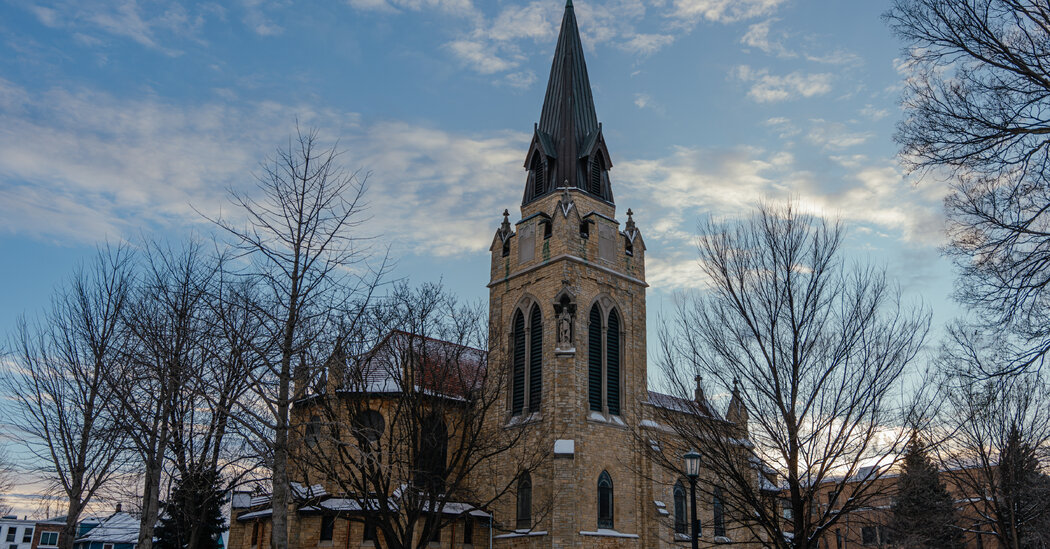
Nearly three dozen demonstrators charged with disrupting a church service in Minnesota this winter to protest President Trump’s immigration crackdown attacked the indictment on Monday with a flurry of motions that raised questions about the fairness of the case and the investigative tactics used to make it.
The jointly written motions were among nearly 50 court submissions filed on Monday in Federal District Court in St. Paul, the broadest assault so far that defense lawyers have made against the charges. Some of the other defendants in the case — including Don Lemon, the former CNN anchor, who has long been a focus of Mr. Trump’s ire — have already challenged the indictment on the grounds that it is part of the president’s campaign to seek retribution against his political enemies.
The charges brought against Mr. Lemon and the others — among them, Nekima Levy Armstrong, a local civil rights lawyer, and a local journalist, Georgia Fort — make up one of two prominent cases emerging from the widespread public protests against Operation Metro Surge, the administration’s name for its sweeping immigration raids in Minnesota. In a separate case, prosecutors in Minnesota have charged 15 people with conspiracy to impede the federal agents carrying out the operation and with belonging to the far-left movement known as antifa.
In one of the motions filed on Monday, defense lawyers argued that the church protest charges should be dismissed in their entirety because the agency that built the case, Homeland Security Investigations, did not have the authority to investigate the charges that were ultimately filed.
Prosecutors have accused the 38 defendants of committing two crimes: a conspiracy to deprive the congregants of Cities Church in St. Paul of their rights by interrupting a Sunday service on Jan. 18, and a separate conspiracy to violate the FACE Act, which bars using threats of force to intimidate or interfere with people seeking reproductive health services or trying to participate in a service at a house of worship.
The demonstrators converged on the church to protest the fact that one of its pastors was also deeply involved in Operation Metro Surge in serving as the acting director of the St. Paul office of Immigration and Customs Enforcement.
Traditionally, the F.B.I. has investigated violations of those two statutes. But the bureau did not work on this case in part because of the chaos that ensued after a senior agent in its Minneapolis field office resigned her post after the fatal shooting of Renee Good by a federal immigration officer. The agent, Tracee Mergen, quit after F.B.I. leaders in Washington pressured her to discontinue an inquiry she had opened into the officer who killed Ms. Good and to focus instead on an investigation into potential connections between Ms. Good’s partner and immigration protesters.
Aside from questioning the involvement of Homeland Security Investigations in the case, lawyers also alleged that the agency engaged in “outrageous government conduct.” They said that the agency had gathered evidence against the defendants not through typical means like search warrants or grand jury subpoenas, but rather through an investigative tool known as an administrative summons, which does not require approval from a judge.
Such summonses are traditionally used only in investigations of customs violations. But in this case, the lawyers said, Homeland Security Investigations issued more than 90 of the summonses to obtain information from cellphone providers, airlines, social media companies, a rental car company and a state employment agency. Last week, in a separate motion, defense lawyers revealed that the agency had used one of the customs summonses to secretly obtain six months of cellphone records from Ms. Fort alone.
In a different motion, the defense lawyers accused prosecutors of unfairly charging their clients from the outset under a rarely used provision of the FACE Act that bars interfering with people in a house of worship.
The law was largely intended to stop anti-abortion protesters from getting in the way of people seeking entrance to abortion clinics — a part of the law that the current Justice Department has said was abused by the Biden administration. The lawyers pointed out that Mr. Trump, early in his second term, pardoned some defendants charged under the abortion provision of the statute but has allowed his Justice Department to pursue the church case under the house-of-worship provision.
“By seeking to punish the defendants on the basis of their views,” the lawyers wrote, “the Justice Department initiated a prosecution in a manner that is unequal, oppressive, and has a clear and dangerous chilling effect on the defendants and anyone else who wants to voice their opposition to U.S. government policies.”
The church case has already run up against an array of prosecutorial missteps and has faced sustained questions from the judges overseeing it.
Earlier this month, for instance, Judge Laura M. Provinzino, the main judge handling the matter, took the highly unusual step of ordering the government to provide her with the full transcripts of the grand jury proceedings in order to determine whether there were any improprieties in the presentation that prosecutors made to obtain the indictment.
