


Welcome back to World Brief, where we’re looking at earthquake recovery efforts in Colombia, ongoing violence in the Middle East, and the persecution of Russia’s only antiwar party.
Devastation in Colombia
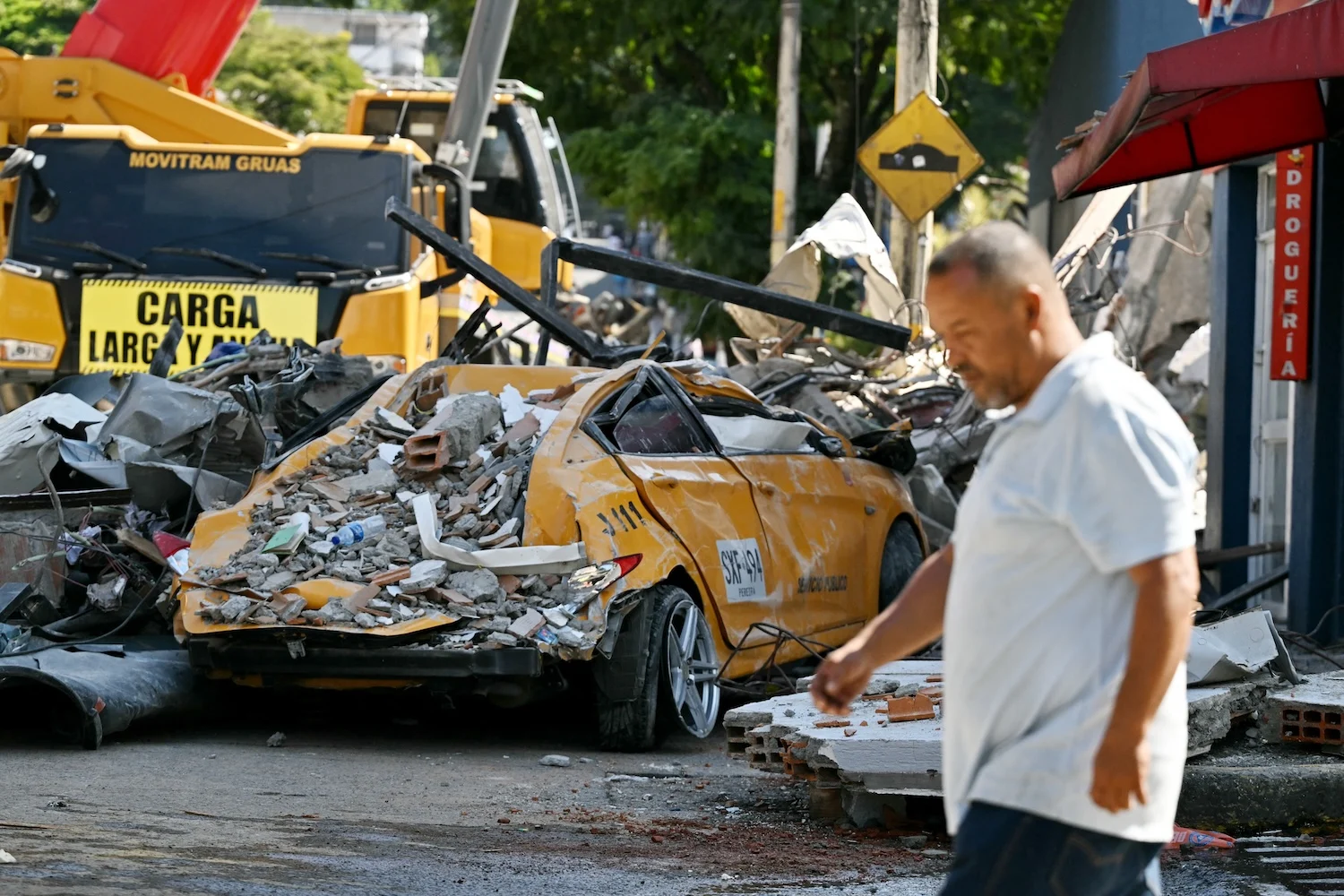
Search and rescue efforts continued across Colombia on Tuesday, as the country reels from a devastating 7.4 magnitude earthquake that has left upward of 200 people dead and thousands more unaccounted for.
The earthquake struck on Monday at 7:34 a.m. local time, with its epicenter near San José del Palmar, a small mountain town in the country’s western Chocó region. The quake was the most powerful one to hit the country in a decade, according to the Colombian Geological Service, which recorded 21 aftershocks by late Monday. Major cities such as Cali, Quibdo, and Pereira sustained serious damage, and an estimated 5,000 homes have been damaged or destroyed.
As first responders dig through the rubble for an estimated 3,000 missing people, the disaster is far from over. Recovery poses the first major challenge for Colombian President Abelardo de la Espriella, who was inaugurated on Friday. Following a Monday night visit to Quibdo, the capital city of Chocó, the leader traveled to Pereira, a city in the Andes east of Chocó, to assess the situation at the “forefront of the emergency” and “coordinate all the capacities of the State to respond quickly and decisively to the affected communities.”
The areas surrounding the epicenter are some of Colombia’s poorest and most rural regions. They were already facing intense violence from armed groups as well as rural neglect before the earthquake hit. Now, patchy communication systems and hard-to-access villages pose logistical challenges for recovery efforts. Local authorities in El Cairo, for example, estimated that about 80 percent of the small town was damaged.
The full extent of the earthquake’s devastation, including a final death toll, will not be quickly established. “What we don’t have is a complete tally of the physical damage because it is truly massive,” Chocó’s governor, Nubia Carolina Córdoba Curi, said on Tuesday.
De la Espriella is already shaping the tragedy to his political messaging: a right-wing, tough-on-crime brand of populism, similar to the politics of El Salvador’s hard-right president Nayib Bukele and U.S. President Donald Trump. “Choco will never again be the ‘land of the forgotten,’” de la Espriella said.
Hours after de la Espriella was sworn in on Friday, the United States pledged $1 billion in security assistance to the new government to help achieve “shared goals” of fighting illegal immigration, gang violence, and drug trafficking. The U.S. State Department then pledged $15.5 million in emergency relief for Colombia on Monday. (The U.S. government similarly assisted a Trump-friendly regime in the region following devastating earthquakes in Venezuela in June, committing almost $400 million to relief efforts and loosening economic sanctions on Caracas.)
Whether de la Espriella can successfully carry his country out of this crisis remains to be seen. “My commitment is with each and every one of the affected families,” he said on X. “We remain on the ground, working for our people.”
Today’s Most Read
What We’re Following
Regional war. Violence continued in the Middle East on Tuesday, as Yemen’s Transport Ministry accused the Houthis of attacking a cargo ship in the Bab el-Mandeb Strait and killing four crew members. The Iran-backed rebel group has not directly claimed responsibility for the attack, but it announced a blockade on Saudi shipping in the waterway last month and has carried out similar strikes since. On Tuesday, the Houthis’ chief negotiator posted a statement on X, saying that the group’s military operations against Saudi ships and other targets are in response to aggression from Riyadh, including an alleged strike on Sanaa airport on July 13.
Yemen’s military also accused the Houthis of launching ballistic missiles on the cities of al-Makha and Marib, as well as killing two Yemeni soldiers and wounding seven in a drone strike in the Shabwa province, according to local reports.
Meanwhile, a U.S. military helicopter fired on a Panama-flagged container ship attempting to cross the U.S. blockade of Iranian ports, according to a U.S. official. No casualties have been reported.
The U.S. attack comes amid reports from Qatar’s Foreign Ministry that negotiations between Oman and Iran to reopen the Strait of Hormuz have reached an advanced stage. However, Iran has repeatedly signaled that any actual reopening will be contingent on U.S. concessions and an abatement of Trump’s current economic pressure strategy.
Apple of discord. The Russian Supreme Court on Monday barred Yabloko, the country’s only antiwar party, from appearing on the ballot in parliamentary elections on Sept. 18.
The case against Yabloko was initiated by Rodina, a small nationalist party, on Friday. Rodina accused Yabloko of copyright infringement; campaign spending violations; and a treasonous, pro-West stance on the war—a litany of charges that gave even pro-Kremlin analysts pause. In an accelerated trial, the court overruled the Central Election Commission’s decision to allow Yabloko on the ballot last month.
Yabloko, which translates to “apple,” currently holds no seats in either of Russia’s legislative chambers. But its opposition to the invasion of Ukraine and support of an immediate cease-fire would have made it a potent protest vote for war-weary Russians, who boosted the party’s profile in social media posts featuring apples.
“We were aware that the more popular we were getting, the more trouble we’re creating for the Kremlin,” Kirill Goncharov, head of Yabloko’s Moscow chapter, told the New York Times. “People want peace, freedom and a life without fear—people want what this party represents.”
Steps toward justice. A Syrian court sentenced former dictator Bashar al-Assad to death in absentia for war crimes on Tuesday. The court cited “premeditated and intentional murder” in addition to “torture, arbitrary arrest, and crimes against humanity” during Syria’s 14-year civil war, in which more than 500,000 people were killed. Eight other regime officials, including Assad’s younger brother, Maher, and his cousin, Najib, were also sentenced to death.
Assad fled to Russia following his overthrow in 2024, along with his brother and other family members; Najib, however, has been in detention in Syria since January 2025 and was the only defendant present during the trial. He was convicted, among other crimes, of overseeing a crackdown in Daraa that catalyzed a broader uprising and ultimately led to the start of the war in 2011.
Syrians have become increasingly dissatisfied with the slow pace of trials since President Ahmed al-Sharaa’s government came to power, expressing their discontent via countrywide demonstrations in June. Some see the verdict—a result of the first trial held in Syria related to the war since 2024—as a test of the government’s willingness and ability to hold perpetrators to account and deliver justice to victims.
Odds and Ends
Stargazers in the Northern Hemisphere will have no shortage of sights on Wednesday. A total solar eclipse will be visible across Spain, Portugal, Iceland, Greenland, and northern Russia. (It will also be partially visible from parts of northern Africa, Europe, and North America.)
Meanwhile, the Perseid meteor shower will reach its peak between midnight and dawn on Wednesday and Thursday and can be witnessed anywhere in the Northern Hemisphere. Views should be particularly clear since solar eclipses only occur during the new moon phase of the lunar cycle, when moonlight is scarce.
