


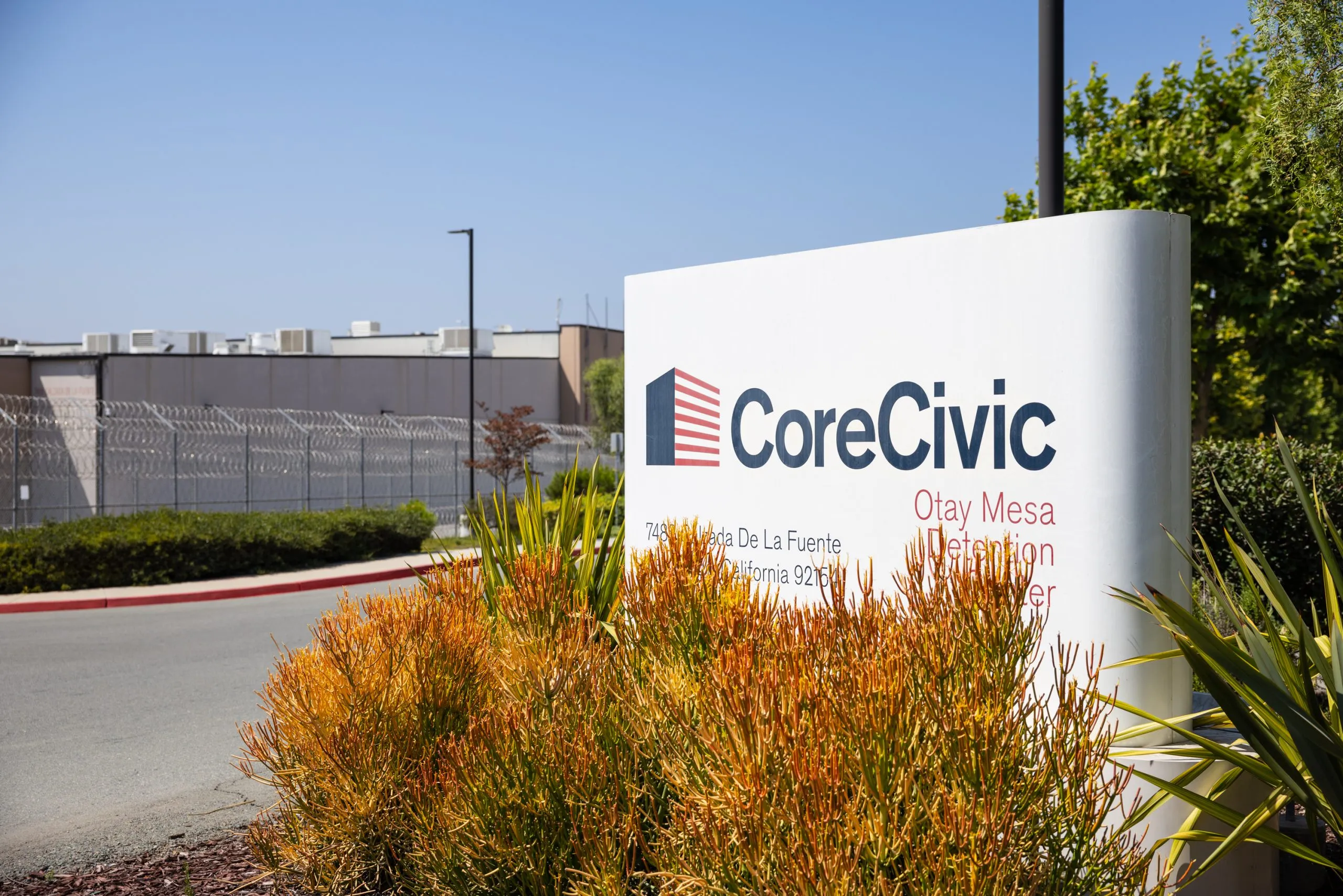
Private prison company CoreCivic said Thursday that it expects to use a substantial portion of proceeds from the recent sales of four immigration detention facilities to the Department of Homeland Security to buy back stock, creating a potential windfall for investors.
DHS purchased the facilities for $2.2 billion, over seven times the book value — the amount invested in the property minus depreciation — that CoreCivic reported in a 2025 financial disclosure.
The largest transaction of the four involved Otay Mesa Detention Center in San Diego, which sold for $739.2 million — more than four times its 2025 reported book value of $159.8 million.
The other facilities are in California City; Leavenworth, Kansas, and Appleton, Minnesota.
On an earnings call Thursday, CoreCivic Chief Executive Officer Patrick Swindle said the sales “were conducted at a fair valuation for both parties” and support “our continued work to be a dependable partner for the government.”
Swindle said CoreCivic will continue to operate the facilities under current contracts with the federal government but that “contract terms may be ultimately modified due to the transfer of ownership.”
The company is in preliminary discussions with Immigration and Customs Enforcement to sell more of its detention centers. It owns nine facilities that contract solely with ICE and 56 total correctional, detention and residential reentry facilities.
The funds from the facility sales are worth about two-thirds of the $3.2 billion total market capitalization of CoreCivic. The company has seen over 60% growth in year to date stock increases.
Swindle said that the company remains undervalued given the cash from recent sales.
“The sale of these facilities substantially strengthens our balance sheet,” he said.
CoreCivic Chief Financial Officer David Garfinkle said that they expect that President Donald Trump’s immigration policies will increase the number of detainees held at their facilities.
During the first 10 days of June, CoreCivic’s stock rose about 25% as Congress approved $70 billion for immigration enforcement, including roughly $38.6 billion for Immigration and Customs Enforcement.
Trump reported that he owned between $15,000 and $50,000 of CoreCivic stock in his 2026 financial disclosure. Since taking office, he has made 29 transactions of private prison stocks valued between $281,000 and $990,000, according to Citizens for Responsibility and Ethics in Washington, a group that studies government conflicts of interest.
CoreCivic has other ties to the administration. In 2024, the company gave $500,000 to the Trump-Vance Inaugural Committee. Its then-chief executive officer, Damon Hininger, personally contributed over $300,000 to Trump-affiliated committees during the 2024 election, according to Federal Election Commission filings.
Some political observers and immigration advocates worry about the financial connections at a time when questions are being raised about the standard of care at the immigration centers.
DHS has restricted access to detention centers nationwide, and sometimes turned away congressional representatives and county inspectors trying to enter Otay Mesa Detention Center.
U.S Reps. Sara Jacobs and Mike Levin inspected the facility in May, but they were prevented from speaking with detainees. County health officials conducted an eight-hour inspection in June after filing a lawsuit, but a report on their inspection has not been made public yet.
An inewsource investigation into allegations of deteriorating health and inadequate medical care at Otay Mesa Detention Center uncovered nearly 70 cases in which court filings mentioned concerns over health or medical care and diabetes care that experts described as potentially life threatening.
The inadequate care they describe is happening as populations at ICE detention centers across the country swell with immigrants. The average population of Otay Mesa has more than doubled over the last five years.
Thursday, CoreCivic reported $684.9 million in second-quarter revenue, up 27.3% from a year earlier, while net income fell 3.6% to $37.1 million. The company said higher occupancy, particularly at ICE facilities, and higher daily rates drove most of its federal revenue growth.
Type of Content
News: Based on facts, either observed and verified directly by the reporter, or reported and verified from knowledgeable sources.
