


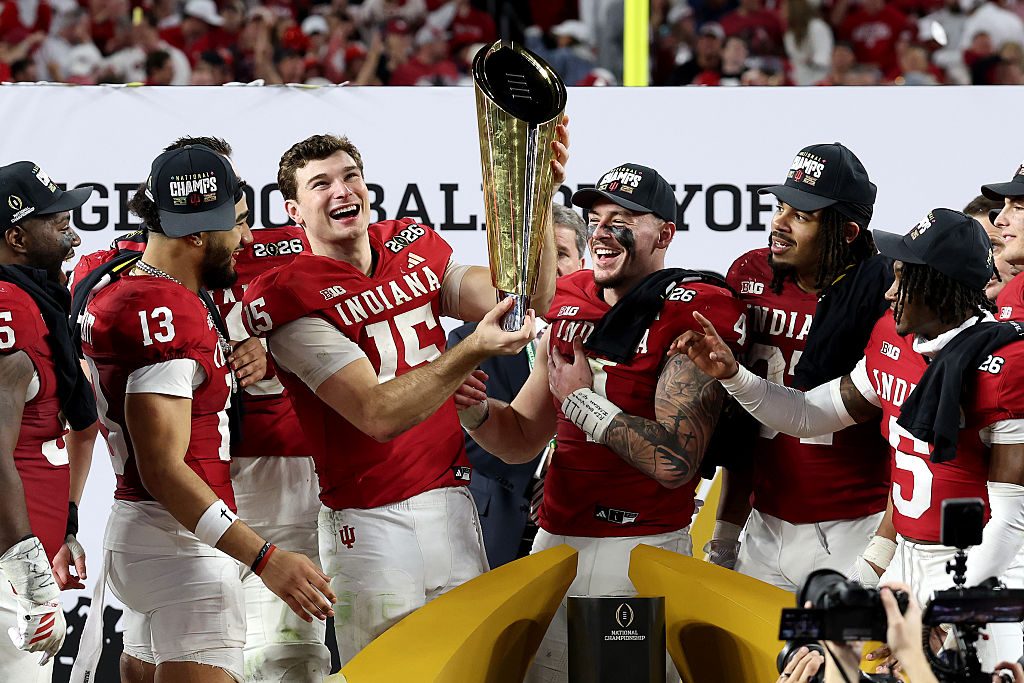
Fernando Mendoza and his Indiana Hoosiers teammates celebrate winning the college football national championship in January. (Photo by Jamie Squire/Getty Images)
Millions of dollars are flowing into Washington to shape the rules governing the millions of dollars now flowing to college athletes.
Coinciding with the kickoff of the college football season, the Senate is planning a vote between Sept. 15 and Sept. 26 on the Protect College Sports Act – a sweeping bill that would establish federal guardrails for the new college sports economy in which schools can pay players directly.
The measure has sparked a surge of lobbying from broadcasters, athlete‑advocacy groups, individual universities and their athletic conferences. Although the Senate bill was introduced just weeks before the second quarter closed, more than 90 organizations had already referenced it or its House counterpart by name in their lobbying disclosures through June 30. Together, those groups reported $31.4 million in lobbying activity during the quarter – a figure that reflects all of the issues they worked on, not just the Protect College Sports Act, since federal reports do not break out spending by individual bill.
The loudest voice belongs to Saving College Sports, a 501(c)(4) nonprofit founded by Texas Tech Board of Regents chairman Cody Campbell – a billionaire GOP megadonor who has poured millions into Republican causes It is now led by four Republican strategists, including the former chief of staff for Sen. Ted Cruz (R-Texas), a bill co-sponsor. That group kicked off the season with a series of television ads, including one shown during games involving historically Black colleges and universities to challenge opposition from the Congressional Black Caucus, and others featuring Hall of Fame player Deion Sanders and seven-time national champion coach Nick Saban.
The Senate is racing to act before the pre-election window closes – but House leaders on Sept. 3 canceled the final two weeks of the session before the election, meaning any Senate-passed bill couldn’t reach the House floor until November at the earliest.
Still, the lobbying battle has taken on urgency due to a “confluence of factors” tied to the rapid financial growth of college sports, David Weber, director of the Sports Law Program at the University of Oregon, told OpenSecrets.
“I think you see the tremendous amount of money flowing into sports,” Weber said. “Right now, I think the posture is, the NCAA is just trying to figure out how they can reassert some sort of control over this sport. And athletes are trying to keep their gains.”
Introduced by Cruz and Sen. Maria Cantwell (D-Wash.), the wide-ranging Senate bill would: offer the NCAA and conferences a limited antitrust exemption, cap fees agents may charge athletes, restrict how frequently they may transfer schools, preempt state regulations and overhaul how college athletes are compensated.
Under the $2.8 billion House v. NCAA antitrust settlement, schools may split athletic department revenue with athletes with the sharing capped this academic year at nearly $21.6 million per school. Players also may earn independent endorsement deals for their name, image and likeness (NIL), and this bill would consolidate those arrangements into a new framework. It would bring much of that money under a new, expanded revenue-sharing cap of up to $48.8 million while preserving “organic” deals – sponsorships athletes earn on their individual fame rather than their school’s existing commercial relationships. While those third-party NIL deals worth $600 or more are reported to the College Sports Commission, that organization does not break out figures by school, making comparisons difficult.
That expanded cap would most benefit the schools that can afford to spend significant sums. “Only the usual suspects are going to be able to take advantage of this provision and use this new funding mechanism to the full extent,” Weber said. “It also has the potential to exacerbate this divide between the haves and the have-nots.”
The NCAA, its most powerful conferences and professional leagues including Major League Baseball, the National Football League and their players’ unions support it. Opponents – which include the AFL-CIO, the NAACP and the Congressional Black Caucus – argue that it would restrict player mobility and market value, and would grant federal protections to colleges and athletic conferences that profit heavily from Black athletes while remaining silent as those same states weaken the voting power of those very athletes.
“The group that’s most disadvantaged by these new limitations would be the athletes who have been earning more money on the open market from their NIL … and by being able to have a little bit more freedom of choice to where they want to play,” Weber said. “Some of those gains, those would dissipate. … When you’re looking at the groups that are probably the least in favor of the PCSA, it’s going to be those athletes who are doing the best financially from the current situation. And that’s generally going to be a lot of those top athletes who play football and basketball, primarily, and especially those at the Power Four conferences.”
Broadcasters with skin in the game
The bill – which also includes provisions governing collective media rights negotiations – has drawn attention from several major broadcast and cable companies.
The National Association of Broadcasters and NCTA – the Internet and Television Association lobbied the legislation. While an NAB spokesperson declined comment to OpenSecrets about the group’s lobbying efforts, President Curtis LeGeyt previously expressed support for a provision that would require subscription streaming services showing high-profile football and basketball games to provide a free, over-the-air broadcast option in local markets, saying it would strengthen “the unique connection between universities, their communities and the student-athletes who inspire them.” OpenSecrets also reached out to NCTA but did not receive a response.
Amazon, Paramount Skydance and Disney Worldwide Services also each referenced the bill in their lobbying disclosures. Between April 1 and June 30, Amazon spent nearly $4.8 million lobbying the federal government on 169 specific issues and 36 unique bills or laws. Paramount Skydance ($1.5 million spent) and Disney (nearly $1.7 million) also listed the college sports measure among dozens of bills they worked on during the quarter.
Disney is the dominant player in sports broadcasting through its ESPN family of networks, while Paramount Skydance subsidiary CBS is a Big Ten Conference rightsholder and Amazon is also expanding into college sports, agreeing to broadcast select Duke University men’s basketball games.
From Ohio State to Ohio U., schools pick sides
A total of 60 colleges and university systems lobbied the measure during the second quarter. That includes 36 members of the NCAA’s four most powerful conferences – the Southeastern, Big Ten, Big 12 and Atlantic Coast. The ACC, SEC and Big 12 also filed their own lobbying reports on the legislation.
The individual institutions include some of the biggest brands at college sports’ highest level (Ohio State, Michigan, Notre Dame) as well as some schools a step or two lower on the ladder. Those include members of the “Group of Six” conferences outside the Power Four (Toledo, Ohio University, Western Michigan) and universities that field football teams at a lower level (Eastern Illinois).
Among universities referencing the sports bills during the quarter, the University of California was the top spender at $840,000, though it lobbied dozens of other bills in addition to the sports measure.
The support from the SEC and Big Ten is significant because they reversed course in late July after initially opposing the bill. The switch came after revisions addressed third-party NIL deals and the “associated entities” that frequently broker those agreements between player and school.
“You have the power conferences, which are operating under a very different budget dynamic than the Group of Six, than the [lower-level] schools,” Weber said. “We have the Power Two [SEC and Big Ten] for sure, and maybe those other two conferences, the Big 12 and ACC, are a little bit worried, too. What’s their future in college sports looking like?”
Saving College Sports: The loudest voice nobody can trace
But the most vocal organization pushing for the legislation is Saving College Sports, the group Campbell founded in February 2025 with a stated purpose of advocating for legislation and rules to support intercollegiate athletics.
Since its formation, it has spent $820,000 lobbying the federal government on bills and issues related to college sports. Nearly a quarter of that – $190,000 – came during the second quarter of 2026, when it lobbied both the Protect College Sports Act and a separate sports-related measure. The SCORE Act, a bill viewed as less favorable to athletes, never came to a floor vote.
Because Saving College Sports – formally, Americans for the Preservation of Intercollegiate Athletics, Inc. – is a 501(c)(4) nonprofit that does not have to disclose its donors, the true source of its funds may never be publicly known. An attorney for the organization declined to identify its donors when OpenSecrets requested them.
Few details about the organization’s operations have been publicly disclosed. While the nonprofit database maintained by the IRS contains no record of either of the group’s names – which experts say is not in itself unusual, given the timing of its incorporation – the attorney provided OpenSecrets with copies of its required notice of intent to operate as a social‑welfare nonprofit and the agency’s acknowledgment of receipt, which notes that the filing is not a determination of tax-exempt status. In response to a follow-up question asking if the IRS had determined that status, attorney Jessica Furst Johnson told OpenSecrets that the organization “is in full compliance with all IRS filing requirements” and that the agency does not require “a more fulsome application for exempt status.”
And while annual tax returns may eventually provide a peek into the finances of a 501(c)(4), those filings are not due until months after the close of an organization’s first fiscal year and may not appear in the IRS database for up to two years.
“This points to an easy two-year window for organizations to have no data up on the website,” said Renee Irvin, an expert in nonprofit management at the University of Oregon. The absence of a determination letter or tax return does not indicate wrongdoing, she said.
“It’s frustrating that we don’t know where the money has come from, what this organization is – we just don’t have any numerical data” on the group’s finances, donors or governance, she added.
The organization changed leadership in September 2025, when Campbell and two other directors left those positions. They were replaced by four Republican operatives, led by executive director David Polyansky – Cruz’s former chief of staff. OpenSecrets reached out to the four directors but did not receive responses.
Campbell’s pattern of giving
Campbell has emerged in recent years as a key player in both college sports and politics. The former Texas Tech and NFL offensive lineman became an energy executive and donated $25 million to the university’s athletic department – the largest one-time donation it has received – and was a major financial backer of the Red Raiders’ roster, helping them reach the 2025 College Football Playoff.
He has also been an active donor to Republican causes – and in one case those two fields appeared to intersect.
Federal Election Commission records show Campbell donating nearly $3 million to Republican candidates and committees between Jan. 1, 2025, and June 30, 2026, including 13 six-figure contributions. The largest of those was a $500,000 donation to the pro-Trump hybrid PAC MAGA Inc. on April 30, 2025. He also made a total of seven $132,000 contributions to the Republican National Committee and the National Republican Senatorial Committee between May 1, 2025, and June 10, 2026.
But questions were raised by the timing of another donation: On June 10, he contributed $274,300 to Paxton Victory – the joint fundraising committee supporting Ken Paxton, the Texas attorney general and Republican Senate nominee. One day later, Paxton sent a letter to the Big 12 – of which Texas Tech is a member – about transfer quarterback Brendan Sorsby, who was ruled permanently ineligible after admitting to betting on his own team at Indiana and placing thousands of wagers on sports. In the letter, Paxton warned the conference that sanctioning the school for allowing Sorsby to play would expose the league to “substantial liability.” Campbell attributed the timing to coincidence, telling the Fort Worth Star-Telegram that there was nothing “nefarious” about it.
Campbell did not respond to OpenSecrets’ request for comment. But his advocacy fits into a broader, recognizable pattern, Weber said.
Invested parties, he added, typically fall into two camps – the “traditionalists” like Campbell and the group he founded who favor a strong central organization governing college sports, and those who support classifying college athletes as employees – opening the door for unionization and collective bargaining.
“If you go down the path of athletes as employees, we don’t even know what all the unintended consequences might be with that,” Weber said. “And so, the traditional [approach] might be the easier path forward, at least in the short term, to establish stability in the marketplace.”
