


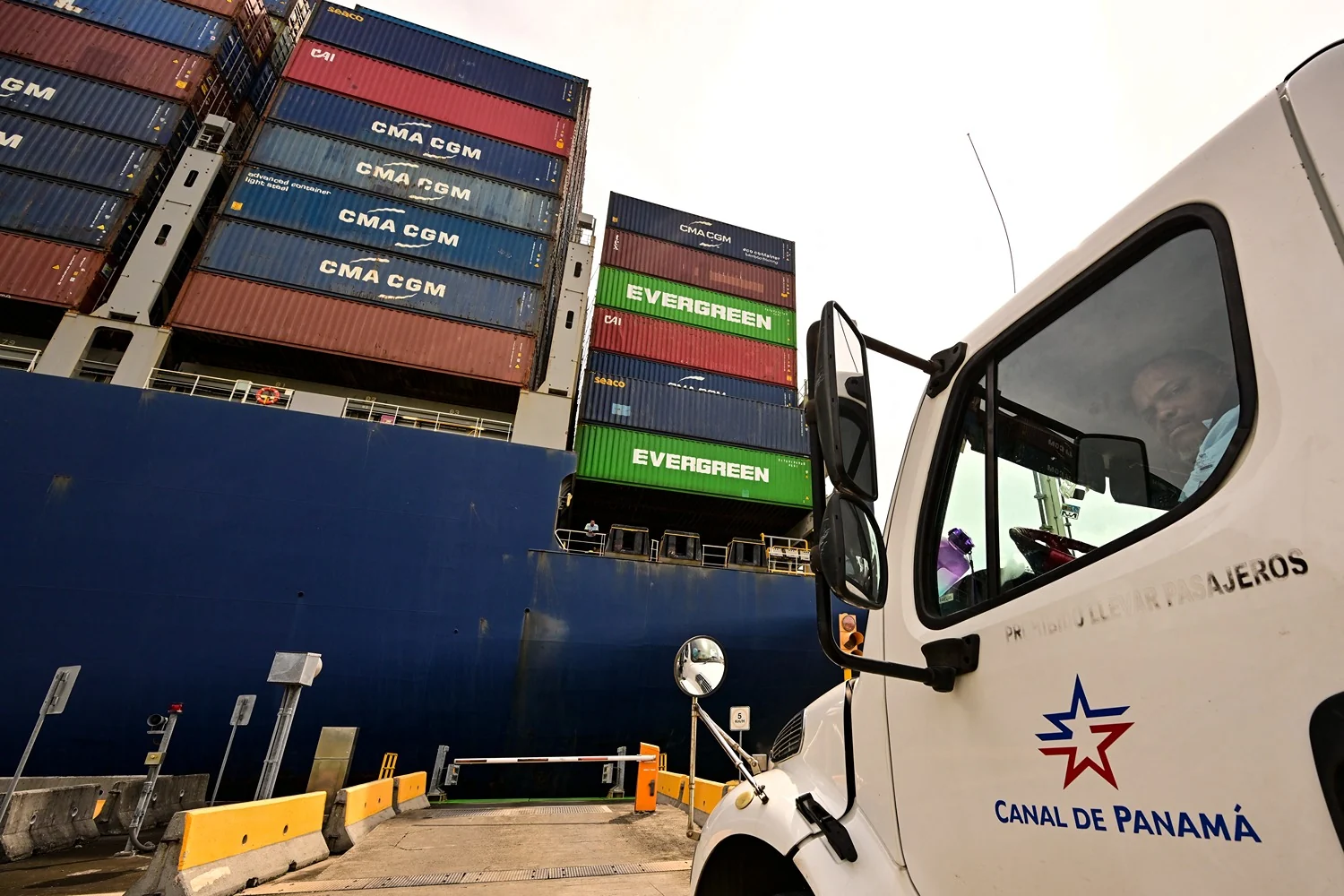
For most of the world, the diplomatic spat between the United States and Panama—over U.S. President Donald Trump’s incorrect claim in his 2025 inaugural speech that China controlled the Panama Canal and that he would retake it—has been resolved. Following the president’s threat, the Trump administration negotiated access for U.S. military training in the Panamanian jungle and Panama’s Supreme Court overturned contracts for two Hong Kong-owned port facilities.
For Panamanians, however, the dispute around the canal continues. Only the White House has moved on.
Between March and July 2026, more than 400 Panama-flagged ships were detained at Chinese ports. The unprecedented rate in detentions began on March 8, reportedly following what the U.S. Federal Maritime Commission has called “informal directives” intended to “punish” Panama-flagged ships. (China’s ambassador to the United States has denied that Panamanian ships are being targeted and says that the increased inspections are due to fishing boat collisions.)
By April, China was responsible for 91 percent of all detentions of Panama-flagged ships across the Asia-Pacific region. Fearing additional detentions and penalties from China, an estimated 500 ships left Panama’s registry between the end of 2025 and this August—about 12.3 percent of the country’s total fleet by tonnage.
Though not yet an open trade war, Beijing’s recent actions against Panama signal a new way of punishing countries for crossing Chinese interests. Beijing is applying economic pressure through the infrastructure of trade: shipping, ports, and logistics.
With the world focused on another maritime chokepoint, Panama is paying the price for angering Beijing. And as freedom of navigation is very much in the news, the implications are broader still. Lawfare now encompasses maritime lawfare as well, and Panama and the United States cannot address this issue alone.
The China-Panama dispute originated from a much broader fight between the United States and China over commercial control of a crucial waterway. At the start of the second Trump administration, the United States repeatedly accused Beijing of exercising undue influence over the Panama Canal, which moves more than 40 percent of all U.S. container traffic.
At the center of the dispute were two port facilities at opposite ends of the waterway: Balboa on the Pacific coast and Cristóbal on the Atlantic. Both terminals were operated by Panama Ports Company, a subsidiary of Hong Kong-based CK Hutchison. Together, they occupy strategically important positions along one of the world’s busiest maritime routes, but in neither case were they operating the canal. Nonetheless, U.S. lawmakers have mentioned the possibility that the facilities were being or could be used to listen to sensitive communications.
In response to the Trump administration’s concerns and warnings, Panamanian officials began to look into the contract between the company and the Panamanian government. The concession, originally granted in 1997 and extended in 2021, was already controversial in Panama amid suspicions of backroom deals in the extension of the contract.
Later, in an audit of the concession, Panama’s comptroller alleged that unpaid dues and improperly granted tax exemptions had cost the country approximately $1.3 billion. On Jan. 30 of this year, Panama’s Supreme Court ruled the original concession and its renewal unconstitutional, ending the legal basis for operating the two terminals.
The Panamanian government took control of the ports and assigned interim operations to two other major shipping companies, both European: Maersk and MSC. Beijing condemned the court ruling as an act of bad faith, attributing it to U.S. pressure. CK Hutchison, meanwhile, rejected the takeover, calling it unlawful, and initiated arbitration proceedings through the International Chamber of Commerce, though there has been little progress so far.
Shortly afterward, Chinese authorities dramatically ramped up their detention of Panama-flagged vessels. In March, China’s Ministry of Transport summoned executives from Maersk and MSC and demanded that the companies withdraw from Balboa and Cristóbal. Chinese firm COSCO Shipping Lines suspended its container services at Balboa, while other Chinese state-owned firms paused new investments in Panama.
In April, Chinese Premier Li Qiang signed a State Council order expanding Beijing’s authority to retaliate against foreign regulatory actions deemed harmful to Chinese interests. The measure added to concerns that China was developing a broader legal and administrative toolkit for responding to disputes with other countries.
Administrative measures such as the ones that China is using to justify stopping the Panama-flagged ships impose significant economic costs while preserving the appearance of routine regulation. China’s efforts are technically legal; they just exploit customs requirements to create supply chain delays and cascading trade disruptions that impose punitive costs on those caught in Beijing’s sights—in this case, Panamanian shipping.
A ship held in port for additional inspections may not make the headlines, but the delay and the signal that it sends to shipping companies is expensive. The stopping of ships for inspection disrupts schedules, raises insurance and operating costs, and can leave cargo waiting for days or weeks.
This is no small threat for one of the world’s logistical leaders. The Panamanian government earns around $125 million to $150 million annually from licensing the 7,700 to 8,500 ships that fly its flag, historically registering more than any other country. For China, it’s a subtle way to punish the country whose Supreme Court overturned concessions for CK Hutchinson on either end of the Panama Canal.
In the long term, the costs to Panama could be much greater. Panama’s registry value relies on its reputation for neutrality and predictability. If shipowners begin to view the Panama flag as politically risky, the erosion of Panama’s market share could be worse than the immediate loss of registration fees.
The pressure has extended into ship financing. According to reports, some Chinese leasing companies have begun requiring shipowners to reflag their vessels away from Panama as a condition of obtaining new financing. As the second-biggest user of the canal after the United States, China accounts for more than one-fifth of all the canal’s cargo traffic.
Response to China has been mostly limited to shipping circles. In April, the United States, Bolivia, Costa Rica, Guyana, Paraguay, and Trinidad and Tobago issued a joint statement supporting Panama’s sovereignty. And in July, the U.S. Federal Maritime Commission threatened to investigate what it described as the “weaponization of port state control inspections” against Panama-flagged vessels. So far, it has failed to spark any change.
Panama’s experience raises a difficult question: How can countries respond when the rules and infrastructure of global commerce become instruments of geopolitical pressure? It’s a challenge that’s not unique to Panama; recently, the Trump administration has been raising concerns about the Chinese-built and now partially owned Chancay port in Peru.
The International Maritime Organization (IMO) would be a natural starting point for investigating this new form of maritime lawfare. While the body focuses on maritime safety, port-state control, and the development of common standards for international shipping, given China’s targeted efforts to single out individual governments for retribution, member states should consider strengthening existing procedures to identify unusual patterns of vessel inspections and detentions.
Likewise, the Word Trade Organization (WTO) provides a forum for resolving disputes over measures that violate international trade agreements. However, current shipping dispute is focused on the infrastructure of trade rather than the regulating of ships and their cargo. And, of course, the WTO has also been severely weakened by the United States.
If it should want to, the White House could engage in efforts to strengthen the WTO’s dispute-settlement system and ensure that members have effective avenues for challenging measures that fall within its rules. In this, the WTO and IMO could play complementary roles: the former in disputes covered by trade agreements and the latter in maritime regulation and inspection practices.
Expecting this administration to lean into the multilateral system to address this fallout from its own actions is, at best, difficult to imagine. But the Trump administration has turned to multilateral organizations when it has determined that they could further specific interests, as in Haiti. In that case, after resolutions for a U.N. peacekeeping mission for Haiti were vetoed by China and Russia, the United States and other countries crafted a U.N. Security Council resolution to create a Gang Suppression Force that is technically separate from the U.N.
Another more positive approach is to compete with China in building ports and infrastructure that challenge China’s ability to threaten supply chains.
Research shows that Chinese contractors’ participation in regional infrastructure projects in Latin America and the Caribbean has increased by more than 50 percent in the past five years. Infrastructure has now displaced energy as the most important sector for investments from Chinese firms. And while the United States remains the biggest investor in Latin America by far, averaging about $28.7 billion per year in greenfield investments, these investments are mostly focused on energy, digital infrastructure, manufacturing, and services.
Beijing has also invested in a number of strategically important ports that bracket Panama throughout Central America and the Caribbean. On the Pacific Ocean, this string of official investments includes ports in Nicaragua, El Salvador, and Colombia.
Institutions such as the U.S. International Development Finance Corporation (DFC), regional development banks, and private investors incentivized by multilateral seed capital should focus on port capacity and alternative shipping connections. But if the DFC is to play a role, it will need to step up its attention and deals.
There is also a more ad hoc, multinational option. Other countries with maritime interests have a shared stake in ensuring that international shipping remains reliable and that commercial disputes do not become a pretext for discriminatory treatment by Beijing or other capitals.
Over the past two years, countries such as Panama, Greece, and Denmark have co-sponsored proposals for global maritime governance and freedom of navigation within the United Nations Security Council. With U.S. diplomatic, technical, and financial support, these countries could work together to improve information sharing, coordinate responses to unusual inspection patterns, and develop common expectations for transparency and due process.
There is one remaining wrinkle. Under the 1977 Panama Canal Neutrality Treaty, the United States and Panama committed to maintaining the canal’s permanent neutrality and ensuring peaceful transit for vessels of all nations on equal terms. China is not a party to the treaty. Although the agreement does not govern commercial disputes, it underscores the United States’ long-standing treaty-based interest in the canal remaining open, under which—despite Trump’s bombast—the U.S. Navy and U.S.-flagged merchant marine vessels have always paid a lower toll.
More attention on Beijing’s retaliatory tactics is needed, not just for Panama but also for other governments that seek to minimize Chinese influence in their economies and infrastructure. The United States, alongside other countries, should reinforce international means to respond.
