


Unlock the Editor’s Digest for free
Roula Khalaf, Editor of the FT, selects her favourite stories in this weekly newsletter.
Chinese actors and online influencers have a new rival: cost-effective advanced AI video generation programmes that are threatening millions of jobs in a once-vibrant area of China’s gig economy.
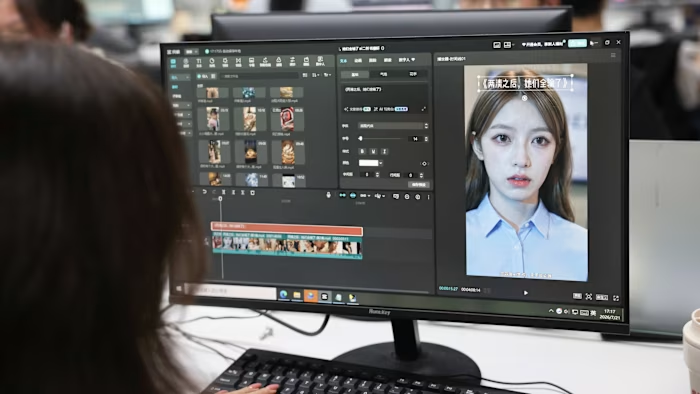
The release of powerful new AI-powered video software, such as tech group ByteDance’s Seedance 2.0 model, has allowed digital actors to replace humans, enabling the production of higher-quality original videos more quickly.
The digital takeover intensified after this year’s release of Seedance 2.0, said Greg Wollner, a short-drama actor and producer in Beijing. Before its release, he was shooting three different productions a week. “And after that, everything just went.” Many of Wollner’s friends “had to quit doing what they love and change to something else”, he said.
In May, 89 of the top 100 animated dramas on Douyin, ByteDance’s domestic Chinese version of TikTok, were AI productions according to DataEye, a marketing analytics company.
In the first quarter of 2026, about 128,000 short dramas were released in China, more than three times the entire previous year and 95 per cent of them AI generated, according to the China Netcasting Services Association.
The economic consequence could be dramatic. China’s short drama industry employs 690,000 people directly, according to a 2026 report from the National School of Development at Peking University. About 15mn people cite live streaming as their primary profession, according to a 2024 report from the China Netcasting Services Association.
In livestreaming ecommerce, AI-generated digital hosts can sell around the clock at roughly 10 per cent of the cost, according to estimates in China’s state-owned media. As of March, ecommerce platform JD.com’s digital hosts were being used by more than 70,000 merchants, according to the financial news outlet Yicai.
A digital double of prominent human streamer Luo Yonghao outsold the real person in several product categories, generating Rmb55mn ($7.7mn) in just seven hours, according to Baidu.
Whereas a three- to five-minute drama production would take five people three months to produce in 2024, according to Professor Shen Yang, director of the metaverse laboratory at Tsinghua University and director of AI animation firm Zeelin, today it takes a single employee one to two days.
The average price was Rmb600-800 ($90-$120) per minute, 10 per cent of the cost of when humans were used. Zeelin published about 8,000 one-minute short-drama episodes in May.
In some cases, performers are being forced to “distil” their images, voices and performing styles into AI tools before losing their jobs. “I was pretty much pinned against a wall,” said the host of a popular children’s educational programme, who was told in April to consent to the creation of an AI replica of herself, or the company would find other actors who would.
“At first, the actors who signed for these things were shamed because they were seen as taking jobs from others,” said the host, who declined to be identified for this story. “Now it seems that . . . change is unavoidable.”
Aside from actors, there are concerns that other types of employees are also being “distilled”, or forced to train their AI replacements before being dismissed.
Lawyers say AI-related labour disputes have risen noticeably over the past two to three years. Workers can use dismissal because of AI as grounds to negotiate higher redundancy payments, said Jiang Xiaotong, a Zhejiang-based labour lawyer, who represented a worker in what is believed to be the first court case in China’s Hangzhou tech hub involving an employee allegedly replaced by AI. The court told the company to pay the employee more compensation.
The children’s educational programme host said her initial redundancy offer was 10 months’ salary for the use of her face, voice and likeness in perpetuity. She eventually settled on a five-year contract, one year’s salary and veto rights.
Actor Todd Kuhns has seen his work dry up. He and his colleagues felt a “general sense of frustration and resignation as we see our livelihoods stripped away from us using tools that have mined our own performances”.
ByteDance did not immediately return a request for comment.
