


Welcome to Foreign Policy’s China Brief.
The highlights this week: The Chinese Communist Party begins its fifth plenum, North Korean leader Kim Jong Un visits Dandong, and China’s first entirely AI-generated animated feature flops at the box office.
Welcome to Foreign Policy’s China Brief.
The highlights this week: The Chinese Communist Party begins its fifth plenum, North Korean leader Kim Jong Un visits Dandong, and China’s first entirely AI-generated animated feature flops at the box office.
A Revealing Fifth Plenum
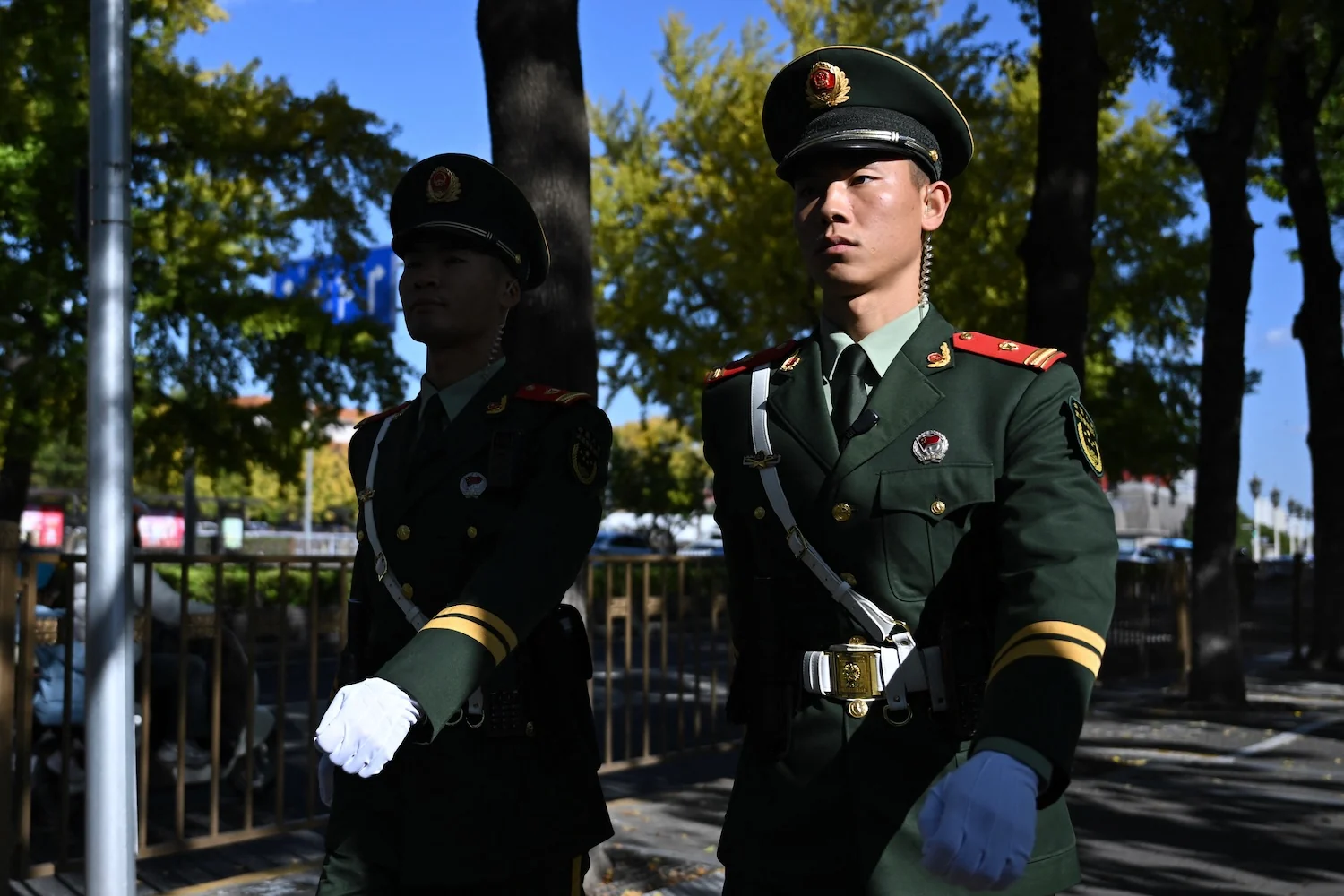
The Chinese Communist Party (CCP) kicked off its fifth plenum on Monday. Plenums operate on a five-year cycle, bringing together the CCP’s Central Committee, a body of roughly 200 voting members and about 170 nonvoting alternates. The group includes Chinese President Xi Jinping, military leaders, department heads, regional leaders, and the mayors and party secretaries of major cities.
As with every CCP leadership meeting, smaller groups tend to informally settle agendas and outcomes in advance, and discussion is pro forma. There are exceptions, such as former President Hu Jintao’s humiliating removal from the party congress in 2022 and senior official Bo Xilai’s expulsion in 2012, but they are rare.
The agenda itself offers clues to Xi’s concerns. Plenums follow a regular cycle; fifth plenums have traditionally focused on the management of China’s semi-planned economy. This week’s agenda is instead centered on “party self-governance,” a formulation that encompasses both anti-corruption efforts and political loyalty to Xi.
That shift suggests that Xi might be worried that his long-running anti-corruption campaigns and purges are not paying off.
When he took office in 2012, Xi was empowered by a consensus among senior leaders that corruption and slackening party control were serious threats to the CCP’s legitimacy. Yet the generation of leaders that he has elevated to replace the corrupt leadership that preceded him has turned out to be just as corrupt.
Plenums especially matter to Xi because his power is rooted in the CCP’s formal structures. This stands in contrast to Mao Zedong, who bypassed formal structures to attack his enemies and strengthen his personality cult. Mao did so most brutally during the Cultural Revolution, when he mobilized the student-led Red Guards against the CCP’s established leaders and hierarchies.
Mao’s successor, Hua Guofeng, also tried to build a personality cult, but Deng Xiaoping eventually pushed him aside. Deng also operated outside formal party structures, though in a different fashion. Even at the height of his power, Deng held relatively few formal titles, relying on informal networks cultivated over decades, from card-playing groups to mentorship circles.
Xi does not have these options. His personality cult operates purely at the surface level. (Unlike Mao, nobody has ever cried singing Xi’s poems.) Xi’s political persona is built around hierarchy and order, not revolution. Before taking power, senior party members viewed him as a safe pair of hands, particularly compared to Bo, his flamboyant rival.
Nor does Xi have the intricate personal networks that Deng used to sustain his influence. Even though Xi is the son of one of the founding fathers of the People’s Republic of China, he has not built close ties to other princelings, choosing instead to curtail them. He has also not hesitated to turn against figures once considered his allies, such as now-fallen top general Zhang Youxia.
As a result, Xi’s power stems almost entirely from his formal position—including, critically, his control of the CCP’s internal security services. That dependence makes it hard for him to ever emulate Deng’s eventual status as an éminence grise: a leader who retains enormous power even after leaving his formal post.
Retirement would be risky for Xi, as he is more likely either to die in office or to be forced out of it. The former could be a long way off: Xi’s father died at 88, and his mother is approaching 100. The latter, if it happens, is more likely to come as an unexpected vote at a party meeting than as guns in the night. But it won’t happen at this one.
What We’re Following
Kim Jong Un visit. North Korean leader Kim Jong Un made a quick trip to the Chinese city of Dandong on Saturday, meeting with Xi’s close advisor Wang Huning and touring a bus factory. The visit was nominally tied to the 76th anniversary of China’s entry into the Korean War, but it also signaled Pyongyang’s eagerness to expand bilateral trade and investment.
In past conversations, Chinese officials and pundits have expressed confusion and frustration at North Korea’s reluctance to follow China’s path of economic liberalization. Kim’s recent efforts to steer the economy toward greater growth—in part by supporting Russia’s war in Ukraine—have been welcome news in Beijing.
Meanwhile, Chinese companies facing rising labor costs at home are also keen for North Korean infrastructure improvements that could make cross-border factories more efficient.
U.N. race shake-up? The Trump administration is reportedly encouraging former Hungarian Prime Minister Viktor Orban to throw his hat into the race for United Nations secretary-general, supposedly with Russian and Chinese backing. Moscow’s support would make sense, but Beijing’s is more doubtful.
My guess is that U.S. officials floated the idea to their Chinese counterparts, received a politely noncommittal response, and mistook it for an endorsement.
China has no problem doing business with corrupt autocrats, but it has spent decades building up institutional power at the U.N. Installing a disruptor like Orban would offer Beijing little obvious benefit, particularly if he owed his position more to Washington. China is more likely to follow the informal convention and back a Latin American candidate.
FP’s Most Read This Week
Tech and Business
AI movie flop. As keen as the Chinese public is to embrace artificial intelligence for everyday usage, people are more reluctant when it comes to art. The country’s first entirely AI-generated animated feature, Sanxingdui: Future Past, flopped at the box office, taking in just $181,000 in its opening weekend.
Animation fans online have contrasted the movie’s failure with the unexpected success of the handmade film Niu Lai, which won over Chinese audiences earlier this year for its authentic awfulness.
Video game success. China has largely struggled to turn its cultural exports into mass-market hits beyond its enormous domestic audience. Video games, however, are becoming an exception. The Chinese video game industry’s cultural ascent continues with Phantom Blade Zero, which has drawn ecstatic reviews ahead of its release this week.
Chinese gaming giant Tencent already wields significant financial influence in the industry, with significant stakes in many Western companies. But Chinese-made games are now serious global competitors. Titles such as Black Myth: Wukong and Genshin Impact have achieved major success, drawing on the traditions of martial arts storytelling and Hong Kong action cinema.
