


Welcome to Foreign Policy’s China Brief. The highlights this week: Chinese President Xi Jinping leaves Washington without much to show for his White House summit, U.S. student numbers in China haven’t recovered from the COVID-19 pandemic, and F-35 fighter jet parts land in Beijing’s lap in a mistaken shipment to Hong Kong.
What to Make of the Trump-Xi Summit
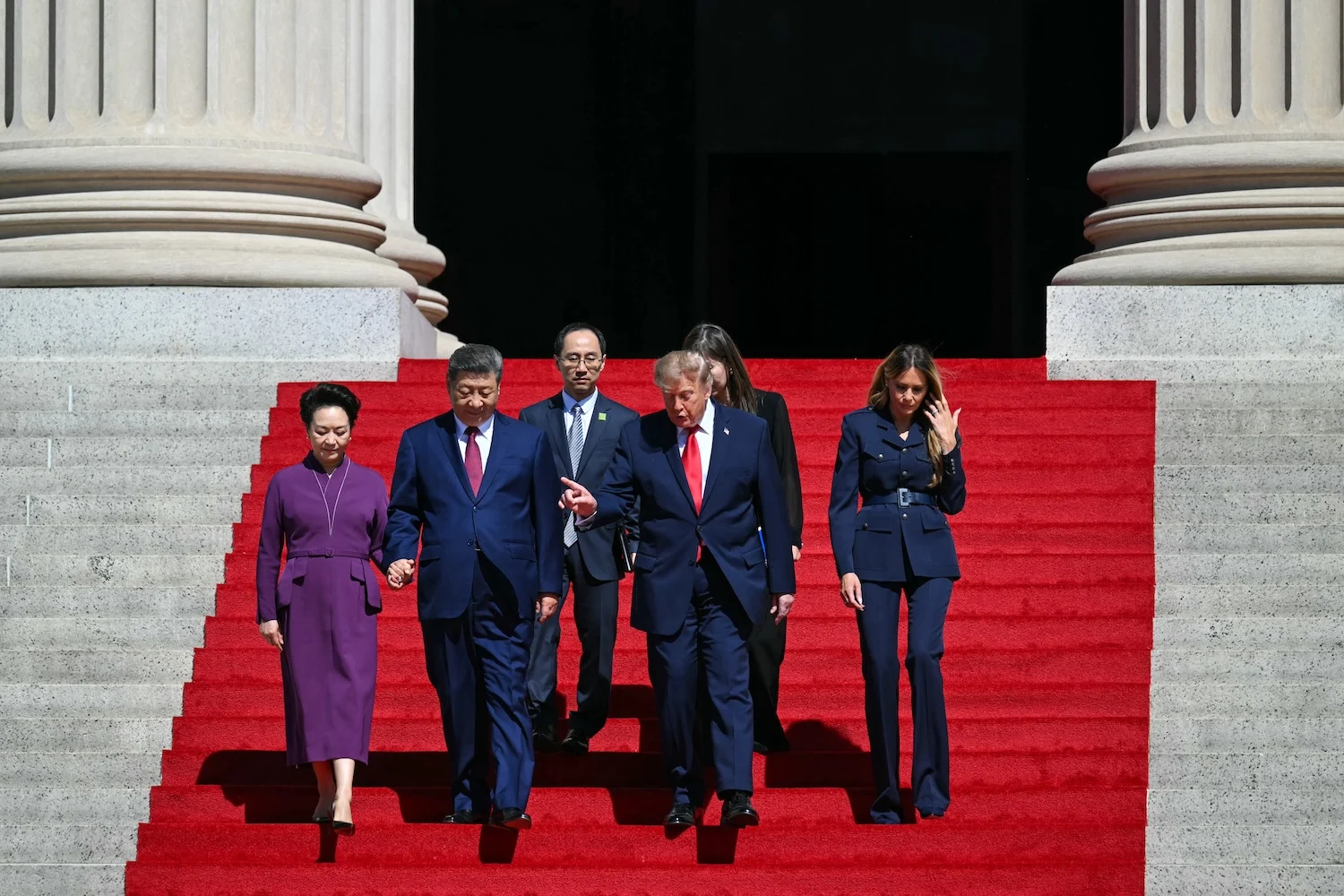
Chinese President Xi Jinping left Washington last week with the air of a man who has just made a dutiful social call to an aging relative. The summit between Xi and U.S. President Donald Trump was—as widely expected—a nothing burger, ending with little more than Trump’s fulsome praise of both the Chinese leader and himself.
Welcome to Foreign Policy’s China Brief. The highlights this week: Chinese President Xi Jinping leaves Washington without much to show for his White House summit, U.S. student numbers in China haven’t recovered from the COVID-19 pandemic, and F-35 fighter jet parts land in Beijing’s lap in a mistaken shipment to Hong Kong.
What to Make of the Trump-Xi Summit
Chinese President Xi Jinping left Washington last week with the air of a man who has just made a dutiful social call to an aging relative. The summit between Xi and U.S. President Donald Trump was—as widely expected—a nothing burger, ending with little more than Trump’s fulsome praise of both the Chinese leader and himself.
Even Fox News was unable to muster a similar level of enthusiasm, while Chinese state media gave the summit routine coverage that had largely fallen out of the headlines by Monday.
But in the U.S.-China relationship at present, nothing might be better than something. Neither superpower seems to have the appetite for a costly confrontation, whether over trade or Taiwan. Awkward topics are simply not brought up, from China’s reported intelligence support for Iran to U.S. Republican claims that Beijing has hypnotized Americans into opposing data centers.
It helps that the trade teams for the two sides have gotten on surprisingly well since spending time together in Switzerland last year. That allows for some progress to highlight at these meetings, such as the $60 billion in tariff cuts that Trump and Xi pledged last week.
The big shock of the summit came after the U.S. ambassador to China said that Trump had offered to sell U.S. arms to Xi, apparently thinking it would be heralded as good news despite the fact that it would be illegal under U.S. law and cause consternation among U.S. allies. (The White House quickly denied the claim—though Trump added, “Maybe it’s a good idea.”)
It seems perfectly possible that Trump made such an offer, however. The U.S. president says a lot of things without meaning to follow through on them, particularly to impress people who he sees as important. The chance that Trump said something like this to Xi is high, but the chance that he had any plan to deliver on it is very low.
All this is bad news for the China hawks who supported a second Trump administration expecting to see a similar swing against Beijing as during his first term.
The U.S. president seems unenthused at the prospect of another clash after the shock of further Chinese export controls on critical minerals last year. The White House lacks interest in the complicated logistical and technological moves needed to untangle U.S. supply chains from China, except as an opportunity to make money.
Notably, there was no real progress on artificial intelligence safety at last week’s summit. Trump is dismissive of the notion that AI regulation is necessary, insisting on a new designation of “super intelligence” rather than AI. The Chinese readout of the meeting ignored the term.
Aside from that, there is a fundamental gulf between the two sides on how AI and AI firms should be handled. China already has more extensive regulations on the technology than the United States. That is a problem, because the speed of rogue AI incidents is accelerating, including interference with government websites and even the hacking of foreign governments.
The coming months could see agents controlled by a U.S. firm like OpenAI hack a Chinese firm—or even a Chinese government agency. It will be hard to convince the Chinese that it was genuinely accidental. If a Chinese firm was responsible for anything like the recent spate of incidents, its CEO would have to grovel to the Chinese Communist Party (CCP) on TV.
On the positive side, the U.S. did get more pandas out of the Trump-Xi summit. The gift of a slow-moving species dying out through its own lack of reproductive enthusiasm does seem like an apt metaphor for the relationship.
What We’re Following
Study abroad boost? One idea that both Trump and Xi seemed keen on at last week’s meeting was more young Americans going to China, with Xi suggesting 100,000 students over the next five years. The number of U.S. students in China has plummeted since the COVID-19 pandemic, hovering for a while in the hundreds and numbering fewer than 2,000 this year.
But China has long been a hard sell to U.S. students, especially compared to a semester abroad in Europe. For instance, there are currently more than 30,000 U.S. students in Spain compared to a peak in the 2010s of maybe 15,000 U.S. students in China.
Studying Chinese isn’t quite the pathway to a job it was advertised to be in the early 2000s. There are simply too many Chinese citizens with good English as an alternative, and Beijing has made work visas increasingly difficult for early-career foreigners.
Chinese intellectuals are worried about the decline in U.S. students in China, believing that a lack of on-the-ground experience makes it more likely for Americans to misunderstand the country. That’s true, but there is also considerable suspicion in the U.S. security clearance process of anyone who has spent time working in China, especially those with Chinese spouses.
F-35 parts land in China. China may not need to buy U.S. arms—parts from the cutting-edge, American-designed F-35 fighter jet were mistakenly shipped to Hong Kong this summer and are still being held by China. The Lockheed Martin shipment, sent by an intermediary, was headed from Australia to the United States for repairs.
How such a mistake was possible remains an open question, with obvious suspicions of espionage. But incompetence is always a more likely option than conspiracy. I know of one case in the 2010s, for instance, in which a U.S. official traveling with sensitive data from Japan to Nepal was accidentally rerouted via Beijing, to the consternation of superiors.
FP’s Most Read This Week
Tech and Business
Weekend controversy. The Shuangxiu Gou (or “two-days’ rest”) app was shut down by internet regulators this month. Introduced earlier this year, the app was part of a movement that encouraged online shoppers to buy only from companies that gave their workers a full weekend off. This was too heady an idea for the authorities.
China’s 1994 labor law limits mandatory hours to no more than eight hours per day or 44 hours per week. But it is rarely enforced; exploitation of workers, especially migrant workers, remains common. The contradiction between the CCP’s ideological commitment to workers’ rights and its hostility to workers’ organizations remains a weak point for governance.
The United States is largely ineffective at exploiting that gap, in part because of many U.S. politicians’ own antipathy toward unions, but also because China has successfully prevented any widespread movement like Poland’s Solidarity from emerging.
AI uptake reaches 50 percent. The Chinese public continues to embrace AI with greater speed than the West, with adoption of generative AI now reaching more than 50 percent, according to a new report. There is greater trust in the tech industry in China, but persistent AI problems are also less noticeable in a country where written work output has always been surprisingly sloppy.
That is partially because the amount of content required from white-collar workers has always been higher in China than in the United States, especially when it comes to producing internal content for bureaucratic monitoring, such as self-assessments.
