


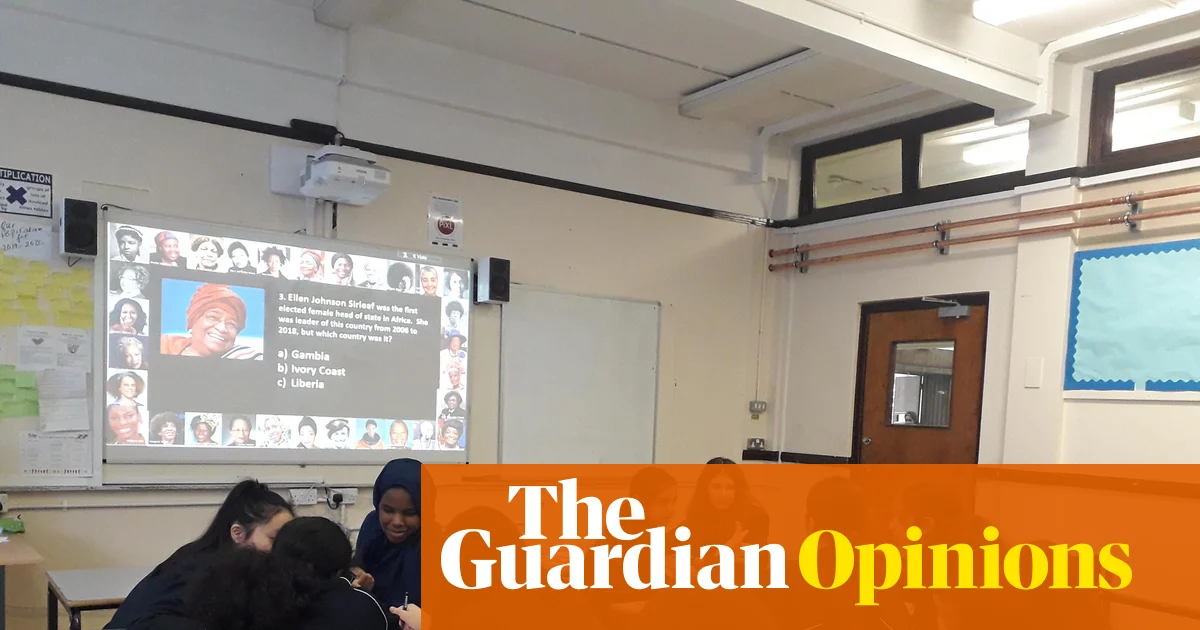
I often think back to my years as a secondary school history teacher, and to what I was and wasn’t able to teach. History is a foundational subject in England, taught to children from the age of five to 14 to build critical thinking, weigh evidence and help pupils understand the world they’ve inherited.
The key stage 3 national curriculum, covering ages 11 to 14, states that pupils should understand how “Britain has influenced and been influenced by the wider world”, including a historically grounded understanding of empire.
That standard was on my mind as I trawled through the recently published Register of British Slave Traders, read the names commemorated in the Great Hall atBarts hospital, and followed our series Enslaving Nation as it traced connections to enslavement across the church, the monarchy and the banking system.
Soon after, the Former British Colonies Enslavement Registers made the records of 4 million enslaved people across 20 former colonies searchable to the public for the first time, a searing record of how enslavement irreversibly altered lives across the former empire.
Britain’s transatlantic trafficking of Africans and much of its imperial history sits as non-statutory content in the current national curriculum, included to preserve choice. But the evidence keeps mounting that enslavement was so embedded in British society that choice is the wrong framework. In my experience, non-statutory becomes optional within a term, and optional is quickly recoded as sacrifice-worthy. Teachers end up teaching the history they can defend, not the history that matters.
In November 2025, the government’s curriculum and assessment review was published. It recommended clarifying what counts as statutory and non-statutory, so teachers understand exactly how much optionality they’re working with, before a new national curriculum due next spring. The government’s response promises to “strengthen” the teaching of the country’s history, and to let teachers reflect Britain’s Black history within it.
Take, for example, Elizabeth I’s resistance to the Spanish Armada in 1588, a mainstay of English history. Two decades earlier, the same monarch had funded John Hawkins’s voyages along the west African coast, among the earliest English expeditions into the slave trade. Teach the armada without Hawkins and you keep the crown’s ambition, but you lose where a bulk of its money came from.
A teacher trying to build a class of intellectually curious students who are keen to learn about enslavement and its legacies has to find the lesson time, build the resources, and defend every hour spent on it. The government’s own response concedes the pressure, citing curriculum overload as grounds to loosen what’s compulsory. The Holocaust remains the only topic children in England must study between the ages of 11 and 14. In Wales, by contrast, learning about Black, Asian and minority ethnic histories has been mandatory since the current curriculum was introduced in 2022.
Black History Month in some settings exists precisely because of this gap, an annual fix for a curriculum that doesn’t otherwise make room. The Black Curriculum, founded in 2019 to get British Black history taught year-round, provided a wake-up call regarding the knowledge gaps around the lives of Black people on these isles.
Those initiatives have not always been popular in political circles. In 2021, the then schools minister Nick Gibb defended the government’s decision not to make lessons on empire and the slavery compulsory, triggering criticism. The leader of the Conservative party, Kemi Badenoch, continues to say Britain ultimately led the fight to end the slave trade and that’s where the focus should be. A month, or a bolt-on curriculum, however well meant, risks treating this history as an addition to the national story rather than part of it. The fix for optionality can’t itself be optional.
after newsletter promotion
The history survives in today’s context where an individual teacher is stubborn enough to protect it. I read scheme after scheme of work marking whole periods “optional” or “if time allows”. If you hail or have heritage from a Commonwealth country, you have probably encountered scholarship that adequately contextualises and foregrounds how imperial history is central to British history – that cannot be omitted. The Guyanese historian Walter Rodney argued that Europe didn’t simply fail to develop Africa, it drained it. Howard W French, the US journalist and author, argues that Africa and its people were central to the making of the modern world, not marginal to it. And in addition to these foundations, undeniable feats of research are adding intellectual weight to arguments around what should be covered.
None of it changes the basic fact: enslavement is a load-bearing wall in Britain’s story. Remove it and the country becomes unexplainable – the wealth of its ports, the reach of its empire, the shape of its economy. To make that history elective is to make the explanation itself optional.
No wonder critics would rather toast the abolitionists than audit the traders who came before them. I rarely got to choose. The curriculum did that for me.
