


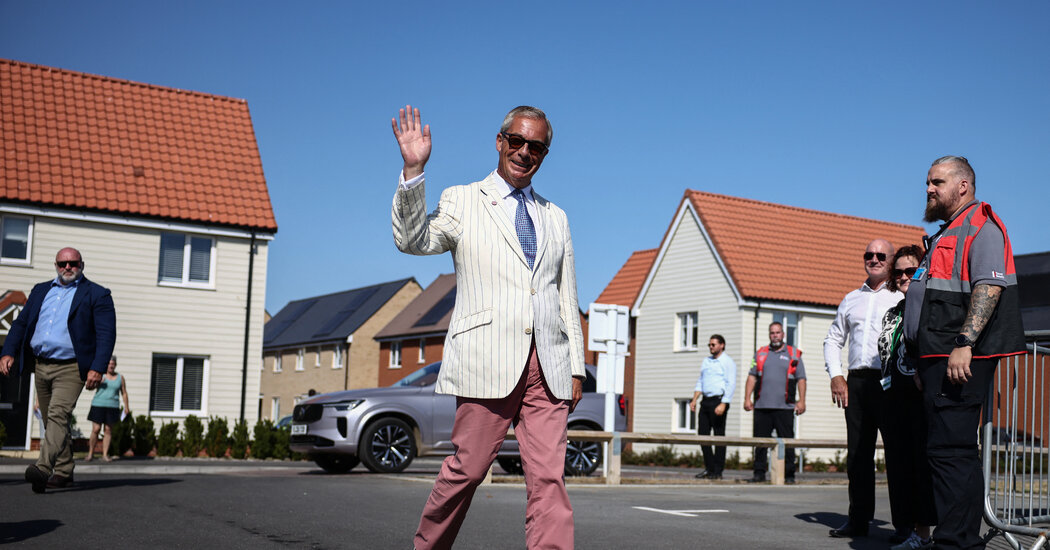
Nigel Farage, Britain’s leading right-wing politician, faced a dilemma last month.
What do you do when the inquiries and accusations are piling up? The police are looking into one of your donors. You are being investigated for potentially breaking Parliament’s rules because you didn’t report a £5 million gift. The news media are publishing new allegations almost daily.
For Mr. Farage, the leader of the Reform U.K. party, the answer appears to have been clear: Attack your critics, undermine the regulatory or judicial processes by labeling them illegitimate before they conclude, and seek pre-emptive absolution from “the people” — your most loyal supporters.
He was borrowing a page from a playbook honed over the years by other embattled populists like President Trump, Marine Le Pen, the French far-right leader, and Benjamin Netanyahu, the Israeli prime minister. Mr. Farage resigned his parliamentary seat and immediately ran for it again in the resulting special election.
On Friday, he declared himself completely vindicated by his victory in the contest in Clacton, in eastern England.
“I wanted the people of Clacton, the voters of this constituency, to be my judge,” he said in an early-morning victory speech while votes were still being counted. “Not the mainstream media in Britain and the political establishment who paint us out to be criminals and bad people every day. I asked the voters of Clacton to be my jury, and the verdict has now come in.”
The result was hardly surprising. Mr. Farage won in a safe Reform U.K. seat, collecting 63 percent of the vote in an election that all the other major parties boycotted and called a stunt. His main challenger? A novelty candidate called Count Binface, who wears a trash can over his head.
The question now is whether the gambit will work, or whether British voters outside of his party’s core base will continue to pay attention to the questions swirling around Mr. Farage about donations and expensive gifts. In the weeks since revelations about his undisclosed benefits were first published in The Guardian and The Sunday Times, his personal poll ratings have fallen, and Reform’s position in national polls has slipped.
Within hours of his speech on Friday, the office of the parliamentary standards commissioner restarted its investigation into Mr. Farage’s failure to declare the 5 million pound gift (about $6.7 million) from a British crypto-billionaire based in Thailand. (Mr. Farage has said he didn’t need to register it because it was a personal gift given before he was a member of Parliament.)
Yet Mr. Farage has proved to be a resilient political survivor who successfully tapped into public anger about successive British governments. His decades-long campaign to limit immigration remains one of the most potent issues in the country, and Reform is still polling within the margin of error of the governing Labour Party and above the Conservatives.
And he is not wrong to notice that the go-on-the-offense political strategy has worked well for several of his peers across the world who, like him, have denied any wrongdoing.
Take Mr. Trump. After leaving office in 2021, he faced a battery of criminal charges and civil lawsuits for accusations including falsifying business records, illegally retaining documents containing national security secrets, trying to reverse the results of the 2020 election, and sexual abuse and defamation.
Mr. Trump railed about the “witch hunts” being conducted by the “establishment” and accused the news media of being the “enemy of the people.” He said judges, prosecutors, F.B.I. agents, intelligence officers and election officials were all corrupt or incompetent — or both.
But most of all, he insisted that none of it would matter to the American voters.
“Your victory will be our ultimate vindication, your liberty will be our ultimate reward and the unprecedented success of the United States of America will be my ultimate and absolute revenge,” Mr. Trump said on the campaign trail in 2024.
By November 2024, when more than 77 million people chose to return Mr. Trump to office, most of the criminal and civil charges against him had either stalled, been dismissed or been nullified by the Supreme Court.
Tony Travers, a professor of politics at the London School of Economics, said Mr. Farage and his allies are betting that he can convince the British public to see the Reform leader in the same way that many Americans see the president — as a victim of unfair persecution.
“That is pretty similar to Donald Trump, it seems to me,” Mr. Travers said. “That people are prepared to overlook all the cryptocurrency stuff and the self-enrichment that’s going on, because somehow he’s different, he’s an outsider.”
In France, Ms. Le Pen was found guilty last year of embezzlement by a criminal court and barred from running for public office for five years. She called the ruling a “political” attempt to thwart her.
“I’m not going to submit to a democratic denial so easily,” Ms. Le Pen added.
When the five-year ban on running for office was lifted by an appeals court last month, she immediately declared: “This evening, I am a candidate in the presidential election.” Like Mr. Trump, she is betting that voters in a national election will look past her legal troubles.
On Friday, Jordan Bardella, a protégé of Ms. Le Pen and the president of their National Rally Party, congratulated Mr. Farage on his victory, writing on social media: “Nigel Farage had the courage and dignity to submit himself once again to the judgment of the voters, the sole masters in a democracy.”
Mr. Netanyahu, Israel’s longest-serving leader, has used similar political tactics to try to undermine bribery and corruption charges that were leveled against him years ago.
He was indicted in 2019 on charges of giving or offering lucrative favors to several media tycoons in exchange for favorable news coverage or gifts worth hundreds of thousands of dollars. He appropriated one of Mr. Trump’s favorite phrases, calling the corruption investigations a “witch hunt,” as well as “a joke” and “an absurdity.”
But in 2022 he was re-elected as prime minister in what he characterized as a total rejection of the charges against him.
“We have won a huge vote of confidence from the people of Israel,” he said.
It remains to be seen whether Mr. Farage’s attempt to appeal to “the people” over the outcome of the investigations will succeed in Britain.
His by-election victory on Thursday was in a tiny, Reform-friendly corner of the country, hardly a nationwide referendum on his actions. And, as a general election does not have to be held until 2029, it may be some time before we find out.
