


Stay informed with free updates
Simply sign up to the Fintech myFT Digest — delivered directly to your inbox.
As the Brics leaders meet in New Delhi, one bright spot for the disparate group of economies is the success of its members’ domestic instant payments systems — which are increasingly linking across borders.
Over the past 18 months, instant payment systems inside the 11-member bloc have handled more than $10tn in transactions, and are surpassing US rivals such as Mastercard and Visa in some of the world’s biggest markets, though cross-border use remains small.
India’s UPI and Brazil’s Pix — government-backed systems that transfer money from account to account without relying on debit or credit cards — now have more than 550mn and 170mn users respectively and are exploring link-ups with central banks overseas. That could help them to increase cross-border payments and find solutions to problems such as quickly converting currencies.
“Wherever Indians live in large numbers, wherever India trades on a large scale, whichever country is ready to walk with us — we must work to connect them all,” Prime Minister Narendra Modi said this week in a speech marking UPI’s tenth anniversary of operation.
When the original four Brics members — Brazil, Russia, India and China — first met in 2009, creating a new global reserve currency to rival the US dollar was a central goal of the group. It is one that remains elusive.
One obstacle is that Brics is far from being a unified monetary bloc, as a largely incompatible mix of currencies with capital controls or mostly fixed exchange rates, such as China’s renminbi, and others that are mostly freely traded, such as the Brazilian real.
As a result, it is difficult to convert transactions from one currency to another at speed without routing into the more liquid market for US dollars as an intermediate step.
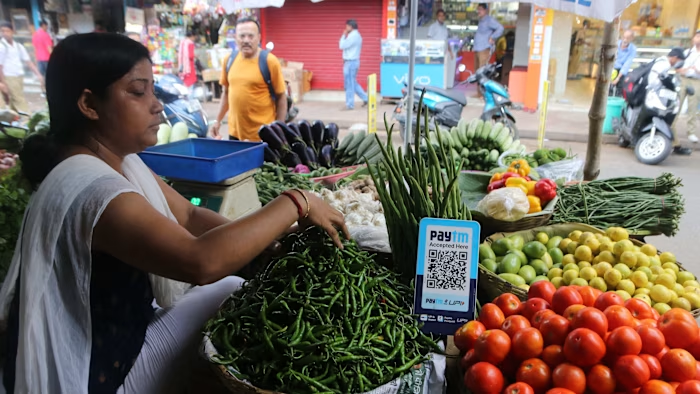
But domestic instant payment systems, which often use a QR code or an ID tag to send money in real time, have surged in popularity and are starting to link across borders. This is adding to the pressure to find solutions for converting currencies and settling payments at speed.
Pix processed payments worth more than $6.8tn last year, while UPI handled $3.4tn in the year to the end of March, according to official data. Every time officials from the Brics nations break from the talks this weekend to buy a coffee or go to a restaurant, they will encounter UPI.
While only a tiny share of the 30tn rupees ($315bn) that UPI processed in August crossed India’s borders, countries from the UAE to Sri Lanka have shown interest in accepting its payments. Singapore’s payments system has integrated UPI since 2023.
The European Central Bank is working on a project to link Europe’s TIPS instant payment platform to UPI, with a pilot planned for the first half of next year, and preliminary studies are also under way about a potential link with Pix, according to an ECB presentation. The Brazilian central bank did not respond to requests for comment.
Pix has become the most popular form of electronic payment in Brazil by number of transactions since it was launched nearly six years ago, including paying for online services offered by global companies.
“When a Google, a Meta, Netflix [or others] come to Brazil they need to accept local methods,” said João Del Valle, chief executive of EBANX, a cross-border payments platform specialising in emerging markets. With recurring payments for subscriptions and other features now embedded in Pix, “it’s pretty straightforward”, he added.
A diplomat from a Brics country said that discussions in the group about integrating payment systems were “still incipient”.
“They’re moving in a direction of facilitating co-operation between those payment systems [in] each country’s own currencies,” they added. “It will also depend on the will of the private sector and contracts drafted for exports.”
Trade imbalances also impede deeper currency linkages. India is increasingly paying for Russian crude in its own currency, but Moscow has scant use for the rupees as it buys little from India in return.
If central banks found an alternative settlement mechanism or common reference asset — which analysts have suggested could be linked to gold or a basket of currencies — it could anchor links between these fast-growing systems for lots of small instant payments as well as large transfers for bilateral trade. In theory, this would operate faster than the current set-up and would be less dependent on western systems.
The US has accused the Brics of promoting de-dollarisation, which members such as India deny.
“This is where a lot of the opportunity lies, and where countries would love to have that flexibility to do bilateral transactions without involving anyone else . . . international settlement is probably the most important thing,” Del Valle said.
