


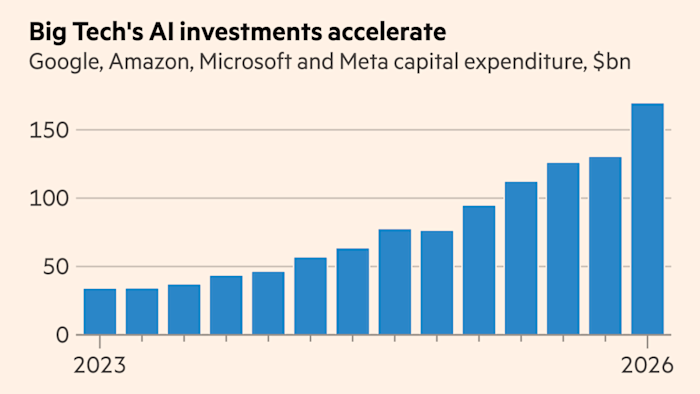
The four big hyperscalers have ploughed more than $1tn into capital investments since their race to dominate AI began three and a half years ago, as America’s largest tech groups bet their future on the technology.
Combined capital spending by Google, Amazon, Microsoft and Meta from the beginning of the AI boom in 2023 to the end of June hit $1.1tn, according to earnings reports from the four companies in the past two weeks.
The massive expenditure is a mark of both the scale of their AI ambitions and the speed with which the US tech giants have turned from capital-light businesses into huge investors in physical infrastructure.
“There is basically no end in sight for the growth in capex,” said Rishi Jaluria, an RBC Capital analyst. “Investors need these companies to toe the tight line between investing in AI and not compromising the things that have made them successful.”
The four companies combined plan to spend $745bn on capex, mainly data centres, advanced chips and the power to run them this year, after both Google and Amazon increased their projections this quarter.
The success of this bet remains partly contingent on the ability of start-ups OpenAI and Anthropic to keep raising funds to meet vast, multiyear commitments to buy computing power, as both AI labs plot their public listings.
The rush of investment has strained supply chains and driven up costs, causing a shortage of memory chips, which hurt Apple, even as the iPhone maker sits out the AI race. Its warnings of lower sales and margins due to cost increases sent the stock falling 6.3 per cent on Thursday.
But Big Tech’s financial results showed these investments are beginning to translate into accelerating revenue growth, particularly in cloud computing.
Google, Amazon and Microsoft all reported rising growth in their cloud units, selling computing power to everyone from OpenAI and Anthropic to corporations embracing AI. The figures boosted Amazon and Microsoft stock.

Meta, which does not have a cloud business, said AI was helping it to target advertising, with total revenue up 28 per cent year-on-year to $61bn in the quarter.
CEO Mark Zuckerberg hinted at a leap into leasing out data centre space, telling investors that Meta was fielding “a large number of offers” to rent out its compute “at a meaningful premium over what we paid”.
He added, however, that “there will continue to be a significantly higher margin on selling intelligence rather than selling compute directly”.
Dec Mullarkey, managing director at asset management firm SLC Management, said the lack of a clear plan from Meta to rent out computing power was partly responsible for its 8 per cent share price decline on Thursday after earnings. “They are a bit all over the place,” he said.
“For investors it’s no longer growth at any cost, they want to see the spending flowing through to results, like at the Big Three,” he said, referring to Google, Microsoft and Amazon.
The search giant’s cloud business added $11bn of revenue on last year’s sales, but investors still sold off shares as it reported its first quarter burning cash since going public over two decades ago, posting negative $6bn of free cash flow for the period.

Google, like its peers, also disclosed huge increases in its future financial commitment linked to AI investments, which ballooned by about $500bn from three months before. The bulk of the new contracts involve long-term purchase commitments for technical infrastructure, as well as energy for data centres.
Meta signed $233bn of new commitments in the quarter. The additions include $96bn in leases for data centres and network infrastructure that will move on to its balance sheet as they come into use, $112bn in purchase commitments, mostly for third-party cloud capacity servers, and other infrastructure, as well as $25bn in new debt.
The group then added another $68bn in data centre leases in July.
Microsoft, meanwhile, signed more than $130bn of new data centre leases in the second quarter in a huge expansion of its commitments.
Together the three companies agreed close to $900bn of new AI-related obligations in the three-month period alone, binding their balance sheets to the AI race for years to come. Amazon has yet to post these detailed disclosures.
Several top executives acknowledged to analysts that the outlay on AI would continue to sap free cash flow in coming quarters. The free cash flow metric is closely watched as a measure of the cash companies have left to service debt or return to shareholders after covering their operating costs and capital spending.

The four groups’ combined free cash flows fell to a decade low of just $7bn during the period, with only Microsoft and Meta bringing in more than they spent.
Amazon chief Andy Jassy told investors that the group would have to absorb free cash flow pressures for some time as it raced to build “many data centres simultaneously” with a two-year lag from commissioning a facility to installing servers that enabled it to charge customers.
“In the short term . . . we’ll spend a lot of capex and encounter free cash flow headwinds until these data centres come online,” he said.
The significant lag between Big Tech’s massive upfront data centre investment and any associated revenue means that investors who have proven fickle in recent weeks amid an AI-led rout will have to be prepared to wait years for meaningful returns on their investment.
“Investors are being forced to rethink their own timelines,” Jaluria at RBC added.
