


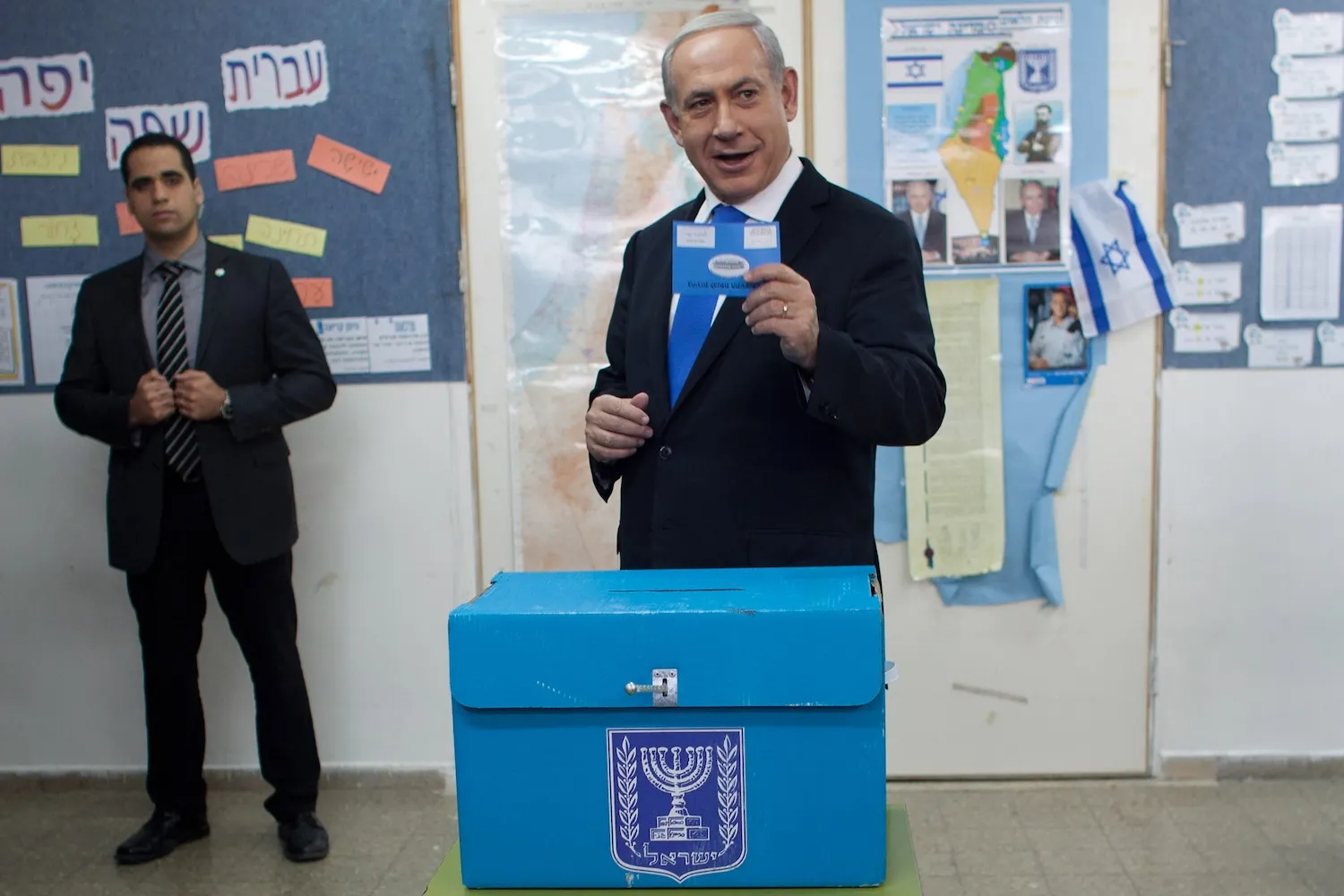
Israel is heading into what may be the most pivotal election in its history, but at stake this time isn’t so much its conflict with neighboring countries or its relations with the Palestinians. The core issue in this vote, slated for Oct. 27, is whether Israel will remain the liberal democracy its founders envisioned when it was established in 1948, or move even more vigorously toward a kind of illiberal regime infused by Orthodox Judaism.
After presiding over a series of center-right governments for 12 years, Israeli Prime Minister Benjamin Netanyahu took an abrupt rightward shift when he returned to power in 2022 in a coalition with far-right and ultra-Orthodox (Haredi) parties. It soon emerged that his government had two primary goals. The first was to undercut the powers of an independent judiciary and vastly increase those of elected politicians, a plan quietly built on the assumption that, as in the case in other illiberal democracies, those in power would remain so because elections would cease to be entirely free and fair. The second was to give a greater role to the Jewish religion in the public space and provide massive financial, legal, and moral support for West Bank settlers. It was accompanied by ever-bigger government handouts and increased privileges for the Haredi community, most prominently a (so far failed) effort to enshrine in law the ultra-Orthodox’s traditional exemption from military service.
Israel is heading into what may be the most pivotal election in its history, but at stake this time isn’t so much its conflict with neighboring countries or its relations with the Palestinians. The core issue in this vote, slated for Oct. 27, is whether Israel will remain the liberal democracy its founders envisioned when it was established in 1948, or move even more vigorously toward a kind of illiberal regime infused by Orthodox Judaism.
After presiding over a series of center-right governments for 12 years, Israeli Prime Minister Benjamin Netanyahu took an abrupt rightward shift when he returned to power in 2022 in a coalition with far-right and ultra-Orthodox (Haredi) parties. It soon emerged that his government had two primary goals. The first was to undercut the powers of an independent judiciary and vastly increase those of elected politicians, a plan quietly built on the assumption that, as in the case in other illiberal democracies, those in power would remain so because elections would cease to be entirely free and fair. The second was to give a greater role to the Jewish religion in the public space and provide massive financial, legal, and moral support for West Bank settlers. It was accompanied by ever-bigger government handouts and increased privileges for the Haredi community, most prominently a (so far failed) effort to enshrine in law the ultra-Orthodox’s traditional exemption from military service.
In the meantime, the government has allowed or even facilitated spiraling settler violence against Palestinians in the West Bank. National Security Minister Itamar Ben-Gvir has tried with much success to turn the national police into a political tool, cracking down on anti-government protesters and giving free rein to settler attacks. Defense Minister Israel Katz has sought to do the same with the army.
Along the way, Netanyahu adopted an approach to politics designed to delegitimize the opposition and government institutions—similar to that of U.S. President Donald Trump. Although Netanyahu is less mocking and his public remarks more coherent, that is not so for his cabinet ministers, lawmakers, and social media network—which do his dirty work. He has not only cowed the opposition but also rivals inside his Likud party and government institutions ranging from the courts to the army.
The Netanyahu government’s marquee project vis-à-vis the judiciary was the plan unveiled by Justice Minister Yariv Levin just days after taking office to limit the Supreme Court’s judicial review powers, give politicians control over judicial appointments, and limit the authority of its legal advisors. The plan was never fully realized because it was met with massive street protests, court rulings striking down parts that the Knesset had approved, and the war that followed Hamas’s attack on Oct. 7, 2023. But the government never abandoned it and capped its last months in office with a legislative blitz that won Knesset approval for facets of the judicial overhaul proposal and favors to the Haredi minority.
Millions of Palestinians in the occupied West Bank and Gaza have none of the rights extended to Israeli citizens. But democratic norms remain the rule inside Israel itself, despite the pressure they have come under in the past four years. If the Netanyahu government remains in power after the upcoming election, then it’s safe to assume that it will feel entirely unconstrained—much the way Trump has blown through governmental norms and conventions in his second term. After all, what could serve as better proof that Netanyahu’s plans to remake Israel have the public’s support?
Israel’s parliamentary opposition, including leftist, centrist, and right-wing parties, as well as two factions representing the Arab minority, has been largely ineffective throughout this period. It never offered a coherent alternative, nor was it able to block the government’s agenda in the Knesset. Yet as bloodless and fractious as it is, the opposition supports judicial independence, opposes the politicization of the army and police, is appalled by settler violence in the West Bank, and has no truck with Haredi privilege, like the draft exemption. An election-day victory for the opposition is the only way to stop Israel’s march to illiberal democracy.
But can it prevail in the election? The opposition’s leadership challenge seems to have been solved. Gadi Eisenkot, a former army chief of staff, has been rising steadily in the polls to the point where his Yashar party is now the biggest vote-getter among opposition parties by far. Indeed, it is running neck-and-neck with Netanyahu’s Likud. In many respects, Eisenkot is a strong candidate. He has the military credentials that many voters regard as a sine qua non for high office. He comes from a working-class, Moroccan immigrant background, which should appeal to voters with similar Middle Eastern or North African roots who traditionally vote Likud. He lost his son and two nephews in the war in Gaza. Eisenkot has kept his political stance close to his chest, but his record as chief of staff, public remarks, and party platform suggest that he is a little left of center.
That said, the opposition has two problems. The first is that Eisenkot’s meteoric rise in the polls may not reflect deep support among his voters, many of whom appear to come from the moderate right and may yet drift back to the Likud. Netanyahu is working to upgrade the Likud’s image by peppering the party’s slate with more respectable candidates than the vulgarians and yes-men that currently fill the party’s Knesset ranks. Recently, he has promised to enforce conscription of Haredim, an issue that has hurt him even among his most loyal supporters.
The second problem is that Eisenkot has pledged to include only Zionist parties in his governing coalition—rejecting Arab-led parties as potential partners. Without at least one of them, such as the more moderate Ra’am party, Eisenkot would likely fail to amass a clear-cut Knesset majority, according to polls.
Eisenkot’s rise may have maxed out the opposition’s potential to draw more votes away from the Netanyahu bloc. A poll conducted by the Jewish People Policy Institute in July found that 82 percent were already “completely” or “fairly” certain which party they were voting for. Among the rest, most were likely debating which party within the two blocs they would support, not about whether to cross lines. Like elsewhere in the world, tribal politics have grown so strong in Israel that large numbers of voters will stick to their camp, even if their leaders aren’t performing. Netanyahu’s campaign plays to that by invoking the dangerous “leftism” of his rivals.
Finally, there are signs that Netanyahu and his coalition plan to wage a dirty campaign. President Isaac Herzog has warned about election violence and intimidation. Others are worried that the politicized police and perhaps the Shin Bet security service will look the other way or even help the government intimidate its critics. If all else fails, Netanyahu and his allies may contest the results. It’s not clear how the opposition could stop them.
Surprisingly, the security issues that preoccupy the rest of the world (and Israelis, as well) are less likely to factor in the election. It’s not that Netanyahu’s forever wars are seen as a stunning success. Successive polls show that voters do not think the country is more secure, particularly after the Iran war. Yet, across the political spectrum, Oct. 7 has left so deep a scar that many Israelis believe the country has no choice but to pursue its enemies aggressively or risk another massacre. Their tolerance for failure is high. As a result, the opposition can only nip at the edges of Netanyahu’s policies.
Nevertheless, it is reasonable to assume that there will be some change on the security front. In Gaza, a government led by Eisenkot would no longer pursue the far right’s dreams of expelling the Palestinians and rebuilding settlements. Israel will likely end its unrelenting attacks and may even pull out its troops. Gaza’s reconstruction may move forward under a new Israeli government, if Hamas agrees to something approaching disarmament. In Lebanon, where Israel occupies a security zone in the south, the new government will face the same dilemma as the old one, namely that pulling out troops would enable Hezbollah to threaten Israel’s north. Nevertheless, the new government will likely give Trump’s peace plan a more serious try and stage at least limited withdrawals. The Iran theater is no longer Israel’s to decide on: By bringing the United States into the war, Israel has forfeited control.
In the West Bank, the wave of settler violence and settlement-building will be tamped down but not eliminated. The extremist wing of the settlement movement has become too powerful and rooted. In any case, there will be no movement toward a two-state solution. Oct. 7 buried the idea of Palestinian statehood for the foreseeable future, and neither Israel nor Trump’s Washington is interested.
