


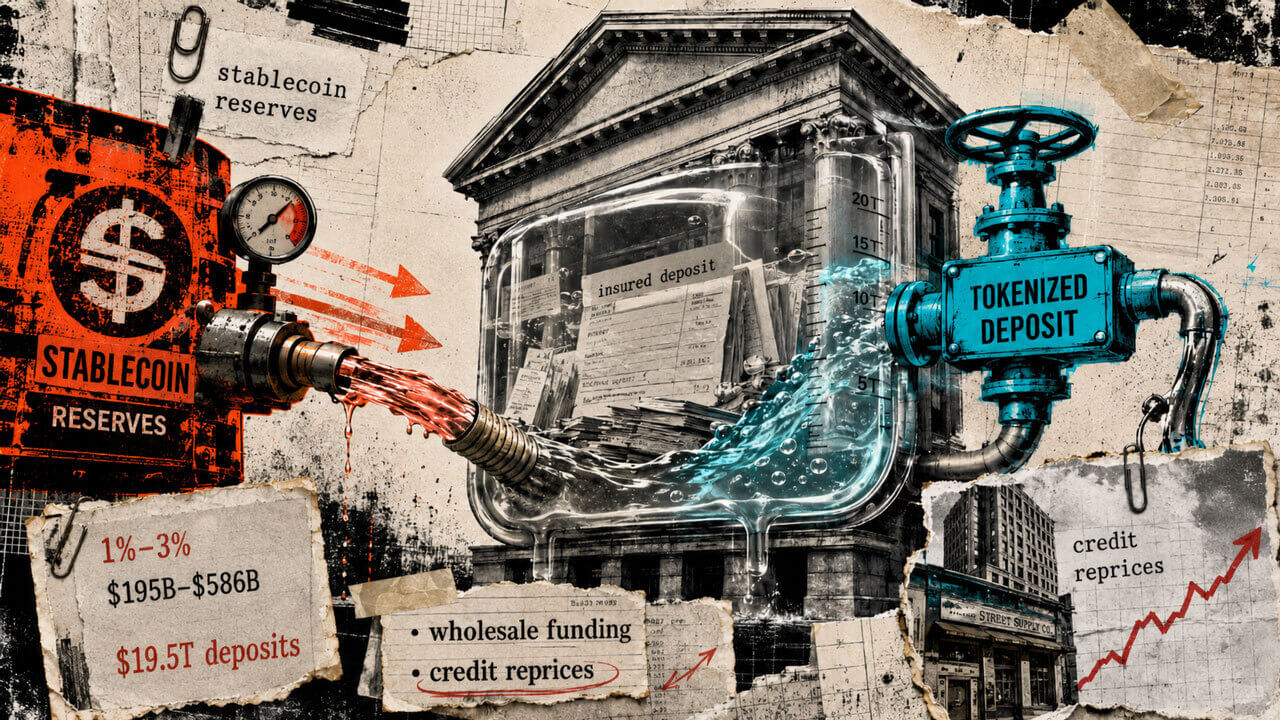
Banks defend themselves against stablecoins by saying they are building tokenized deposits to modernize payments, with programmable money and around-the-clock settlement.
Falcon Finance chief RWA officer Artem Tolkachev told CryptoSlate that the explanation covers only half the reason:
“It is the balance sheet, not the technology.”
A tokenized deposit keeps the money a stablecoin would move off a bank’s balance sheet, leaving it as a deposit the bank can still lend against. Tolkachev said:
“A stablecoin competes with the deposit. A tokenized deposit is the deposit, just programmable.”
Underneath stablecoins and tokenized deposits
Tolkachev said that, to whoever is holding them, a tokenized deposit, a reserve-backed stablecoin, and an overcollateralized synthetic dollar look identical.
In the case of a tokenized deposit, the $100 million sits on one bank’s balance sheet. The bank earns the return by lending it out, and the holder carries that bank’s credit risk, though the position still counts as an insured deposit.
The FDIC’s position backs that reading, saying tokenization changes a deposit’s form while leaving its substance intact.
In a reserve-backed stablecoin, the money moves into the issuer’s reserves, and the issuer earns the yield on those reserves. The holder carries the issuer’s operational and reserve risk with no claim on the upside, since the GENIUS Act bars issuers from paying that yield to holders. No deposit insurance sits behind the position.
In an overcollateralized synthetic dollar, the token is backed by more collateral than its face value, held apart from the issuer. The return depends on how that collateral is managed, and the holder’s protection comes from the size of the overcollateralization and the separation between custody and the issuer itself.
Tolkachev noted that this is the “same face value” with “three different risk owners,” adding that the key question is where the money sits and who can touch it.
| Digital dollar format | Where the $100M sits | Who earns the economics | What the holder relies on |
|---|---|---|---|
| Tokenized deposit | On the issuing bank’s balance sheet | The bank, through lending and balance-sheet use | Bank credit, supervision, and applicable deposit insurance |
| Reserve-backed stablecoin | In the stablecoin issuer’s reserve assets | The issuer/reserve structure | Reserve quality, issuer operations, and redemption process |
| Synthetic dollar | In a separate collateral/custody structure | Depends on the collateral strategy | Overcollateralization, custody separation, and liquidation mechanics |
The fight is over funding, and it starts before deposits leave
The Dallas Fed said in July that a deposit token stays a commercial-bank deposit, remains on the issuing bank’s balance sheet, settles at par, and sits inside the same supervisory framework as any other deposit.
The FDIC’s April proposal stated that deposits held as stablecoin reserves would be insured to the stablecoin issuer as a corporate deposit, with individual stablecoin holders carrying no pass-through insurance claim of their own.
Deposit insurance itself should apply the same way regardless of which technology records the underlying deposit liability.
Tolkachev also argued that, if stablecoins pull deposits away from banks, the first effect is higher funding costs, and it shows up before anyone notices deposits leaving. A bank that loses cheap, sticky deposit funding has to replace it with pricier wholesale money to keep lending at the same level, compressing margins before lending itself gets cut back.
He added that the pattern is “argued over more than measured,” with current research treating it as a plausible channel still awaiting real documentation.
Both the Federal Reserve and the Bank for International Settlements have separately identified the same mechanism, tying stablecoin-driven deposit migration to higher funding costs and, eventually, loan repricing.
Tolkachev said:
“This is a fight over the cheapest liability in the system, and the cost of credit is downstream of who wins it.”
Wells Fargo announced plans in early August to launch tokenized deposits for corporate and commercial clients this fall, starting with USD-to-GBP transactions before expanding further in 2027.
The bank says the product will carry the same regulatory protections and deposit-insurance eligibility as its existing deposit products.
JPMorgan already runs JPM Coin as a deposit token on the Base blockchain, letting institutional clients move money and post collateral on public rails while the underlying balance stays a commercial-bank deposit.
| Step | What changes | Why it matters |
|---|---|---|
| 1. Customer money leaves deposits | Cash moves from bank deposits into stablecoin reserves | Banks lose cheap, sticky funding |
| 2. Bank replaces funding | Wholesale or market funding fills the gap | Replacement funding is typically more expensive |
| 3. Margins compress | Net interest margin comes under pressure | Lending becomes less profitable |
| 4. Credit reprices | Banks charge more or tighten standards | Borrowers feel the impact downstream |
| 5. Banks respond | Tokenized deposits offer programmable money without losing deposits | The product becomes defensive, not just innovative |
Which side of the balance sheet wins the next few years
Tolkachev said that a stablecoin still makes more sense for money that needs to move, cross-border, around the clock, into onchain settlement or between counterparties instantly.
A bank deposit still makes more sense for money that needs to sit, with insurance, a lending relationship and a balance sheet behind it.
He said:
“Most treasurers will use both, matched to the job.”
Tolkachev also warned that a bank deposit comes with a lender assessing risk and a regulator watching the reserves behind it. A stablecoin hands over a dollar without that machinery, which is why it moves faster and why a treasurer should check the collateral behind it before trusting the yield on it.
The bull case has large banks building interoperable tokenized-deposit networks that keep corporate treasury balances inside bank rails, adding 24/7 programmable settlement without giving up the underlying funding.
In that scenario, tokenized deposits become the banking industry’s real answer to stablecoins, matching the technology while keeping the deposit base that funds their lending.
| Use case | Stablecoin advantage | Tokenized deposit advantage |
|---|---|---|
| Cross-border payment | Fast, 24/7, easier onchain movement | Strong if bank networks become interoperable |
| Corporate treasury reserves | Less natural unless funds need to move quickly | Better fit for money that needs to sit with a bank relationship |
| Onchain settlement | Stronger current interoperability | Useful where counterparties accept bank deposit tokens |
| Collateral movement | Fast and composable | Strong for regulated institutional workflows |
| Cash-like holding | Depends on reserve quality and redemption confidence | Backed by bank balance sheet, supervision, and deposit treatment |
The bear case has even a modest 1% to 3% move out of US commercial-bank deposits, worth roughly $195 billion to $586 billion against the current $19.5 trillion deposit base. That capital moves into stablecoins faster than tokenized deposits can hold the line.
Under that path, funding costs rise first, margins compress, and loan repricing follows. The market is starting to treat stablecoins as a genuine threat to the liability side of bank balance sheets, well beyond their current reputation as a payments product alone.
Banks are building tokenized deposits because stablecoins proved what a programmable dollar can do for customers. The fight now underway is over which side of the transaction gets to keep the money while it waits.
