


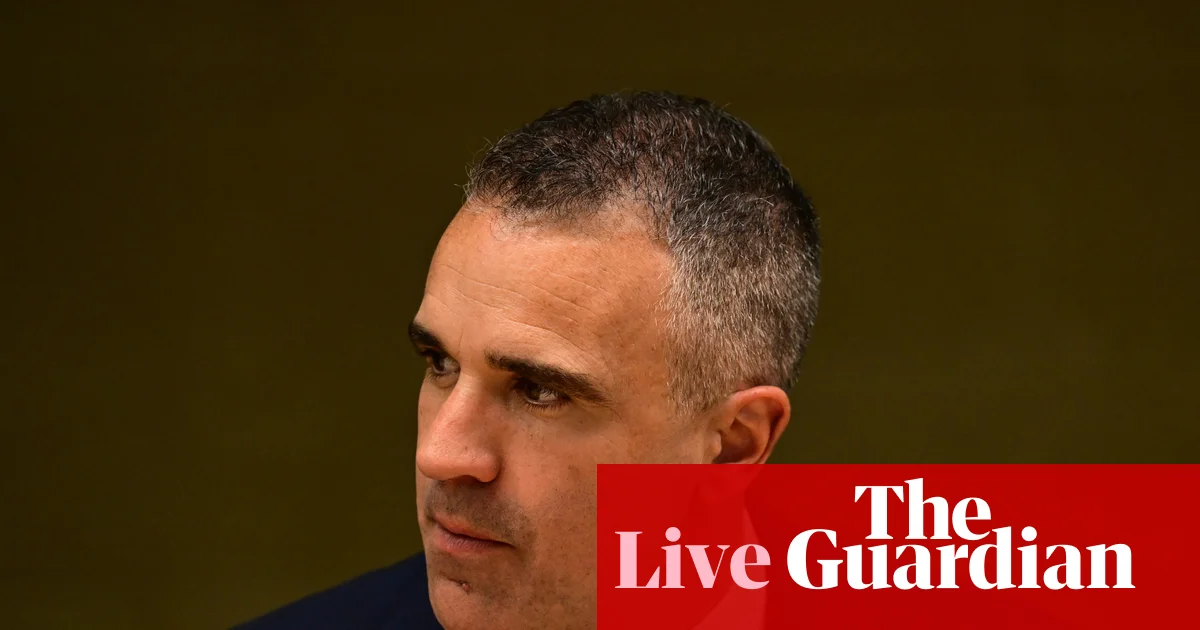
Don’t appease One Nation on migration, Malinauskas warns
The South Australian premier, Peter Malinauskas, has iwarned the Albanese government not to join the “madness” of cutting migration to appease One Nation.
In a speech in Sydney last night, Malinauskas – whose grandparents migrated to Australia after the second world war – said the wave of populist politics has “more than arrived in Australia”, but the government should push back.
Above all else, [we must] preserve our strong migration program … The correct political response to anti-immigration politics and populists is not appeasement.
More troubling is the prospect of mainstream politics entering a political race to the bottom for who can cut migration numbers the most. This is not unfortunate – this is madness.
There could be no greater act of national economic self harm at this time than to slash migration numbers for political purposes.
He also warns against cutting international student numbers, calling it “crazy”.
Imagine if we did this to the mining industry, there world be an ad on every television station and mobile phone about how we’re killing the goose that lays the golden egg. It is crazy.
Key events
‘We need to explain Australia doesn’t have a migration crisis’: Malinauskas
Peter Malinaukas says he understands the concerns of Australians worried about migration and the housing shortage in Australia, but that the answer is politicians need to explain there is a housing crisis not a migration crisis happening.
He tells the ABC’s AM program that Australia will soon have more people over 65 than under 15 and migration will be essential to replace the ageing workforce.
We need to explain that Australia doesn’t really have a migration crisis so much as a housing crisis. If we have a housing crisis, we would do well to focus our skills policy on making sure that we’re bringing in the very workers that we require in the housing construction industry. You know, Australia’s got a massive shortage of almost every trade.
Everyone, I think, accepts that it needs to be a well-calibrated, balanced migration program. My point is that we haven’t seen much evidence in the political discourse in this country in the last few years making the case for migration. Just to be seeing be a lot of culture wars being executed against migration. And I think that’s self-defeating, and we’ve got a responsibility to stand up against it.
But when asked what the magic number is for a well-balanced migration program, Malinauskas won’t say.
Instead of coming up with an arbitrary number and then cutting different parts of the migration program, Malinaukas says governments should work from the ground up, determining the skills shortages, and growth in regional areas, and then coming up with a target.
Don’t appease One Nation on migration, Malinauskas warns
The South Australian premier, Peter Malinauskas, has iwarned the Albanese government not to join the “madness” of cutting migration to appease One Nation.
In a speech in Sydney last night, Malinauskas – whose grandparents migrated to Australia after the second world war – said the wave of populist politics has “more than arrived in Australia”, but the government should push back.
Above all else, [we must] preserve our strong migration program … The correct political response to anti-immigration politics and populists is not appeasement.
More troubling is the prospect of mainstream politics entering a political race to the bottom for who can cut migration numbers the most. This is not unfortunate – this is madness.
There could be no greater act of national economic self harm at this time than to slash migration numbers for political purposes.
He also warns against cutting international student numbers, calling it “crazy”.
Imagine if we did this to the mining industry, there world be an ad on every television station and mobile phone about how we’re killing the goose that lays the golden egg. It is crazy.

Krishani Dhanji
Good morning, Krishani Dhanji here with you for the final sitting day of the fortnight.
We’ll be hearing more on migration today with the South Australian premier, Peter Malinauskas, overnight warning the Albanese government not to join the “race to the bottom” against One Nation in cutting migration. The premier is doing the media rounds this morning.
Speaking of One Nation, the stoush between Pauline Hanson and Andrew Hastie continues – we’ll be following that closely.
And expect some more fight over the grants program that gave Labor seats a majority of funding, as well as the government’s digital duty of care bill, it’ll be an interesting issue for the Coalition – we understand there’s a pretty wide spread in opinion across their party room over the bill.
There’s plenty to get to, so let’s get stuck in!

Adeshola Ore
In Victoria a car is stolen or broken into every 43 minutes: data
Melbourne recorded more insurance claims for stolen and broken-into cars than all other Australian capital cities combined, according to the Insurance Council of Australia.
Property crime data released by the ICA showed Victoria had the highest rates of car theft and home burglary claims in the country in the last financial year. Analysis of Insurance Statistics Australia (ISA) data showed that there were more than 12,300 claims – costing insurers $244m – lodged in the state for cars stolen or broken into.
In the same time period, every other state and territory recorded a decline.
The ICA’s chief executive, Andrew Hall, said in Victoria a car was stolen or broken into every 43 minutes while a home is broken into every two hours.
The insurance data shows Victoria has a crime problem, and it is being felt directly by households, businesses and communities.
The ICA has called for a statewide strategy and better intelligence sharing, the establishment of centrally coordinated clean-up arrangements, and the abolishment of stamp duty on business, home and contents insurance products.
It also called for improving insurance affordability for healthcare professionals, community organisations and live music venues by “modernising civil liability laws”.
Adeshola Ore
Hopes Australia would join UK trade ban on Israeli settlements in West Bank
Speaking to the ABC’s 7.30, Emily Thornberry, the chair of the UK’s foreign affairs select committee, was asked whether she hoped Australia would join the UK’s trade ban decision:
I think it was hoped that they might but, you know, all countries have their own decisions to make. We all want the same thing and nobody says this is easy.
On Tuesday, the UK government announced it would ban imported goods from illegal settlements in the occupied territories. Australia is preparing another round of sanctions against Israel but has stopped short of joining the UK’s trade ban.
Thornberry said she had a “a lot of time” for the foreign affairs minister, Penny Wong:
I don’t know the basis upon which she’s made a decision not to be involved with us, but I’m sure that you know she believes that what she’s doing is in the interests of Palestinians and in the interests of justice.
She later added:
I’m always happy to talk to my Australian friends and maybe even persuade them.
On Wednesday, Wong said she was concerned a blanket ban could have “unintended consequences” for Australian businesses, Palestinians and Israelis and reiterated the country would continue to protect the prospect of a two-state solution.
Australia should ‘put shoulder to the wheel’ on multilateral diplomacy: Rudd

Tom McIlroy
Former prime minister Kevin Rudd is in Canberra for a round of high-profile speeches this week, marking his return to Australia after serving as ambassador to Washington DC.
Rudd spoke at the Australian Institute of International Affairs on Wednesday night and will be at the National Press Club today.
He said Australia must continue to push multilateral diplomacy, even as Donald Trump withdraws the US from a range of important global institutions. Australia, as a leading middle power, should promote the United Nations system, which has support across Asia and Europe, according to Rudd.
There remains an opportunity for Australia, in partnership with other middle powers around the world, to put our shoulders to the wheel in supporting those UN multilateral institutions which now find themselves under financial and institutional pressure as a result of the US withdrawing.
Australia remains active in the UN, the IMF and the World Bank. We remain active in the G20 and in APEC.
We remain active in major regional institutions, such as the Pacific Islands Forum, where the government has once again registered a remarkable series of foreign policy achievements.
Rudd said this kind of serious engagement would “put flesh on the bones” of the plan outlined by the Canadian prime minister, Mark Carney, at Davos earlier this year.
And it would mark a deeply practical contribution to sustaining the multilateral rules-based system as America resolves its internal domestic debate on its future posture within it.
Good morning
Welcome to Guardian Australia’s live coverage for Thursday.
Krishani Dhanji will join us shortly.
Let’s begin.
