


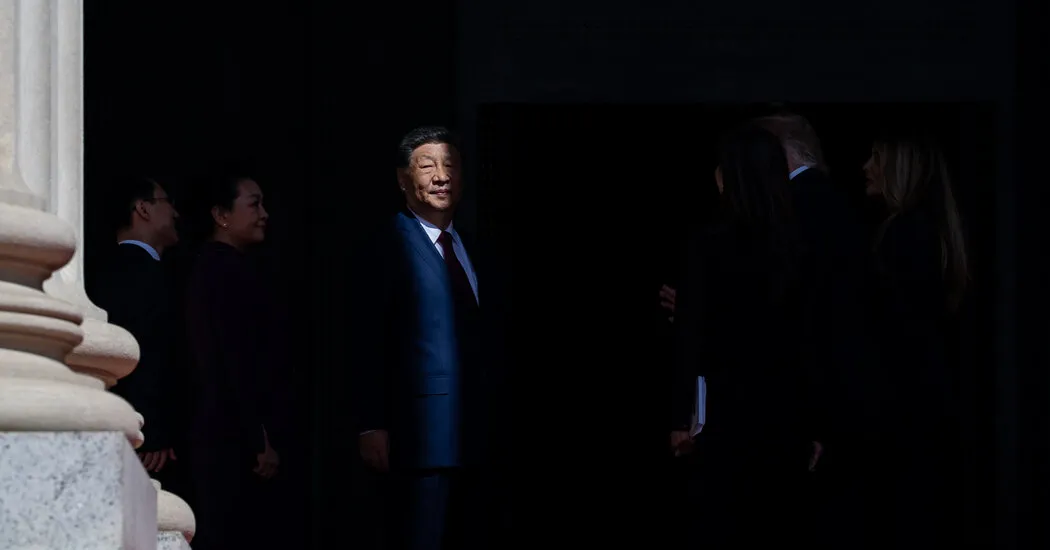
When President Trump and Xi Jinping, the leader of China, met earlier this fall, they sounded committed to finding common ground on calibrating the rapid development of advanced artificial intelligence.
“We have both the capability and responsibility to develop and manage A.I. for good and ensure that the development of A.I. is always under human control and serves the well-being of the people,” Mr. Xi said in September in the grand foyer of the White House.
Mr. Trump leaned into that spirit, saying, “The decisions we make in these areas today can promote peace and prosperity for decades and decades to come..” But he has called fears of A.I. threats a “hoax,” and earlier that week said at the United Nations that he would label artificial intelligence “super intelligence” to give it a better brand.
On the eve of their third leadership summit of the year, the two men and their administrations have made little if any progress on negotiating A.I. safety issues and development guidelines, despite growing fears about the technology, current and former U.S. officials say.
And that was before Jensen Huang was forced to resign last week as chief executive of Nvidia, the U.S. technology giant that supplies computer chips fueling the A.I. boom.
Mr. Huang stepped down after The New York Times reported last month that the U.S. had gathered intelligence showing that a Chinese businesswoman in Singapore with whom he had a close relationship might have been secretly working or in contact with China’s main spy agency. Mr. Huang has publicly admitted that he had an affair.
Advancements in technology — and particularly on A.I. — have become a focal point in the superpowers’ economic and military rivalry in recent years, but never have those issues been more in the spotlight.
“The primary point of competition between us is certainly on A.I., quantum computing, biotech, cyber, all those issues,” said R. Nicholas Burns, a former career U.S. diplomat who was ambassador to China in the Biden administration.
“But obviously we’ve got a self-interest, and I think they do too,” he added, “in making sure the competition doesn’t veer off in a direction that would be destabilizing and potentially increase the probability of a conflict.”
Secretary of State Marco Rubio said last week that the governments have had conversations about A.I. safety “sort of at the technical level.” “Obviously, we’ve heard their perspective, they’ve heard ours, but that’s still a work in progress,” he said.
One reason there has been little momentum is that the two nations have differing views of the greatest risks posed by A.I., the current and former U.S. officials say.
In the United States, officials, executives and researchers talk about the possibility of A.I. becoming autonomous and working on its own outside human control or even dominating humans.
That is a concern in China, too, but its government appears to be more worried about how A.I. could be used by humans to undermine the Chinese Communist Party.
At the same time, the party’s main spy and counterintelligence agency, the Ministry of State Security, aims to use A.I. for intelligence gathering both in the country and overseas, The Times has reported.
Suspicions about espionage heighten the mutual distrust in Washington and Beijing over A.I. issues. Each side thinks the other is engaged in spying to learn more about rival A.I. secrets and to dominate development faster, the officials said.
The murky trade and spying scandal involving Mr. Huang and Nvidia looms over the meeting between Mr. Trump and Mr. Xi scheduled for Thursday in Shenzhen, a technology and manufacturing hub in southern China.
In his second term, Mr. Trump has ordered the U.S. government to loosen export restrictions to China on advanced chips. But on Monday, the Trump administration announced that it was moving forward with a new rule that would limit China’s ability to access certain chips through the use of data centers in other countries.
The policy on advanced chips is separate from the safety issues about A.I. development. The nascent dialogue on safety is being run by the Treasury Department. Critics say the talks are virtually nonexistent, though Treasury Secretary Scott Bessent insists they will happen.
The governments “expect to exchange best practices for evaluating and testing advanced models before their release, and for keeping human judgment firmly in command of this technology,” he said last week.
He added that they are “establishing a direct channel to ensure that either nation can promptly alert the other to serious incidents involving” A.I. models.
As he eventually did with Mr. Trump, Mr. Xi agreed to start a dialogue on A.I. with the Biden administration. The first meeting was held in Geneva in May 2024. Mr. Biden’s aides had hoped China would send officials from the three agencies most involved in monitoring or regulating A.I. development, including the Ministry of State Security, the spy agency.
But China sent foreign ministry officials disappointing the Americans, former U.S. officials said. The two sides made little headway.
However, that November, when Mr. Biden and Mr. Xi had their final meeting, in Lima, Peru, the two leaders announced one agreement on A.I. — that humans and not A.I. must have control over the two countries’ nuclear arsenals.
But like Mr. Trump, some Chinese officials are wary of any constraints on broader development.
For one thing, the Chinese government sees the technology as critical for addressing a coming demographic crisis. A.I. could power a wave of robot labor.
“The Chinese view any type of outreach that we are doing as a means to really keep them down or a ploy to not allow their industry to develop as rapidly as possible,” retired Gen. Paul M. Nakasone, the former head of the National Security Agency and U.S. Cyber Command, said in an onstage interview last month.
Even if China committed to an international agreement on A.I. safety, U.S. officials will likely doubt that Beijing would abide by the terms, given its history of violating past cybersecurity accords, a senior U.S. intelligence official said.
In 2015, Beijing signed an agreement with the Obama administration pledging that the two countries would not hack into each other’s companies for the purposes of stealing intellectual property. But U.S. intelligence agencies quickly concluded that China was violating the pact, the official said — and later Washington publicly accused Beijing of that.
Chinese Communist Party officials appear to think A.I., while posing new risks, could be used to monitor Chinese citizens and reinforce party control. The government’s internet regulator, the Cyberspace Administration of China, is also the A.I. overseer. That agency suppressed a relatively freewheeling Chinese internet earlier this century and transformed online space into a controlled zone that security officials use for surveillance.
On the flip side, the government’s anxiety over potential A.I. threats to party rule was made clear in a September article by Chen Yixin, the head of the main spy agency. He called for more party control over A.I. to prevent political instability, defend against cyberattacks and misinformation campaigns from “hostile forces,” and compete militarily with the United States.
Mr. Chen’s spy agency is involved in a range of activities involving A.I., including possibly gathering intelligence on Mr. Huang and other American technology executives, U.S. officials said.
The Chinese government has said the espionage concerns over Alice Huang, the Chinese executive who worked at Megaspeed, the technology company in Singapore, are a “fabrication.” There are signs China has turned to hackers in seeking more insight into U.S. strategies on A.I.
Last month, Proofpoint, a U.S.-based cybersecurity firm, released findings accusing China-aligned hacking groups of targeting A.I. experts at American research institutes, universities and law firms. Some of them work on regulation and export issues.
The campaign relied on emails in which the hackers impersonated A.I. policymakers, including a senior one at the White House.
Proofpoint did not disclose whether the hacking attempts were successful, but it said the activity “aligns with the broader Chinese intelligence priorities amid growing U.S.-China competition over A.I., export controls and strategic technologies.”
Julian E. Barnes and Alan Rappeport contributed reporting from Washington, and Michael Crowley contributed from Paris.
