


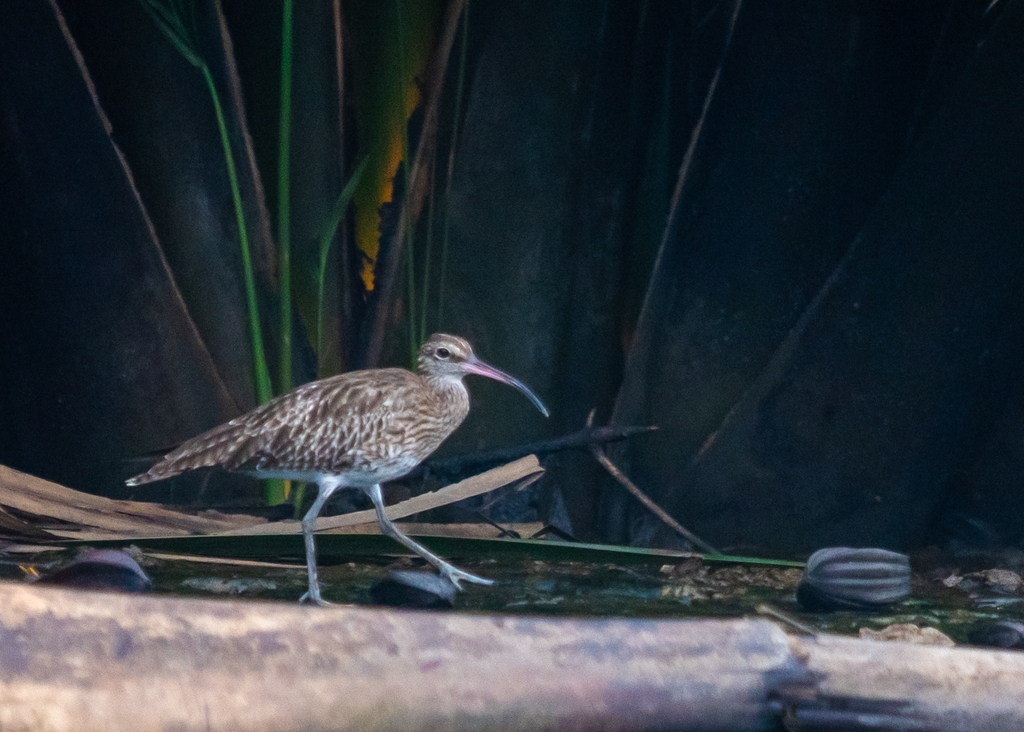
- Every year, migratory birds arrive at the wetlands at Ayetoro, in southwestern Nigeria; some will remain here through the Northern Hemisphere winter, while others rest and refuel and continue on to other places.
- Increasingly powerful tides linked to rising sea levels are rapidly eroding the coastline here, damaging local community infrastructure as well as the wetlands that shorebirds rely on.
- A project run by the Nigerian Conservation Foundation has trained and equipped members of the local community to help gather data about bird populations.
- More funding is needed both to monitor this wetland and to address the severe coastal erosion, advocates say.
The point where land meets sea at Ayetoro, in southwestern Nigeria, is marked by the skeletons of now-submerged landmarks. Birdcalls, crashing waves, and the sounds of local fishing boats’ outboard engines wash over the crumbling remains of old buildings as well as a wetland that’s a vital stopover and wintering site for migratory waterbirds like Eurasian curlews, whimbrels, and common sandpipers.
These birds are just some of the billions that travel vast distances each year in their annual migration between breeding sites far to the north and warmer climates during the Northern Hemisphere winter.
They arrive at Ayetoro at varying times between October and January, where their stay in the wetland is observed by members of volunteer bird groups from the local community, who take part in an annual count at the start of each year. These volunteers are part of a wetlands monitoring project of the Nigerian Conservation Foundation, and are paid a stipend to help NCF personnel identify and count birds in the area, record their population data, and collect behavioral and photographic evidence of their activities.
The work, which the NCF is also carrying out at two other sites across Nigeria, is part of the Climate-Resilient East Atlantic Flyway (CREAF) project, funded by Germany’s International Climate Initiative, to strengthen monitoring and management of migratory waterbird habitat in 11 countries on Africa’s Atlantic coastline.
The monitoring of Ayetoro’s wetland has become more urgent recently, as coastal erosion affects both human and avian communities here.
Ayetoro is a site on the East Atlantic Flyway, one of the world’s 14 recognized routes for migratory birds. Some of the migrants wing in from breeding grounds as far away as subarctic regions of Scandinavia and Russia in the case of whimbrels (Numenius phaeopus) and sandpipers (Actitis hypoleucos), and either settle in the wetland or use it as a stopover site
“[Bird stopovers are] like fueling sites when you’re traveling and you have to stop over at certain points to take in additional fuel to get you to your final destination,” Stella Egbe, the NCF’s senior conservation manager leading bird monitoring and conservation activities at Ayetoro, told Mongabay in a phone interview.
The wetland also hosts year-round residents including great white egrets (Ardea alba) and purple herons (Ardea purpurea), which nest, feed, and grow families here. But this avian haven is being washed away. Egbe said ocean encroachment due to climate change is the major threat: “If you go to Ayetoro, which is the community that is most proximal to the ocean on that axis, more than half of the community has been swallowed up by the ocean.”
The sea has unusually dramatic effects on the roughly 80 kilometers (50 miles) of coastline Ayetoro sits at the center of. Using satellite imagery, researchers calculated that waves and powerful tides deposited substantial new mud in some places while washing large amounts of land away in others — along two-thirds of the coast here, erosion claimed more than 10 meters (33 feet) of land per year between 2010 and 2020.
With some parts of the coast receding by as much as a kilometer (0.6 mi) over the past 30 years, hundreds of buildings have been submerged, and vast areas of mangrove swamp and other bird habitat have been lost.
Oluyinka Odewumi has taken part in a rapid biodiversity assessment of this coastline, where the Oluwa and two other rivers arrive at the sea via a profusion of small creeks and wetlands. He’s continued research into how rising sea levels are increasingly driving saltwater into this low-lying area.
Odewumi, a professor in the Department of Ecotourism and Wildlife Management at the Federal University of Technology in Akure, Nigeria, told Mongabay that increasing salinity is affecting plants and aquatic animal species that birds rely on for food and habitat. The shoreline is also affected by pollution from oil production.
In addition to seawater intrusion, Odewumi said some habitat has been lost where mangrove forest has been cleared to grow rice, or disturbed for sand mining.
“All this leads to deforestation and habitat degradation. So definitely, it will also affect,” he said. “That means that the habitat that these birds need for them to survive is becoming reduced or not that viable.”

The NCF’s work with local communities goes beyond gathering data. At one of the other sites where CREAF-supported work is being carried out, locals have also worked to uproot invasive nipa palms (Nipa fruticans) and plant mangrove seedlings.
The citizen scientists at Ayetoro enhance the NCF’s capacity while reducing the cost of operations, Egbe said. Access to the area is principally by boat, and having capable locals who already live nearby means the NCF can dispatch smaller teams. “And then you work with the local communities [in the field], especially the volunteers whose capacities we have developed over the years,” she told Mongabay.
Since 2024, CREAF has also supported Nigeria’s participation in the annual International Waterbird Census. The funding has also enabled the NCF to pilot a project providing solar-powered refrigerators to fishers, allowing them to preserve their catch without cutting down trees to smoke it.
But, Egbe said, the CREAF project support for the NCF will end in 2027, potentially ending the ecological monitoring.
She and Odewumi agree that greater funding is needed to tackle challenges at Ayetoro. Odewumi said continuous training of community members as citizen scientists is vital: “Monitoring biodiversity in such an area is not [something] an individual can do. It requires funding.”
Egbe added that “The amount of encroachment they have is something that actually requires government intervention, not NGO level, unless of course you have a huge fund, because it’s going to involve structural modifications that would help to mitigate that impact.”
Since 2009, the government has issued several contracts to build embankments to protect Ayetoro from further erosion, but these have been abandoned or unsuccessful. In October, Dayo Faduyile, a senator who represents this area, raised the issue in the Senate, calling for funding to be allocated from federal budgets and international climate adaptation finance to pay for coastal protection and the restoration of community infrastructure. The Senate referred the matter to committees for a response within four weeks.
As migrating birds begin arriving at Ayetoro for another season, conservationists and members of the local community say they hope effective responses will be found soon.
Banner image: Eurasian Whimbrel (Numenius phaeopus) at Kalaibiami I, Rivers state, Nigeria. Image © Adedotun Ajibade via iNaturalist (CC BY-NC 4.0)
Citation:
Ogunrayi, O. A., Mattah, P. A., Folorunsho, R., Jolaiya, E., & Ikuomola, O. J. (2023). A spatio-temporal analysis of shoreline changes in the Ilaje coastal area of Ondo state, Nigeria. Journal of Marine Science and Engineering, 12(1), 18. doi:10.3390/jmse12010018
Feedback: Use this form to send a message to the author of this post. If you want to post a public comment, you can do that at the bottom of the page.
Cite this article
Amir Sadiq (2026). As the sea swallows a Nigerian community, migratory bird habitat disappears. Mongabay Conservation news. DOI: https://doi.org/10.66709/news-334141

