


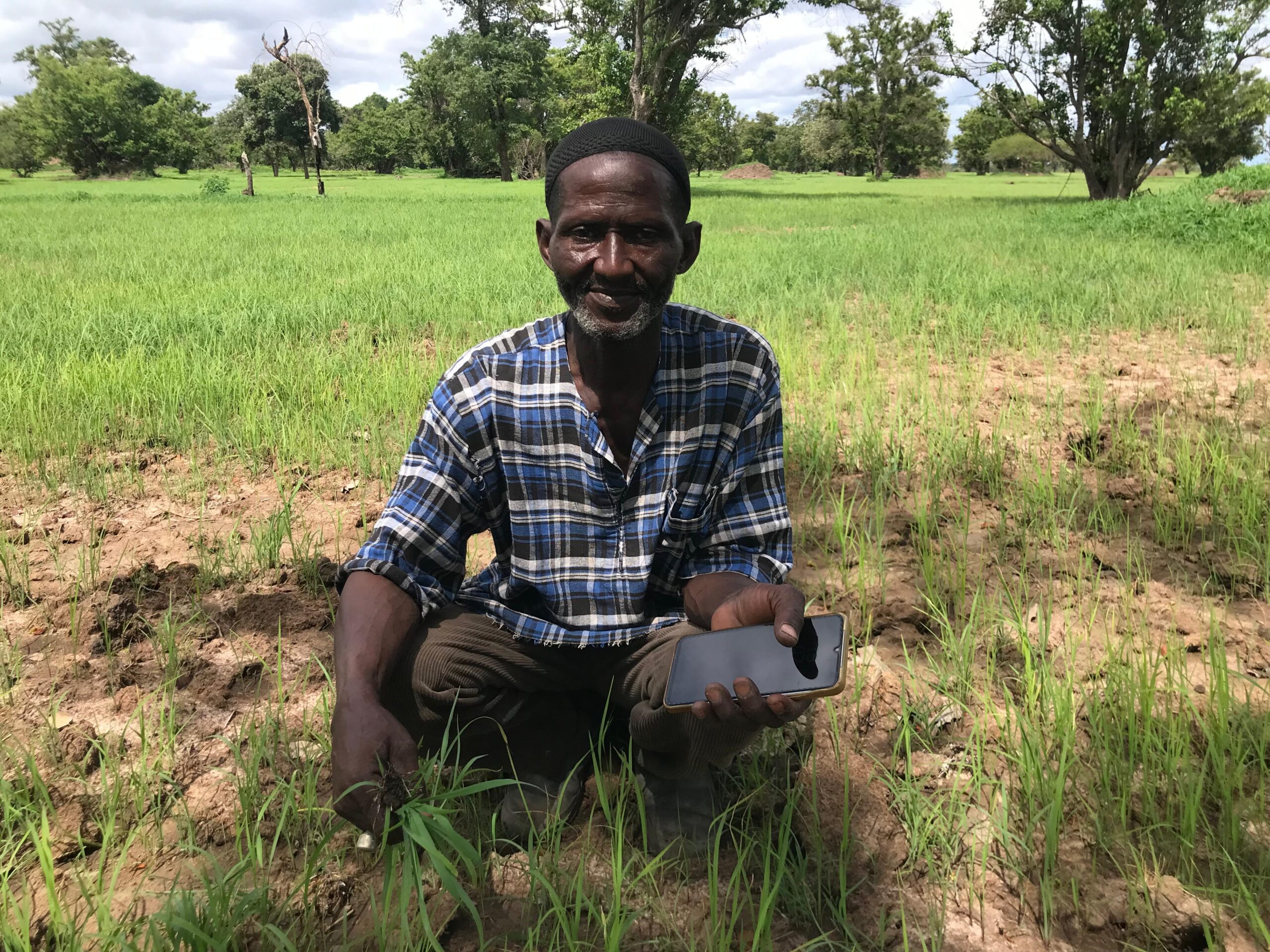
- Every year, the villagers of Kiang Jifarong in the Gambia contribute their labor and money to building earthen dikes from clay and mud in an effort to keep seawater out of their rice farms along the Bintang Bolong estuary.
- Stretches of salt-blighted or barren plots and growing numbers of farmers moving inland to higher ground are a sign that rising sea levels and uncertain rainfall that could flush saline water out of the estuarine landscape are overcoming this defense.
- The villagers look enviously at a UNDP-funded concrete dike at a nearby village, but one sustainable development expert says permanent dikes often aggravate the problem.
Every year, the villagers of Kiang Jifarong contribute labor and money to build earthen dikes using clay and mud in an effort to keep seawater out of their farms. Rice fields once stretched unbroken for 5 kilometers, about 3 miles, along the Bintang Bolong estuary here in western Gambia. For generations, families cultivated rice on these fertile lowlands, relying on seasonal floods and freshwater to sustain one of the country’s oldest farming traditions. There are now worrying gaps in this productive landscape.
For 10 years now, many of the villagers have retreated inland, away from the coastline, as saltwater transforms once-productive rice fields into barren land.
Farmers say saltwater stress is easy to recognize: rice leaves turn yellow, while harvested grains become light and hollow because the plants fail to develop properly.
“The grains become almost empty,” says Tombong Barrow from the Kiang Jifarong village development committee, a statutory body responsible for identifying local development needs at the village level and coordinating responses to them. “The salt makes them useless.”
Jonni Kinteh and Mama Njie, both veteran rice farmers, say they abandoned their fields eight years ago after repeated crop failures linked to salinity.
“We have farmed these fields since childhood alongside our mothers,” Kinteh says. “Now we can no longer use them.”
“Our parents farmed much closer to the river,” Barrow says. “Now those fields have been completely taken over by salt. We’ve had to move uphill, into areas that were never meant for rice cultivation.”
Families that once depended almost entirely on locally grown rice now spend scarce income buying imported rice. “Before the saltwater came, we hardly bought imported rice,” Njie says. “Now we have no choice.”
The loss of productive farmland is also increasing pressure on nearby forests as communities clear higher ground for cultivation.
In Tendaba, about 22 km (14 mi) from Kiang Jifarong, residents say concrete dikes constructed under a United Nations Development Programme-supported coastal resilience project have successfully reduced saltwater intrusion and improved rice production.
Sustainable development specialist Kawsu Jammeh cautions that hard-engineering solutions have often failed to address the complex hydrology of the country’s coastal rice-growing areas.
“The construction of concrete dikes has, in many cases, worsened hyper-salinity,” Jammeh tells Mongabay. “Saltwater can still penetrate beneath the structures and damage rice fields over time.”

He links the high salinity around Kiang Jifarong to historical interventions in the estuary, where sandbags were for a long time used to block tidal flows. These were removed in 2005, but the consequences of this intervention on natural water circulation have persisted.
Jammeh also criticizes the practice of awarding dike construction contracts to firms with heavy machinery but limited understanding of wetland ecology. “These are engineering projects, but they are also ecological systems,” he says.
Jammeh says examples from elsewhere in the Gambia, Senegal, and Guinea-Bissau show that poorly designed concrete dikes often obstruct natural tidal exchange, increasing salt concentrations rather than reducing them.
It’s vital to build the dikes in the right places, he says. “They should be placed between the highest water mark and the rice fields. If they are built within the saltwater margins, they can render large areas of farmland unusable.”
He advocates for the very seasonal dikes built from clay and mud, which communities like Kiang Jifarong have relied on for generations. Unlike permanent concrete barriers, he says, these earthen structures allow for natural water movement while retaining freshwater during the rainy season.
Jammeh also points to a newer generation of “gated dikes” being introduced in neighboring Senegal and Guinea-Bissau as a promising alternative. These structures can be opened during tidal cycles, allowing saline water to be flushed back out into rivers or the ocean by seasonal rainfall.
Barrow says rice remains central to his household’s food security despite the mounting challenges. The agriculture ministry has distributed two salt-tolerant varieties suitable for lowland and irrigated areas.
“[The new] rice matures within three months and has become more reliable than many other crops because rainfall patterns have changed,” Barrow says.
He and other farmers along the Bintang Bolong estuary will continue to face an uncertain future with traditional and novel approaches.
Banner image: Tombong Barrow in his rice field rice at Kiang Jifarong, the Gambia. Image by Yero Bah for Mongabay.
Saline intrusion in Mekong Delta leaves farmers and scientists at odds
Green and gray: Mangroves and dikes show potential in protecting shorelines together
Feedback: Use this form to send a message to the author of this post. If you want to post a public comment, you can do that at the bottom of the page.
Cite this article
Yero S. Bah (2026). As saltwater advances, Gambian farmers rethink how to protect rice fields. Mongabay Conservation news. DOI: https://doi.org/10.66709/news-329393

