


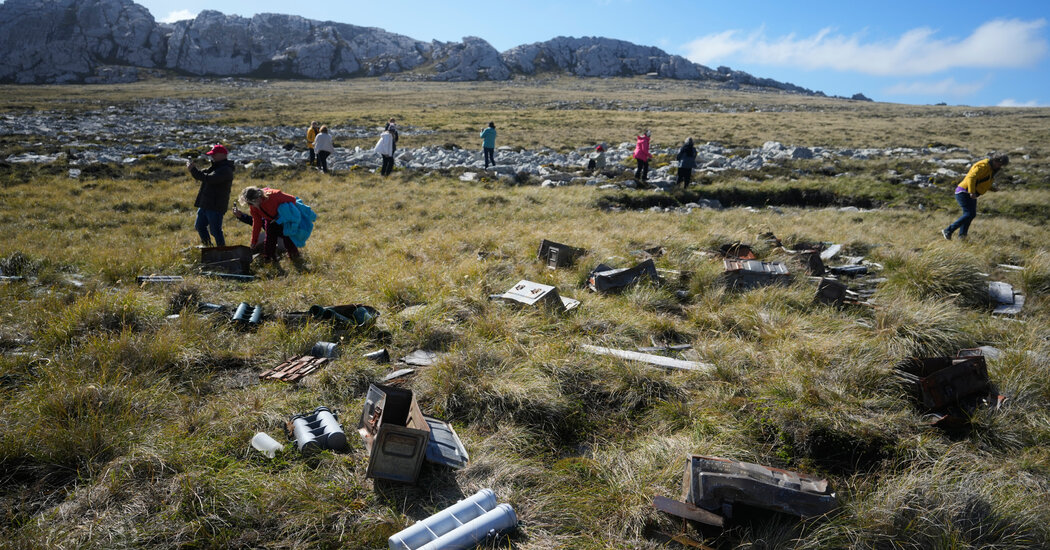
President Javier Milei of Argentina has been ramping up his country’s claim over the long-disputed Falkland Islands, a British territory for almost two centuries.
Mr. Milei, a right-wing populist and staunch ally of President Trump, said on Thursday that his government would take stronger steps against an offshore oil project near the Falklands. In a nationally televised address, he described the project by Israeli and British firms as a threat to Argentina’s sovereignty and an attempt to steal natural resources from its people.
Argentina, which calls the islands the Malvinas, has never accepted British sovereignty over them. An Argentine invasion of the islands in 1982 set off a brief and bloody war that Britain won.
Mr. Milei’s speech followed recent comments from Mr. Trump that raised questions about U.S. neutrality on the dispute.
Here’s what to know about the Falklands and why they are so contentious.
The dispute is centuries old.
The archipelago, with two main islands and hundreds of smaller ones, is about 300 miles east of the South American mainland. About 3,600 people live there, according to the 2021 census.
The first European expeditions reached the islands starting in the late 1500s, leading to dueling claims. Britain gained effective control in the 1830s.
Argentina, which declared independence from Spain in 1816, has maintained its claim over the islands and has not accepted British sovereignty over them.
The Falklands are mostly self-governing. Britain controls the islands’ foreign policy and defense, and it maintains a military presence, including fighter aircraft.
In a referendum in 2013, residents of the Falklands voted overwhelmingly to remain a British territory. Britain has said that people in the Falklands have the right to determine their status, but Argentina has contended in the past that the islands were populated illegally.
Argentina tried, and failed, to take the islands by force.
The dispute between Argentina and Britain bubbled up repeatedly in the 20th century. Several rounds of talks were held but were all inconclusive.
On April 2, 1982, Argentina sent several thousand troops to seize control of the islands. President Ronald Reagan had tried and failed to persuade the leader of Argentina’s military junta to call off the invasion.
Britain responded with a major military deployment, including warships and submarines, eventually forcing Argentina’s surrender after 74 days. Almost 650 Argentine soldiers were killed.
More than four decades later, the war and the loss of life are still a source of pain in Argentina. It has not given up its claim to the Falklands, which is part of the Argentine Constitution. The islands are frequently invoked in expressions of national identity, especially among supporters of Argentina’s soccer team.
At the World Cup this summer, two Argentine players held up a banner saying the Falklands belonged to their country after their team defeated England. That prompted disciplinary proceedings by FIFA, soccer’s governing body, which does not allow political slogans at its events.
Trump says the U.S. position is under review.
Questions about the Trump administration’s view of the dispute have brought it back into the spotlight this year.
After the United States and Israel began their war against Iran in February, Mr. Trump expressed displeasure over the lack of support from NATO allies including Britain. A Pentagon email, reported by Reuters, suggested that pulling back from the U.S. position on the Falklands would be a way to punish Britain over the Iran war.
The United States has historically accepted Britain’s de facto control over the islands but remained neutral on which country has sovereignty over them.
A reversal on the issue by the Trump administration would be a major diplomatic affront to Britain. The British government has said that the islands “are and will remain a British overseas territory in line with the wishes of the Falkland Islanders.”
Earlier this week, Mr. Trump said he was reviewing the U.S. position on the Falklands. And in an interview with the British television channel GB News that aired on Thursday, Mr. Trump declined to directly respond when asked if he would come to Britain’s aid if Argentina claimed the Falklands. He instead turned the conversation toward the war in Iran.
“Your country was not there to help me,” Mr. Trump said.
Hours later, Mr. Milei said in his televised address that the United States knows that Argentina is a reliable partner in a position of strategic importance — and one that could be a valuable ally in the coming decades.
“Without that,” he added, “none of this would be possible.”
