


Microorganisms developed biodegradable plastics long before humans began making them. Many bacteria and archaea naturally produce compounds known as polyhydroxyalkanoates (PHAs), which they store inside their cells as reserves of carbon and energy.
Scientists had long assumed that only microorganisms could break down these natural plastics. New research from the Max Planck Institute for Marine Microbiology in Bremen, Germany, now challenges that idea. In a study published in Nature Ecology & Evolution, researchers found that a wide range of animals, including marine worms, starfish, earthworms, and other terrestrial species, possess enzymes that can degrade microbial PHAs. The discovery points to a previously unrecognized pathway through which carbon stored by microbes can move into animal food webs.
A Gutless Marine Worm Reveals a Hidden Ability
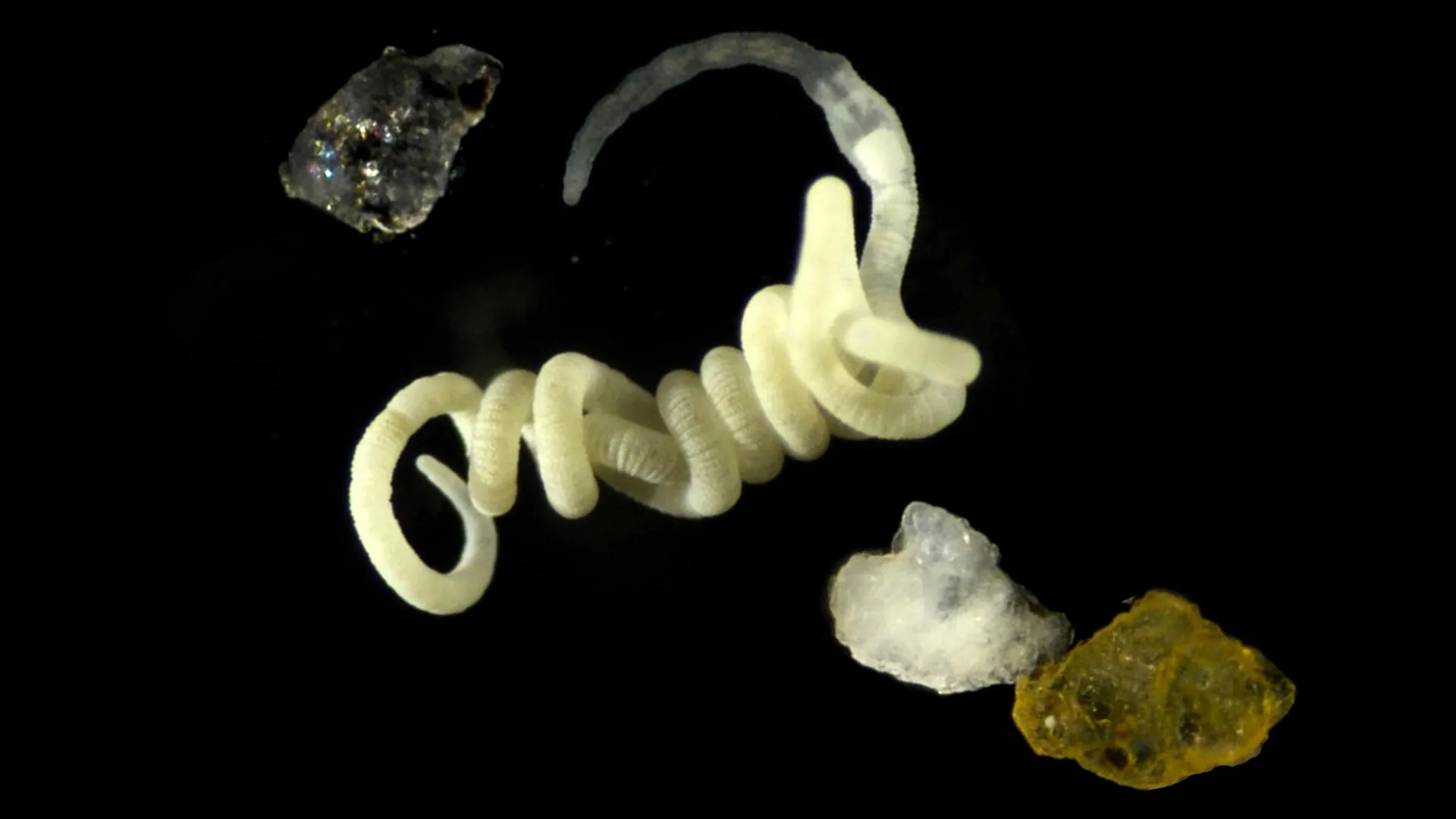
The investigation began with an unusual marine worm called Olavius algarvensis. Unlike most animals, it has no mouth or gut. Instead, the worm depends on symbiotic bacteria that live beneath its skin, which it digests as a source of nutrition.
“One of the worm’s bacterial symbionts stores enormous amounts of carbon as PHA,” says corresponding author Nicole Dubilier, Director at the Max Planck Institute for Marine Microbiology. “We wondered whether the worm had evolved a way to access this rich energy reserve.”
The answer was: Yes. Researchers identified an enzyme in the worm that can break microbial PHAs into smaller molecules that animals are able to use. High-resolution imaging also revealed that the enzyme is produced in the same location where the worm digests its bacterial partners. That finding indicates that the worm can tap into the PHA reserves stored inside its symbiotic bacteria.
The discovery did not stop with a single marine worm. When the team examined animal genomes more broadly, they found related enzymes in more than 66 species spanning nine different phyla. Laboratory tests showed that enzymes from very distantly related animals, including a sponge, an earthworm and a springtail, could also degrade microbial PHAs.
“This was the real surprise,” says first author Caroline Zeidler from the Max Planck Institute for Marine Microbiology. “What started as a discovery in a single marine worm turned out to be a widespread capability shared by animals from very different branches of the tree of life.”
PHA bioplastics
PHAs serve as microbial energy and carbon reserves, but they are also used to manufacture biodegradable plastics. In industrial production, bacteria are grown inside large fermentation tanks and given carbon-rich materials such as sugars, starch, or plant oils. Under the right conditions, the bacteria build up large amounts of PHAs. These compounds can then be extracted and turned into plastic-like materials.
PHA-based plastics can be molded, resist water relatively well, and remain stable enough for a variety of everyday uses. They are used in products such as food packaging and hygiene materials. In agriculture, fertilizers can be enclosed inside PHA beads that gradually release their contents as the plastic breaks down. Medical applications include wound dressings, drug delivery systems, and resorbable implants or sutures that slowly degrade inside the body.
PHAs are especially notable because of their biological circularity: They are made by microorganisms and can also be broken down through biological processes. Even so, they currently account for only a small share of the bioplastics market. That could change as demand rises for biodegradable, bio-based materials and global production capacity for bioplastics is expected to grow substantially in the coming years.
The new findings add another dimension to this picture by showing that many aquatic and terrestrial animals also carry enzymes capable of breaking down PHAs.
Natural Bioplastics Are Widespread in the Environment
Microbial PHAs are found naturally in soils, sediments, and aquatic environments around the world. Microorganisms produce them when they have more carbon than they immediately need, storing that excess for later use. PHAs are also among the relatively few naturally occurring plastics that are completely biodegradable.
Interest in PHAs has grown because they are increasingly being manufactured as sustainable alternatives to conventional plastics. As a result, scientists are paying closer attention to how these materials are broken down in natural environments.
The findings from Dubilier and her colleagues suggest that animals may help degrade natural bioplastics alongside microorganisms. Even more significantly, the results show that animals can gain access to a microbial carbon reserve that scientists had previously considered unavailable to them.
“Our study changes our understanding of who can use these microbial carbon stores,” says co-corresponding author Maggie Sogin, who carried out much of the work at the Max Planck Institute for Marine Microbiology and is now Assistant Professor at the University of California, Merced. “Animals have probably been feeding on nature’s original bioplastic for hundreds of millions of years – we’re only discovering it now.”
A New Pathway in the Carbon Cycle
Scientists still do not know how common this process is in natural ecosystems or how much it contributes to the global cycling of carbon. Even so, the discovery offers a new way to think about the relationships between microorganisms and animals.
It also demonstrates how research on unusual organisms can expose biological processes that have remained hidden despite potentially operating for hundreds of millions of years.
