


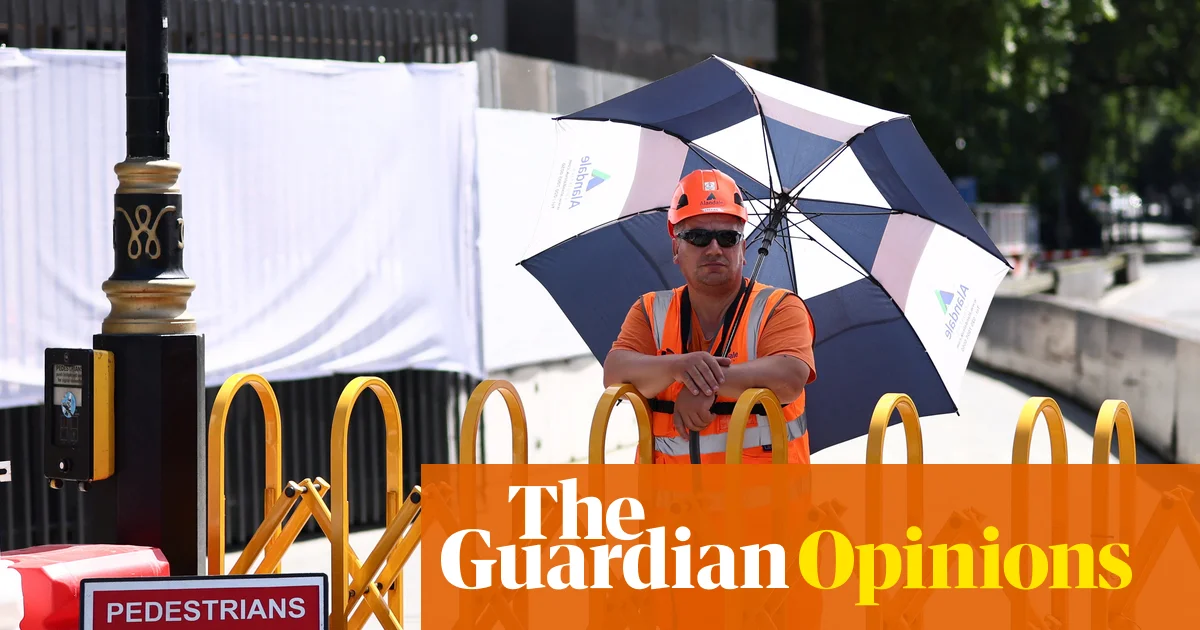
I don’t think I have ever written before about a British strike directly related to the climate emergency. But that’s exactly what began late last week in north London, with a zeitgeisty connection to Andy Burnham’s fixation on buses: picket lines outside depots and massed walkouts, while the temperatures in the relevant parts of the capital and its suburbs hovered at about 34C (93F).
Last Friday, more than 1,500 drivers employed by the transport giant Arriva began a planned run of 26 stoppages through to October, affecting bus routes spread between London and Essex. Everything is being led by the union Unite, whose recent grievances include alleged company union-busting and assaults by the public on staff. But the fundamental basis of the dispute is at the heart of the national condition: the near-impossibility for millions of people of working through another insanely hot summer.
Most of Arriva North London’s buses, says Unite, have old-fashioned air cooling systems rather than air conditioning, which means that onboard temperatures have come down by only two or three degrees during this year’s five heatwaves. On other such vehicles, it insists, the air-con is broken. The cabs where drivers sit are essentially compact greenhouses, and can easily reach 40C or higher. And there is another grim twist: union members complain of a shortage of toilets on too many routes, meaning they refrain from drinking water. Unite has been warning about all this since the phases of intense heat that began back in May; its members, the union says, have experienced “heat exhaustion, heatstroke and dehydration”.
Arriva’s last financial figures showed a pre-tax profit of £133m. The company insists that it has “introduced short-term measures to protect drivers”, and is now also spending money on “longer-term fixes, including cab air-conditioning upgrades and our ongoing investment in new fleet”. But the root of its current problems seem clear. There is a longstanding failure, which runs across the UK’s public and private sectors – and also transcends national boundaries – to understand the mounting everyday effects of global heating, and to engage in what so many 21st-century companies and institutions remain so bad at: protective investment, with both eyes fixed not just on the searing inevitabilities of the future, but realities that are already here.
Arriva places tight restrictions on its drivers talking to the media, so Unite pointed me instead to Mo, who has worked for another London bus operator for over 15 years, and had come to a picket line to show the strikers his support. “When it’s very hot, it’s very difficult to concentrate,” he told me. “Imagine the heat you feel when you put your hand near an oven. That’s what it’s like.” What, I wondered, had happened when these problems were raised with management? “Sometimes, we don’t want to raise this stuff, because they don’t want to hear it. If you say, ‘I’ve got a hot cab, I want to come out,’ they’re like, ‘Well, we’re going to lose mileage; we’re going to get penalised by TfL [Transport for London].’ I know the mayor’s put the message out” – in June, Sadiq Khan said he was committed to improving working conditions for drivers – “but the company says, ‘He doesn’t employ you. We do.’”
There are no end of similarly unsettling reports from other occupations. The Royal College of Nursing says some of its members working in the health service have recently collapsed, while others have reported dizziness, nausea and dripping with sweat “from head to toe”, along with profound concerns about NHS patients’ most basic welfare. Recent research into the building trade from the University of Reading showed that 44% of the construction workers it contacted had experienced a heat-related illness, such as heatstroke, heat exhaustion or dehydration. Moreover, 57% said they had received no compulsory training on how to deal with heat.
Almost exactly a year ago, I wrote about the tragic story of Montse Aguilar, a 51-year-old woman who worked as a street cleaner in Barcelona, and returned home from a working day in which the city’s temperatures had reached 35C, only to collapse, hit her head and die. Soon after, people marched carrying banners that read “Extreme heat is also workplace violence”, and street cleaners demanded better summer workwear and more breaks. Much to her family’s distress, the city council has still not recognised her death as a workplace accident, and there has yet to be an autopsy.
This year, Barcelona’s authorities handed out about 1,400 bracelets for staff working outdoors – including street cleaners, park workers and refuse specialists – which measure workers’ body temperatures and go into alert mode if they sense that the wearer is at risk: as and when that happens, the person concerned has to stop working. But despite Spain’s reputation for comparatively stringent heat regulations, unions continue to draw attention to a supposed system of protection still full of gaps. Late last month, the CGT union filed official complaints with Barcelona’s labour inspectorate about what it deems deficient management of those wristbands, a lack of air-con in working vehicles and pledges from the city council being applied “late and halfway”.
Across the world, every hot season inevitably brings more victims. In the US, official figures suggest that more than 550 workers die annually from heat exposure across the country. One recent story is that of Umeshkumar Thakkar, a 58-year-old postal worker who lived in Little Elm, Texas – who, though the cause of his death has yet to be officially established, has been cited as the third such employee in three years to die in the Dallas area amid extreme heat. Amazingly, Texas has barred its cities and counties from passing local heat protections – while, to quote the New York Times, “The Trump administration is moving to rewrite Biden-era rules that would mandate breaks and access to water and shade for workers.” Hydration, it seems, is that bit too woke.
after newsletter promotion
The UK’s position, it is a relief to say, is not nearly as dreadful, though there is still much work to do. For people working indoors, official guidance suggests a minimum temperature of 16C, which falls to 13C for “physical work”, but there are no maximum temperatures for either indoor or outdoor labour. Things do finally seem to be moving: last month, the Department for Work and Pensions said that the Health and Safety Executive will soon launch a public consultation on improvements to safety-at-work rules that will cover levels of heat at work. There again, the official line from the prime minister’s spokesperson sounds bleak: “We have no plans to introduce a mandatory maximum workplace temperature.”
In the wake of the Green MP Hannah Spencer’s private member’s bill to establish exactly that, Unite is loudly making the case – as are the TUC and the independent advisory Climate Change Committee, which wants employers to “ensure that workplaces and working practices are safe for employees, including for those working outside”. Meanwhile, having planned for a late summer talking about the cost of living, Burnham did not mention the climate crisis until last Friday, in a country where brown fields are so starved of water they are now turning a scorched yellow, homes have been engulfed by wildfires, and far too many workers are finding the once-simple business of earning a living physically impossible. Like many people – including, I would imagine, plenty of those north London bus drivers – my guarded optimism about the new prime minister and his government endures. But the last of those issues needs as much urgent action as the others, before another boiling summer takes an even grimmer toll.
