


Most kids learn in elementary school that the seasons are caused by Earth rotating on a tilted axis during its yearly orbit around the Sun. The substantial tilt, about 23.5 degrees, is thought to be the result of an ancient planetary body, Theia, smashing into Earth about 4.5 billion years ago, in the same cataclysmic collision that formed the Moon.
To visualize why Earth has seasons, imagine the planet as a spinning top tilted to one side. Around the June solstice, the Northern Hemisphere leans toward the Sun, bringing more direct sunlight and longer days. Around the December solstice, the Southern Hemisphere does the same. That’s why June ushers in summer and warm weather in the Northern Hemisphere, while December does so in the Southern Hemisphere.
The March and September equinoxes serve as the midpoints between these two seasonal extremes. On those days, the terminator—the boundary between the sunlit and dark sides of Earth—runs directly through both poles. As a result, the Northern and Southern Hemispheres receive almost the same amount of sunlight, and day and night are nearly equal in length.
What do the seasons look like from about one million miles away? That’s the view provided by NASA’s EPIC (Earth Polychromatic Imaging Camera) aboard the NOAA mission DSCOVR (Deep Space Climate Observatory). By maintaining an orbit that puts the spacecraft between the Sun and Earth roughly 1.6 million kilometers (1 million miles) from Earth, the camera has a nearly continuous view of the sunlit hemisphere. As Earth spins during the course of a day, EPIC captures a full-disk image of the planet’s sunlit face every few hours.
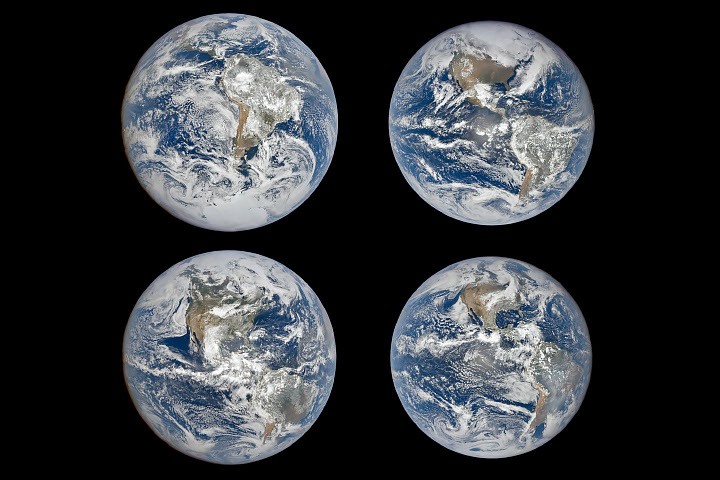
The four images above, taken at roughly the same time of day, show how EPIC’s view of the Western Hemisphere changes over the year, from the December solstice (upper left) to the March equinox (upper right), June solstice (lower left), and September equinox (lower right). The most striking difference is between the two solstices. In December, South America lies near the center of the disk and much of Antarctica is visible, while North America is partially out of view. In June, Earth’s tilt means the situation is reversed: the Northern Hemisphere and North America are more centered, Arctic sea ice comes into view, South America is offset, and Antarctica is completely out of view.
There are other notable differences among the four images. Earth looks slightly smaller during the March and September equinoxes, for instance. That’s because DSCOVR was tens of thousands of miles farther away from Earth on those dates than on the solstices. On December 21, 2023, DSCOVR was 1,447,327 kilometers (899,327 miles) from Earth compared with 1,561,901 kilometers (970,520 miles) on September 22, 2024.
The slight difference in Earth’s apparent size has nothing to do with Earth’s tilt. Instead, it occurs because DSCOVR follows a looping, three-dimensional path called a Lissajous orbit to keep the spacecraft near Lagrange point 1, where the combined gravitational pull of the Sun and Earth and the centrifugal pull of the satellite balance out, making it easier for engineers to maintain the spacecraft’s position without using much fuel. DSCOVR’s distance from Earth swings between its maximum and minimum roughly every three months, and the timing drifts throughout the year because of lunar influences and orbital maneuvers. In 2024, the orbit happened to put the spacecraft slightly farther from Earth at both equinoxes, but that is not always the case.
There’s one other notable way the images differ. Because of DSCOVR’s Lissajous orbit, the angle between the Sun, Earth, and satellite varies between 2 and 12 degrees, explained Alexander Marshak, the deputy project scientist for the DSCOVR mission. Earth appears as a fully illuminated disk at smaller angles and less rounded at larger angles, like a “bite” has been taken out, similar to a gibbous phase of the Moon. For this set of images, the September 22 image has a slightly lower angle (8.1°) than the December 21 image (10.3°), making it appear slightly rounder and fuller. The angle between the Sun, Earth, and satellite in the other two images is between 9° and 10°.
“You can see the subtle influence of the changing orbital geometry in these images,” Marshak said. “But the most obvious changes—the apparent location of the continents—are due to Earth’s tilt.”
EPIC’s vantage point offers a perspective that makes it easier to understand and visualize why Earth has seasons, but after more than a decade in space, the mission has also opened up new approaches to understanding and observing how daily and seasonal cycles play out on a planetary scale. It has collected more than a decade of diurnal and seasonal data on many key features on Earth, including vegetation, clouds, ice, snow, UV radiation, ocean color, and aerosols.
NASA Earth Observatory image by Michala Garrison, using data from DSCOVR EPIC. Story by Adam Voiland.
December 21, 2023
March 19, 2024
June 20, 2024
September 22, 2024
- Kostinski, A., et al. (2024) Deep space observations of conditionally averaged global reflectance patterns. Frontiers of Remote Sensing, 5, 1404461.
- Kostinski, A., et al. (2021) Deep space observations of terrestrial glitter. Earth and Space Science, 8, e2020EA001521.
- Lyapustin, A., et al. (2026) Editorial: Earth observations from the deep space: 10 years of the DSCOVR mission. Frontiers in Remote Sensing, 7, 1810164.
- NASA (2026, June 19) Earth Polychromatic Image Camera. Accessed September 21, 2026.
- NASA Earth Observatory (2011, September 23) Seeing Equinoxes and Solstices from Space. Accessed September 21, 2026.
- NASA (2026) EPIC: Publications. Accessed September 21, 2026.
- NASA Scientific Visualization Studio (2012, December 27) Earth Orientation Animations. Accessed September 21, 2026.
- NASA Space Place (2026, July 31) What Causes the Seasons? Accessed September 21, 2026.
- Roberts, C., et al. (2015) Early Mission Maneuver Operations for the Deep Space Climate Observatory Sun-Earth L1 Libration Point Mission. Accessed September 21, 2026.
- Valero, F., et al. (2021) Lagrange Point Missions: The Key to next Generation Integrated Earth Observations. DSCOVR Innovation. Accessed September 21, 2026.
