


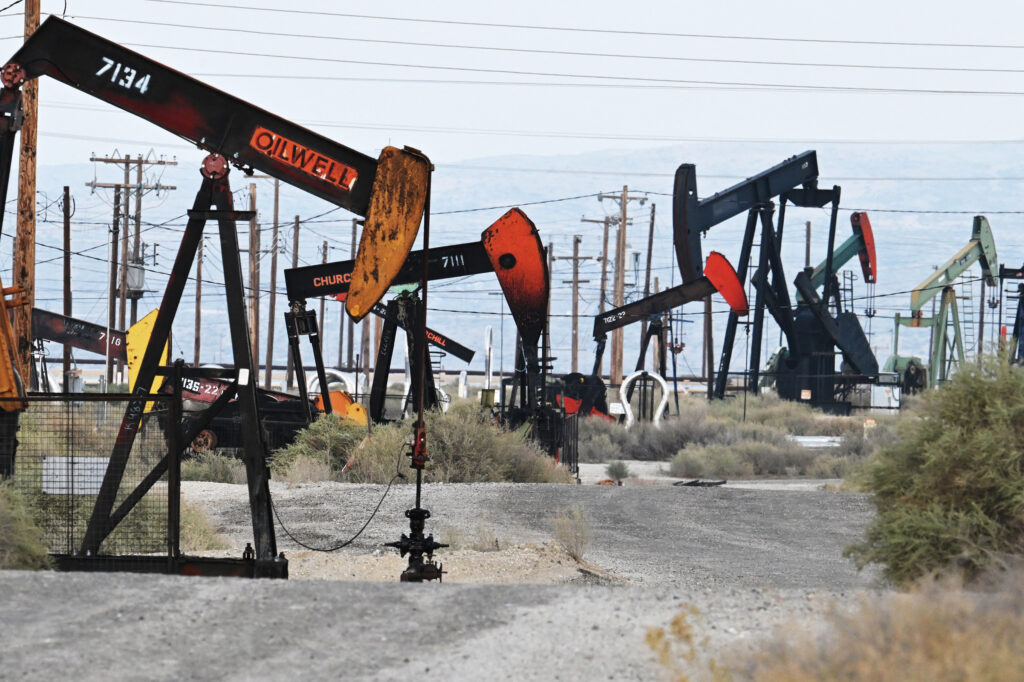
The “enabled emissions” that come when oil and gas drillers use artificial intelligence to find and exploit new energy reserves are far more damaging to the climate than the emissions that come from the data centers that power AI platforms, a new study by two former Microsoft employees concludes.
Will and Holly Alpine spent years building AI platforms before founding a nonprofit, the Enabled Emissions Campaign, to hold tech companies accountable for helping expand fossil fuel production. Their study, published in Nature, found that AI tools used by oil and gas companies have made production faster, cheaper and more profitable, expanding output that otherwise wouldn’t happen.
This increases global emissions by 0.47 to 1.8 gigatonnes of carbon dioxide each year, their study reported, or 1.2 to 4.8 percent of global energy-related emissions in 2024. That’s up to 13 times the emissions than what the International Energy Agency estimated data centers were responsible for in 2025.
To reach these findings, the Alpines used a type of economic simulation that models how an economy responds to changes in policy, technology or an outside disruption in multiple scenarios. First, they looked at data and forecasts of AI’s effects on both the fossil fuel industry and the renewable energy industry and converted those effects into “productivity shocks”—how much AI improves or speeds up each industry. They considered levels of AI adoption ranging from none to heavy use and adjusted their findings to line up with a respected forecast, the International Energy Agency’s 2035 projections.
Will Alpine, the study’s lead author, said he spent years building AI platforms and saw firsthand how the tools can accelerate whatever they are applied to.
Yes, AI “can advance renewable energy, strengthen the grid, and improve efficiency,” Alpine said in a statement. “But it has also been boosting the productivity of the fossil fuel industry for years, and our research shows that effect is asymmetric: it acts as an economic lever that reinforces the viability and dominance of fossil fuels.”
Holly Alpine said that most measures of AI’s climate impacts are framed as a tradeoff between data center energy use compared to the emissions AI might help avoid, for example by making airline flight paths more efficient to save fuel or synchronizing traffic lights across a city to lessen vehicles’ idling time.
In fact, another study published in the same journal in 2025 by London-based researchers from the Grantham Research Institute and Systemiq, a climate-focused investment and consulting firm, found that while AI can contribute to increased emissions due to data centers’ energy use, AI has the potential to reduce emissions in the food, power and mobility industries. Collectively, the three industries make up nearly half of the world’s greenhouse gas emissions.
AI is well-positioned to speed up a transition away from fossil fuels, according to the 2025 study, and reimagine interconnected systems such as energy, transportation, cities and land use. There’s little research on the combined effects of AI and the low-carbon transition, that report found.
Google utilized its own machine learning technology DeepMind to make its data centers more efficient. The tech company reported it managed to reduce the amount of energy it used for cooling by 40 percent.
Microsoft has said it is prioritizing bringing new, carbon-free electricity to grids where it operates. In 2025, Microsoft reported that it matched all of its global electricity consumption with renewable energy.
A Microsoft spokesperson said that as the context of AI has evolved, so must the company’s approach in its pursuit of becoming a carbon-negative, water-positive and zero-waste company that protects ecosystems.
“We believe technology plays a critical role in enabling industry-wide decarbonization, and that this progress must be pursued in a principled way that balances today’s energy needs with the innovation required for tomorrow,” the spokesperson said in a statement to Inside Climate News.
Still, what’s often not assessed, Holly Alpine said in a statement, is how AI makes oil and gas production more commercially feasible. “Until enabled emissions are recognized, measured, and governed, we’re only addressing a fraction of AI’s climate impact,” Holly Alpine said.
Clara Vondrich, senior policy counsel for Public Citizen, a nonprofit consumer advocacy group, said in a statement that the new research exposes the tech industry as a lead accomplice to the fossil fuel industry. AI developers are making contracts with oil companies and selling proprietary tools designed for the purpose of speeding up oil production, Vondrich said.
“You can’t make this up,” Vondrich said. “Big Tech companies, self-avowed climate champs for decades, are working hand-in-glove with Big Oil to find, dig, and burn more fossil fuels to make a buck.”
At the largest annual conference of fossil fuel executives in March, CERAWeek by S&P Global, Chevron CEO Mike Wirth said the tech and energy industries are crafting creative deals and oil and gas is leaning on AI to streamline its operations.
The Boston Consulting Group published a slide deck last year for executives on how AI-first companies can win the future of oil and gas. The global consultancy reported that AI is allowing oil and gas companies to streamline operations by predicting equipment failures and shrinking processes from months to weeks.
Oil and gas companies using AI have said it significantly reduces the time to analyze geological and seismic data, making it faster and cheaper to identify promising drill sites. Processing 3D seismic data used to take a year, and AI can cut that down to about two weeks, according to the consultancy firm.
By using AI tools, the oil and gas industry could access an additional 470 billion barrels of oil from existing fields, according to estimates from consultancy Wood Mackenzie.
The Alpines found that just to keep emissions flat and cancel out AI’s boost to fossil fuels, AI would need to improve renewable energy four to five times more than it improves oil and gas.
About This Story
Perhaps you noticed: This story, like all the news we publish, is free to read. That’s because Inside Climate News is a 501c3 nonprofit organization. We do not charge a subscription fee, lock our news behind a paywall, or clutter our website with ads. We make our news on climate and the environment freely available to you and anyone who wants it.
That’s not all. We also share our news for free with scores of other media organizations around the country. Many of them can’t afford to do environmental journalism of their own. We’ve built bureaus from coast to coast to report local stories, collaborate with local newsrooms and co-publish articles so that this vital work is shared as widely as possible.
Two of us launched ICN in 2007. Six years later we earned a Pulitzer Prize for National Reporting, and now we run the oldest and largest dedicated climate newsroom in the nation. We tell the story in all its complexity. We hold polluters accountable. We expose environmental injustice. We debunk misinformation. We scrutinize solutions and inspire action.
Donations from readers like you fund every aspect of what we do. If you don’t already, will you support our ongoing work, our reporting on the biggest crisis facing our planet, and help us reach even more readers in more places?
Please take a moment to make a tax-deductible donation. Every one of them makes a difference.
Thank you,

Reporter, Texas Renewables
Arcelia Martin is an award-winning journalist at Inside Climate News. She covers renewable energy in Texas from her base in Dallas. Before joining ICN in 2025, Arcelia was a staff writer at The Dallas Morning News and at The Tennessean. Originally from San Diego, California, she’s a graduate of Gonzaga University and Columbia University Graduate School of Journalism.
