


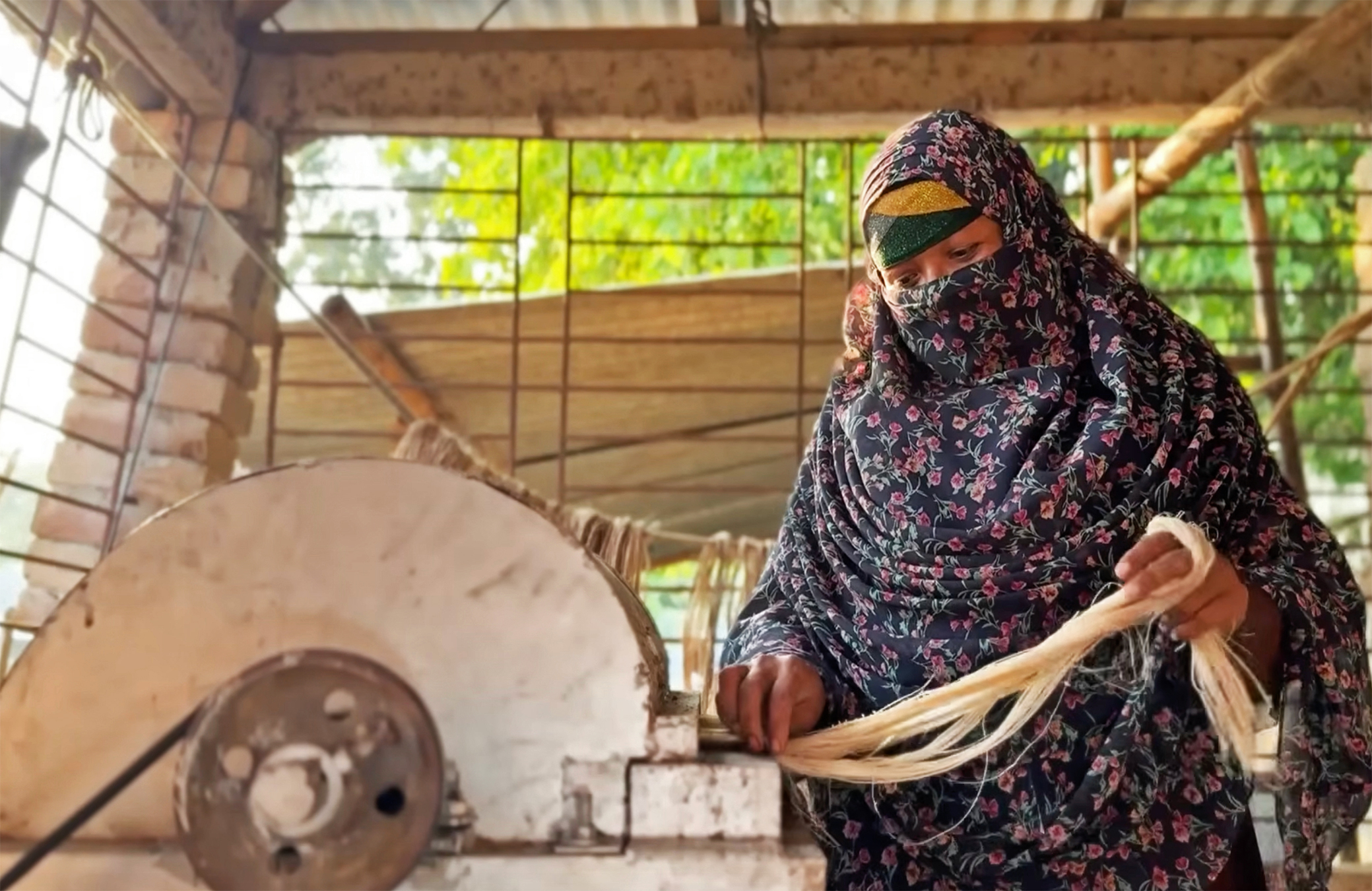
- In Bangladesh, the agricultural byproduct of bananas, the fiber from the stems, is used to produce handicrafts, sarees, curtains, mats, and bags, among other products.
- A study shows the country could commercially produce around 37,778 tons of banana fiber, with the potential to generate more than $94 million in export earnings annually.
- The price of banana fiber in the local and global markets is more than double that of jute fiber.
- Currently, the country earns around $1.5 million from banana fiber exports annually.
Bananas make up 20% of all fruit crops grown in Bangladesh, and the country has begun to unlock the hidden potential of the plant’s agricultural byproducts. Banana fiber, extracted from post-harvest stems, is emerging as a versatile biodegradable material that can be used to manufacture textiles, blended yarns and handicrafts.
In Bangladesh, banana fiber is used to make handcraft biodegradable items like the highly celebrated Kolaboti saree, curtains, mats, bags, handicrafts, ropes, paper, packaging material and eco-friendly composite products .
According to World Population Review data, Bangladesh ranked 27th in global banana production in 2024, producing roughly 813,600 tons annually. India was the largest producer, with about 37.6 million tons.
A 2024 study shows that Bangladesh could produce around 37,800 tons of banana fiber annually and generate more than $94 million in export earnings if the sector is commercialized effectively. In the Bangladeshi market, banana fiber is sold by some small and medium entrepreneurs for around 150 takas to 500 takas per kilogram (roughly $1.20 to $4 for 2.2 pounds).
The study also shows that Bangladesh has significant potential for banana fiber production because banana is cultivated across 54,756 hectares (133,305 acres) of land. The country generates substantial biomass from banana pseudo-stems, estimated at around 3.78 million tons annually, of which approximately 1% can be extracted as fiber.
According to the study, banana fiber is generally more cost-effective on the raw material end because it uses agricultural waste, while jute requires dedicated cultivation. However, the market price of banana fiber is more than double that of jute fiber.
Bangladesh is the world’s second largest producer of jute fiber and the top exporter. The country produces an estimated 1.3-1.5 million tons of jute annually, contributing roughly 30-40% of global output.
Meanwhile, a 2025 study shows that banana fiber has higher tensile strength, good flexibility and silk-like softness in its inner fibers, while jute fiber has a coarser texture.

Local manufacturers are scaling up
Local banana fiber manufacturers are scaling up, although challenges in technology and standardization remain. Entrepreneurs began with locally made fiber-processing machines, but these machines often cannot produce high-quality fiber, limiting product prices. Technology-supported machine modernization is therefore needed.
Among the entrepreneurs, Parveen Akhter from the southwestern district of Narail said it costs about 200 takas ($1.6) to 350 takas ($2.8) to produce 1 kilogram (2.2 pounds) of banana fiber, including labor and electricity. She collects banana stems from orchards near her home and, after cleaning them, extracts fiber from the trunks.
She told Mongabay, “One machine usually needs two people: one to operate it and another to process the stalks. After preparing the banana fiber, we sell it to export buyers for 500 takas [$4] to 600 takas [$5] per kilogram.”
Md Hafijul Islam, owner of New Bhai Bhai Engineering Workshop in Gazipur, near Dhaka, collects banana fiber from 250 entrepreneurs across the country and exports it to China. He also sells machines for producing banana fiber.
In Hafijul’s factory, about 20 to 25 staff members make hundreds of handicraft items, including baskets and flower vases, which are sold in tourist destinations such as Cox’s Bazar, Sylhet and Kuakata. He also supports a network of more than 1,000 local women who braid fiber at home during their spare time, earning extra income for their families.


“I started this journey back in 2016, but I didn’t begin manufacturing my own machines until 2021,” Hafijul told Mongabay. “I saw videos from China and India where they were using machines to turn banana trees into fiber for products such as sanitary pads, and I thought, ‘If they can do it, we Bangladeshis can do it too.’”
“I sell machines ranging from 30,000 takas [$250] to 120,000 takas [$1,000], depending on their production capacity,” he said. “But I don’t just sell the machines; I provide training and a 10-year buy-back agreement. I tell my entrepreneurs they can sell their fiber back to me for the next decade.”
Entrepreneurs said the process is straightforward but labor-intensive. It takes about five to eight banana trees to produce one kilogram of fiber. They categorize the fiber into three grades: A-grade, priced at 600 takas ($5) per kilogram; B-grade, at 350 takas ($3) to 500 takas ($4); and C-grade, at 180 takas ($1.5).
Banana fiber export earnings
Companies such as Banana Fiber BD in Narsingdi specialize in extracting fiber from discarded banana stems and producing export-grade raw fiber, yarn, bags and handicrafts. Aliza Handicrafts exports banana fiber alongside other natural fibers to overseas buyers. Other producers, including Modern Banana Fiber Company Ltd., Artic Fiber and Musa Banana Fiber, are also expanding production to meet increasing global demand for sustainable, biodegradable materials.
EcoFiber BD supplies and exports premium raw banana fiber from Bangladesh. Founded in 2025, they work with a nationwide network of more than 1,000 fiber entrepreneurs, together capable of supplying up to 100 tons of natural fiber every month.
The 2024 study shows that Bangladesh’s banana fiber exports are still emerging but promising. Companies such as Musa Banana Fiber, Modern Banana Fiber Company Ltd. and others export to markets in Eastern Europe, South America, Oceania and Central America, with a total export value typically around $1.5 million. Modern Banana Fiber exports fiber worth around $400,000 annually.
While current volumes are modest compared to potential output, established trade relationships provide a foundation for growth. The focus remains on raw and semi-processed fiber, with significant room for value-added products.

Compost could increase profit
After extracting banana fiber from pseudo-stems, the remaining waste can be converted into high-quality vermicompost, generating significant additional revenue.
According to the 2024 study, Bangladesh could produce approximately 37.4 million tons of compost annually from this process, which can be sold at around $52 per ton, yielding an estimated annual income of about $20 million from compost alone.
One of the study’s researchers, Rojina Akter, an assistant professor at the Asian University of Bangladesh (AUB), said banana fiber production could be highly profitable while promoting sustainable waste management and a circular economy in Bangladesh. Vermicompost produced from the leftover waste after banana fiber extraction is a nutrient-rich organic fertilizer that can be used in agriculture, horticulture and organic farming.
“In Bangladesh, bananas are available throughout the country year-round,” Akter told Mongabay. “Therefore, if the government pays attention to this sector and the textile industry prioritizes it, banana fiber has immense potential.”
Banner image: An entrepreneur extracts banana fiber from the stems of banana plants in Pabna, west-central Bangladesh. Image by Md Hafijul Islam.
Banana fiber sari offers sustainable, biodegradable alternative in Bangladesh
Jute loses ground to plastic despite Bangladesh’s packaging law
Citations:
Based, M. A. (2025). Extraction of banana fiber and characterization analysis of hybrid (banana, jute, carbon and glass) reinforced composite materials. Results in Materials, 28. doi:10.1016/j.rinma.2025.100803
Kader, M. A., Hossain, H., Akter, R., & Sulaiman, M. (2024). Unlocking the potential of banana fiber exports from Bangladesh: A comprehensive marketing strategy analysis. Journal of Hunan University Natural Sciences, 51(7). Doi:10.55463/issn.1674-2974.51.7.19
Cite this article
Md Jahidul Islam (2026). A banana byproduct transforms farm waste into profits in Bangladesh. Mongabay Conservation news. DOI: https://doi.org/10.66709/news-325560

