


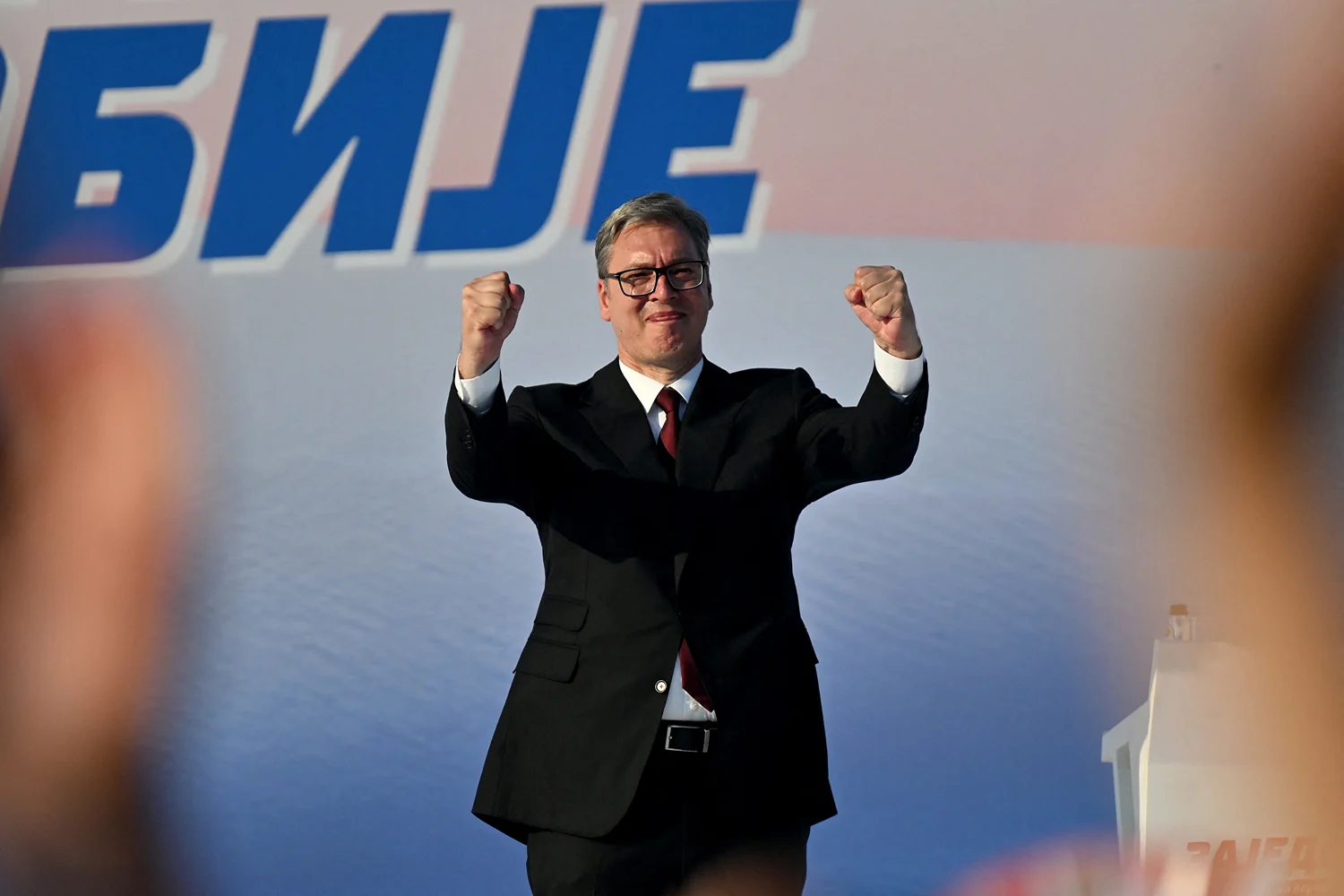
On July 17, the United States and Serbia jointly announced a strategic dialogue—a formal, permanent architecture of diplomatic engagement between the two states. The move is hardly earth-shattering; the United States maintains the same posture with dozens of other countries, and even does the same in the Western Balkans with Slovenia, Croatia, Albania, and North Macedonia.
Yet the shift suggests worrying things about the direction of U.S. foreign policy and its impact on the security and stability of a highly volatile region. It is especially strange in the context of Serbia’s growing closeness with China and its leaders’ aspirations to autocracy.
On July 17, the United States and Serbia jointly announced a strategic dialogue—a formal, permanent architecture of diplomatic engagement between the two states. The move is hardly earth-shattering; the United States maintains the same posture with dozens of other countries, and even does the same in the Western Balkans with Slovenia, Croatia, Albania, and North Macedonia.
Yet the shift suggests worrying things about the direction of U.S. foreign policy and its impact on the security and stability of a highly volatile region. It is especially strange in the context of Serbia’s growing closeness with China and its leaders’ aspirations to autocracy.
In mid-July, Serbian President Aleksandar Vucic’s government suffered a major political setback when it became clear that, despite the urging of the European Commission, Serbia would not be permitted to proceed to the next stage of its European Union membership accession process. Nearly a third of all EU capitals opposed the move due to significant democratic backsliding in Serbia, which has occurred under Vucic’s leadership and has particularly accelerated over the past three years.
The pushback was a major blow to Vucic’s reelection bid. The country is mandated to hold parliamentary elections by the end of 2027. Since 2012, when Vucic’s hard-right Serbian Progressive Party (SNS) assumed power, as a successor to the ultranationalist Radicals in whose ranks he spent the 1990s and 2000s, Serbia has held parliamentary elections approximately every two years.
The frequent snap polls have been used by the SNS to dismantle Serbia’s institutional opposition. But ever since a deadly canopy collapse in Novi Sad in November 2024, the regime has been confronted by massive student-led protests that it has been unable to curb.
For Vucic, who has styled himself as a kind of Serbian-nationalist version of former Yugoslavian leader Josip Broz (“Tito”), perpetually able to balance between East and West, the EU’s tacit “no” was a sharp snap to reality. No halfhearted visit to Ukraine would do to reset matters with the European capitals. They had simply become too aware of his consistent efforts to undermine neighboring states, his deepening commitments to China, his ongoing alliance with Russia, and, of course, his generally autocratic rule.
Matters hardly improved when Serbian media published an interview with Snezana Paunovic, Serbia’s minister for state administration and local self-government, in which she bemoaned that the country’s former leader and genocidal strongman, Slobodan Milosevic, had engaged in an insufficient scale of ethnic cleansing in Kosovo. European officials and members of the European Parliament were aghast, but both Serbian Interior Minister Ivica Dacic and Vucic himself supported Paunovic’s comment. Both Vucic and Dacic served in Milosevic’s last cabinet, and they were pallbearers at his funeral.
Whatever the case, the announcement of the U.S.-Serbia Security Dialogue was like manna from heaven for the waning political fortunes of a man who had just traveled to Beijing for a five-day visit, which he called “the most important” one of his political career. Vucic’s own sympathies have always been with the personalist regimes in Russia, China, and Iran, but even his own voters understand that Serbia depends economically on its relations with the West. Thus, for Serbia to lose the support of the EU is dangerous, but to lose the support of both the Europeans and Americans is fatal.
So, the Trump administration may well have saved the Vucic regime from political ruin. But why?
The Serbian regime has certainly not been above groveling. Vucic has made repeated, direct appeals to U.S. President Donald Trump, writing, for example, in Fox News op-ed: “While others may scoff at your vision, Serbia understands it. While others may fear your strength, Serbia respects it.” Milorad Dodik, a Bosnian Serb secessionist and Belgrade vassal, also routinely writes hagiographic posts about the U.S. president on his social media. Dodik has also paid millions in lobbying contracts to Trump world insiders and social media surrogates, managed to secure sanctions relief for himself last year, and has since even enlisted Trump’s purported spiritual advisor Pastor Mark Burns to engage in thinly veiled genocide revisionism.
The Serbian nationalist establishment has also invested heavily in convincing its American counterpart that it is involved a shared civilization struggle—that the systematic crimes against humanity that the Milosevic regime perpetrated in Kosovo and Bosnia and Herzegovina in the 1990s, and which remain objects of glorification by the governments in Belgrade and Banja Luka, were heroic Christian crusades. Serbian nationalist organizers in the United States have already largely managed to rehabilitate the image of Nazi collaborator Dragoljub Mihailovic, so they figure that Milosevic, Radovan Karadzic, and Ratko Mladic are the logical next steps.
None of this is good for the United States, though—not for its strategic interests in the Western Balkans, not for its global posture against China, and certainly not for any effort that seeks to reintroduce moral clarity into U.S. foreign policy.
Therefore, aside from the fact that Vucic and Dodik are clearly trying to buy American acquiescence for their regional machinations—which in no way align with Washington’s long-term interests in the Western Balkans—there is also a deeply poisonous effect on the American body politic.
The U.S. response to the dissolution of Yugoslavia was not without its flaws. Both the George H.W. Bush administration and the Clinton administration waffled and delayed, which allowed the worst atrocities in Europe since the Holocaust to unfold under their watch. And contra Vucic, if there was any error associated with the U.S.-led bombing campaign of Serbia in the 1998-1999 Kosovo War, it was that it came about seven years too late.
But the United States’ interventions in the Balkans were nevertheless largely driven by the logic of atrocity prevention. It is why the Bosniak and Albanian majority populations of Bosnia and Kosovo, respectively, are two of the most pro-American populations in the world to this day. In contrast, their Serbian neighbors overwhelmingly look to China and Russia.
It is legitimate and normal for bilateral relationships to evolve. What is not typical, nor desirable, is for such resets to come at the expense of the United States’ security or moral standing.
