


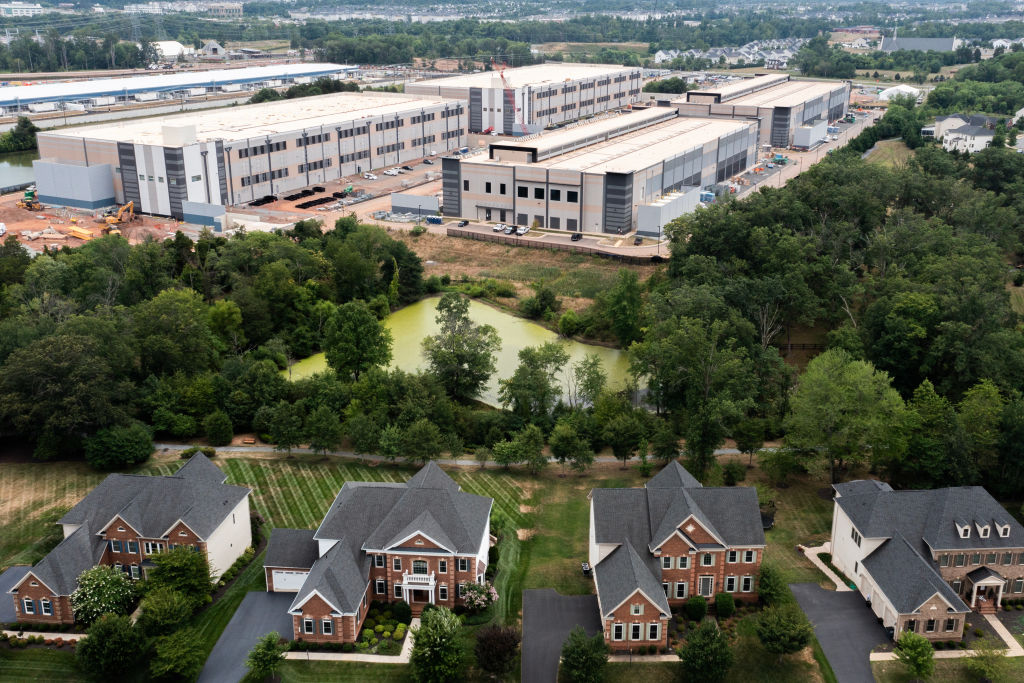
An Amazon Web Services data center is situated near single-family homes in Northern Virginia, known as “data center alley.” (Photo by Nathan Howard/Getty Images)
Virginia residents say they don’t want data centers in their neighborhoods. Politicians have expressed hesitancy about unchecked expansion. But the money trail raises questions.
Three Northern Virginia Democrats representing the world’s largest data center market have received tens of thousands of dollars in campaign contributions from industries positioned to benefit from the artificial intelligence and data center boom.
Northern Virginia has been dubbed “data center alley” for the large number of massive, windowless structures proliferating in the suburbs just northwest of Washington, D.C, consuming vast amounts of electricity and requiring extensive cooling infrastructure.
Rep. Suhas Subramanyam (D-Va.), who is running for a second term in Congress, represents Loudoun County, which houses 293 operational data centers, with 154 more planned. In Loudoun alone, the number of data centers has more than doubled in the last five years and they now cover over 53 million square feet – equivalent to about 1,000 football fields or 14 Disneylands.
As of June 30, Subramanyam has received $11,000 from individuals employed by Alphabet Inc., Google’s parent company, during the 2026 election cycle. Vinton Cerf, a recently retired Google executive, accounts for half of this total, giving $7,000 to Subramanyam’s campaign this year.
Google has become a major player in Virginia’s AI infrastructure landscape, investing $9 billion in the state’s data centers and amassing 148 acres of land in Loudoun County for cloud infrastructure and data processing. The company has stated that it is building these centers “responsibly” and is launching initiatives to help drive down monthly utility bills for Virginians. However, support for the facilities among residents has dwindled, plunging from 69% in 2023 to 35% in 2026 according to a Washington Post-Schar School Poll.
Amazon has also made Loudoun County a major hub for its data centers through Amazon Web Services. Subramanyam received $2,000 from Amazon’s PAC.
Subramanyam has called for a National Strategic Data Center Plan and cautions against the rapid, unchecked expansion of data centers. At the same time, he was also one of eight Democratic House incumbents endorsed by Leading the Future, a pro-AI super PAC network that aims to elect candidates who want to unleash the industry, with limited restrictions. The super PAC has raised more than $100 million and works through two partisan arms, American Mission (supporting Republicans) and Think Big (Democrats). Both have spent nearly $25 million, but have not allocated any of these funds to Subramanyam’s campaign.
In the neighboring 11th district, Rep. James Walkinshaw (D) has also received tens of thousands in contributions from individuals and political action committees with ties to the state’s data center expansion. Walkinshaw received $15,000 from Science Applications International Corporation (SAIC) PAC, a government technology contractor that provides cloud infrastructure and services used to operate data centers.
Walkinshaw has stated that there are some appropriate locations for data centers, pushing for them to be concentrated within industrial areas of the district. He has also argued that data center companies should fully assume the electricity costs of these facilities.
High-level executives and PACs affiliated with companies like Microsoft, Amazon and Google, some of the most prominent forces behind the state’s data-center boom, have also poured more than $10,000 into Walkinshaw’s campaign. Shannon Kellogg, vice president of public policy at Amazon Web Services contributed $2,000 while Nima Binara, global data disclosure strategy counsel at Google, gave $3,500. Amazon’s PAC gave $5,000 to Walkinshaw’s campaign, while Google’s PAC gave $1,500 and Microsoft’s PAC gave $1,000.
Walkinshaw also received $14,000 in contributions from individuals employed by Granite Telecommunications, a provider of network and cloud connectivity infrastructure necessary for high-capacity data centers. Half of those funds came from Robert Hale, the company’s CEO, who has also given $7,000 to Democratic Rep. Don Beyer (Va.).
Beyer raked in a combined $21,000 from two Anthropic AI researchers, Steven Bills and Todor Markov. Both Bills and Markov previously worked for OpenAI before resigning and joining Anthropic.
Anthropic has emerged as a major force in the building of AI infrastructure. The company behind the Claude chatbot recently signed more than a dozen letters of intent with multiple U.S. data center developments in an effort to directly control its servers and infrastructure.
Beyer received $1,000 from Microsoft’s PAC, $1,000 from Google’s PAC and $6,000 from SAIC PAC. He also received $14,000 from individuals affiliated with Zetta Venture Partners, a venture-firm partnering with AI and data infrastructure companies. Half of this came from Mark Gorenberg, the firm’s managing director.
Beyer has not endorsed a total moratorium on data center construction like some other progressive lawmakers, but has rather focused on electricity rate reforms and expanding the power grid’s capacity.
