


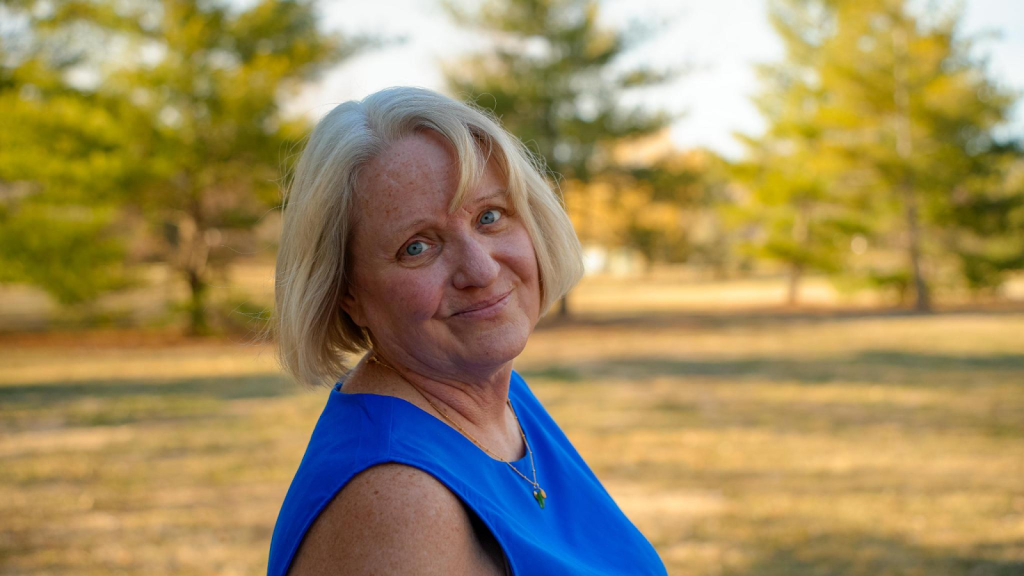
Democrat Cindy Burbank dropped out of the Senate race in Nebraska after winning the party’s nomination. (Photo by Cindy Burbank for Senate)
Most U.S. Senate candidates spend millions just to survive the primary season. In Nebraska, Democrat Cindy Burbank spent less than $20,000, won in a landslide – and then dropped out.
After capturing the nomination with nearly 90% of the vote, Burbank withdrew in mid-July. The move cleared the November ballot of a Democratic nominee – triggering a lawsuit from the candidate she defeated – and consolidated non-Republican voters behind independent Dan Osborn, a Navy veteran and mechanic whom the state Democratic Party chair had publicly backed a year ago.
Nebraska Secretary of State Bob Evnen called it a “cynical manipulation of the ballot process.” University of Nebraska at Omaha assistant political science professor Huchen Liu characterized it as a “ruse or a maneuver” carried out with the understanding that Burbank would step aside after winning.
“The Democrats did an extremely good job of getting the word out cheap,” Patrick Borchers, a law professor at Creighton University, told OpenSecrets.
It leaves Republican incumbent Pete Ricketts and Osborn – who avoided a costly primary and no longer risks splitting votes with a Democrat – as the main players in the November race. However, the ballot shift offers little financial benefit to Osborn, experts say. While it preserves his existing war chest, it doesn’t meaningfully alter his core fundraising or spending requirements entering the fall.
“From a campaign finance perspective, almost nothing happened to Dan Osborn,” Liu said. “A little more happened in his favor in terms of actually winning votes.”
(function(){function e(){window.addEventListener(`message`,function(e){if(e.data[`datawrapper-height`]!==void 0){var t=document.querySelectorAll(`iframe`);for(var n in e.data[`datawrapper-height`])for(var r=0,i;i=t[r];r++)if(i.contentWindow===e.source){var a=e.data[`datawrapper-height`][n]+`px`;i.style.height=a}}})}e()})();
Through June 30, Osborn raised nearly $5.8 million – making him the highest-raising independent Senate candidate on the ballot this year. His total is roughly half of the $11.2 million raised by Ricketts, according to Federal Election Commission filings. The Cook Political Report rates the race as likely Republican.
Freed from an expensive primary battle, Osborn spent less than $900,000 during the second quarter and entered July with $2.4 million in cash on hand. Still, Burbank’s departure “does not give Osborn a major financial boost,” Liu said, noting that he was never facing a primary opponent to begin with.
What it does eliminate is the cost of persuading Democrats not to vote for their party’s nominee.
“Not everybody’s super well-informed,” Borchers said. “There are going to be anti-[President Donald] Trump voters or normal Democratic voters who are just going to fill in the Democratic bubble. And almost all of those votes would have come from Osborn, which would almost surely keep him from having any chance of beating Ricketts.”
An Osborn campaign spokesperson told OpenSecrets in a statement that the team had “nothing to do with Cindy Burbank, and [has] not been in coordination with her or the Nebraska Democratic Party.” OpenSecrets reached out to state Democrats and to the Burbank and Ricketts campaigns but did not immediately receive any responses.
Burbank’s path to the primary ballot
Burbank’s exit capped a brief campaign that began with a legal fight simply to appear on the ballot at all.
The 62-year-old retired pharmacy technician entered the race on March 2, a day before she filed her statement of candidacy with the FEC. When Evnen refused to certify her candidacy weeks later, Burbank sued, and the state Supreme Court eventually sided with her, ruling that her name be placed on the primary ballot because state officials and the GOP did not formally object within a seven-day window as required by state law.
She cruised to victory in the May 12 primary, securing the nomination with more than 110,000 of the over 123,000 votes cast. Still, she repeatedly stressed that she would consider quitting the race if she didn’t see a path to victory, telling NBC News before the primary that “I will drop out when and if the time comes that I cannot win in November.”
That time apparently arrived on July 17. One day after Evnen’s office verified that Osborn’s campaign collected enough signatures by petition to appear on the ballot, Burbank posted a video to Facebook of herself at a courthouse explaining that she was leaving the race, saying, “I’ve looked at the numbers. I won’t be your next senator.” In subsequent posts, she urged her supporters to instead donate to Osborn’s campaign and referenced the nearly $5.3 million Ricketts contributed to his own, saying, “it could not have been more obvious that I could not stay in that ring.”
Under state law, primary winners have until Aug. 3 to formally file a declination of nomination to ensure their name is removed before November ballots are printed. Because she met that deadline, Evnen said in a sharply critical statement that he had “no discretion to refuse.”
The state saw a similar maneuver two years earlier on a smaller scale, in a race the Democrats sat out. Kerry Eddy won the Legal Marijuana NOW party’s Senate primary, then withdrew before the general election and threw her support to Osborn, who lost to Republican incumbent Deb Fischer. Railroaders for Public Safety, a super PAC that spent nearly $1.2 million to support Osborn during that cycle, also spent $34,000 to back Eddy – double what Eddy’s campaign both raised and spent. That super PAC has not reported any independent expenditures in the current cycle.
“They went through kind of the same thing that Democrats went through this time,” Borchers said.
A micro-budget campaign
Burbank ran one of the leanest major-party Senate campaigns in recent memory. FEC records show her committee raised $39,711 and spent $18,945 between Jan. 1 and June 30 – an effective cost of roughly 17 cents per vote. By comparison, Illinois Lt. Gov. Juliana Stratton ($5.51), former North Carolina Gov. Roy Cooper ($8.99) and Texas state Rep. James Talarico ($13.08) each spent significantly more per vote apiece to win their respective Democratic Senate primaries.
Burbank’s total included about $20,000 in itemized individual contributions, largely through ActBlue pass-throughs, and roughly $19,000 in unitemized, small-dollar donations. She reported no transfers from political action committees or party committees.
Her spending came entirely on operating expenses such as service fees and reimbursements. Two outside groups reported spending to support her: the Common Defense Action Fund (roughly $190,000) and the Nebraska Democratic Party (less than $140,000).
“It’s probably a good thing for the campaign to have both raised and spent a minimal amount of money,” Liu said. “We would not have liked to see a disingenuous campaign that raised and spent a lot of money anyway, right?”
Burbank’s campaign held just over $20,000 in cash on hand on June 30 – a relative pittance compared to the millions in the accounts of two other Senate candidates who are no longer in their respective races. In Maine, Democratic nominee Graham Platner, who withdrew amid sexual assault allegations, reported a war chest of nearly $1.8 million as of June 30. South Carolina Sen. Lindsey Graham (R), who died July 11 age 71, had $2.3 million in cash on hand through June 30 after raising $21.5 million since 2021 – the most among Republican Senate candidates running this year.
For Burbank, even her modest financial footprint dwarfed her primary opponent’s: William Forbes reported no monetary contributions from individuals or committees. His entire financial activity consisted of a single $1,000 in-kind contribution – an out-of-pocket payment to a Wyoming-based consultancy and advertising firm.
Burbank defeated him handily in May with nearly 90% of the vote. Forbes, a pastor, was accused by state Democrats of being a decoy candidate – with Burbank calling him “Pete Ricketts’ stooge” on her website. He told CNN in March that he voted for Trump and attended a training session for conservative candidates recommended and promoted by the state’s Republican Party.
“There wasn’t really anything to compete with, in that sense, because I don’t think Forbes spent any money,” Borchers said. “It wasn’t the kind of primary where anybody was doing direct mail, or certainly not TV or radio or anything like that.”
Forbes then sued state Democrats to force them to replace Burbank on the ballot. The lawsuit filed in Lancaster County District Court days after Burbank’s withdrawal states the party “has an obligation to replace” her, saying state law requires it. A spokesperson for Evnen declined to comment on the lawsuit. OpenSecrets reached out to Forbes through his Paxton, Neb., church but did not immediately receive a response.
In a statement, party chair Jane Kleeb blasted the lawsuit as “frivolous” and Forbes as “a Ricketts plant,” saying Democrats do not have to nominate a replacement.
Two candidates, two fundraising worlds
Burbank’s exit leaves two main candidates with sharply contrasting fundraising styles.
Osborn has amassed one of the nation’s largest totals among candidates who do not belong to either major party. He leads all independent Senate candidates on the ballot this year, and among all independents trails only Sen. Bernie Sanders (Vt.), who raised $24.9 million through June 30 but is not up for re-election until 2030.
Of the $5.7 million his campaign has raised, more than 97% ($5.5 million) came from individual contributions, FEC records show. That includes $3.3 million in itemized contributions and nearly $2.2 million in unitemized, small-dollar donations. Another $138,000 came via transfers from other committees, including several PACs affiliated with labor unions.
By contrast, nearly half of the more than $11 million raised by Ricketts – the son of TD Ameritrade founder Joe Ricketts and one of the wealthiest members of Congress – came directly from his own pocket via a $5.25 million contribution on May 11. His campaign also received nearly $1.6 million in transfers from his joint fundraising committee.
Ricketts held $6.9 million in cash on hand as of June 30 – nearly three times more than Osborn’s war chest.
Unburdened by a primary, Osborn spent $890,000 between April 1 and June 30, allocating nearly $75,000 on polling and $37,000 on digital consulting while expanding his national fundraising and direct-mail footprint.
“The Osborn-Ricketts race – there’s money in that one,” Borchers said.
