


Unlock the Editor’s Digest for free
Roula Khalaf, Editor of the FT, selects her favourite stories in this weekly newsletter.
Japan’s Prime Minister Sanae Takaichi has said authorities are in a “race against time” to find survivors after a powerful earthquake left at least 13 people dead.
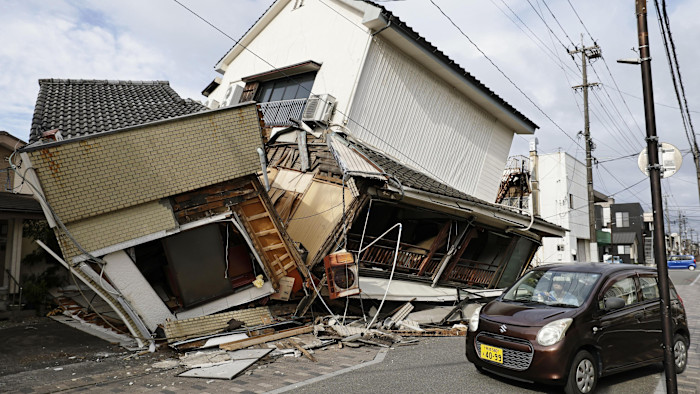
The earthquake hit Kumamoto prefecture with an estimated magnitude of 7.1 at 4.27pm local time on Tuesday, buckling roads, cutting power to tens of thousands of homes and causing the collapse of some buildings.
“As of 8.30am today, authorities have confirmed 13 deaths, including cases still under investigation as to whether they are disaster-related,” said Takaichi. “In addition, extensive damage has been confirmed, including injuries, collapsed buildings, fires, and damage to roads and other infrastructure.
“There are still people waiting to be rescued, and this is now a race against time. We will marshal every available resource on the ground in an effort to save as many lives as possible,” she added.
Takaichi has deployed 3,600 members of the country’s Self-Defense Forces to the prefecture, on the island of Kyushu, to help with the aftermath, including restoring water and power supplies.
At least two people died after an explosion at the Aeon Mall in the town of Kashima, according to national broadcaster NHK, with another six people rescued from the building. Multiple injuries have been reported with at least seven people still missing.
Aeon said on Tuesday that the explosion occurred after the shopping centre was evacuated following the earthquake.
Kyodo News agency said two people had been found “unresponsive” at a Nippon Paper Industries plant in Yatsushiro city, where a smokestack had collapsed, while nine others remained unaccounted for.
Japan’s meteorological agency said the earthquake occurred at a relatively shallow depth of about 10km, making it and subsequent strong aftershocks particularly intense. The agency warned people of possible further quakes in coming days.
The last earthquake of such severity in Japan was in 2024 on the Noto Peninsula, resulting in hundreds of deaths. Kumamoto itself was hit by large earthquakes in 2016.
The region around Kumamoto is home to a large number of Japanese industrial companies, including significant semiconductor plants and car manufacturers.
Taiwan Semiconductor Manufacturing Company, the world’s largest chip manufacturer, initially evacuated workers from its plant in Kumamoto but said operations were gradually resuming after structural inspections.
Carmaker Toyota also suspended operations following the earthquake but planned to resume operations on Wednesday. Nissan said production at its plant “continues as planned”.
However Sony said its plant in Kumamoto, which produces image sensors used in devices from cars to smartphones and digital cameras, remained suspended. “Damage to the site’s building and manufacturing lines is currently being evaluated,” said the company.
