


It’s not just the energy and geopolitical shocks of the Iran war that are set to leave their mark on the global economy this year. There’s also El Niño.
The world is already experiencing the naturally occurring weather phenomenon, which drives anomalous weather conditions and has the power to scorch or drench. El Niños see abnormally warm Pacific waters that pump heat into the atmosphere. That surge in heat shifts global rainfall and temperatures, fueling wetter conditions in some places and drier conditions in others.
It’s not just the energy and geopolitical shocks of the Iran war that are set to leave their mark on the global economy this year. There’s also El Niño.
The world is already experiencing the naturally occurring weather phenomenon, which drives anomalous weather conditions and has the power to scorch or drench. El Niños see abnormally warm Pacific waters that pump heat into the atmosphere. That surge in heat shifts global rainfall and temperatures, fueling wetter conditions in some places and drier conditions in others.
That may sound routine, but the consequences can be stark. Prior El Niño events are estimated to have cost the global economy at least tens of billions of dollars, or by some estimates even trillions, impacting tens of millions of people worldwide. And with this El Niño forecasted to be one of the strongest on record—and landing as the world reels from the 11 hottest years on record—governments are on high alert.
El Niño has the potential “to cause or contribute to a series of potentially cascading failures in the global food system and also be a really significant source of conflict and fragility in the developing world,” said Cullen Hendrix, a senior fellow at the Peterson Institute for International Economics.
El Niños typically occur every two to seven years, according to Brian Barker, a principal faculty specialist at the University of Maryland who works for NASA Harvest, the agency’s food security and agriculture program. But no two events are identical; each El Niño differs based on when it develops, atmospheric conditions, and how it strengthens, he said.
This year’s event is still strengthening and is poised to peak in the winter. But it has already made waves because it is forecasted to be “very strong”—the highest of four levels at the U.S. National Oceanic and Atmospheric Administration (NOAA).
The strength of an El Niño matters because it influences the probability of what will happen. Strong El Niños in particular are a big deal because they increase the odds that precipitation shifts mirror historic impacts. “A stronger El Niño increases your likelihood of having a certain outcome—it doesn’t make it a certainty,” said Andrew Hoell, a research meteorologist at the NOAA Physical Sciences Laboratory.
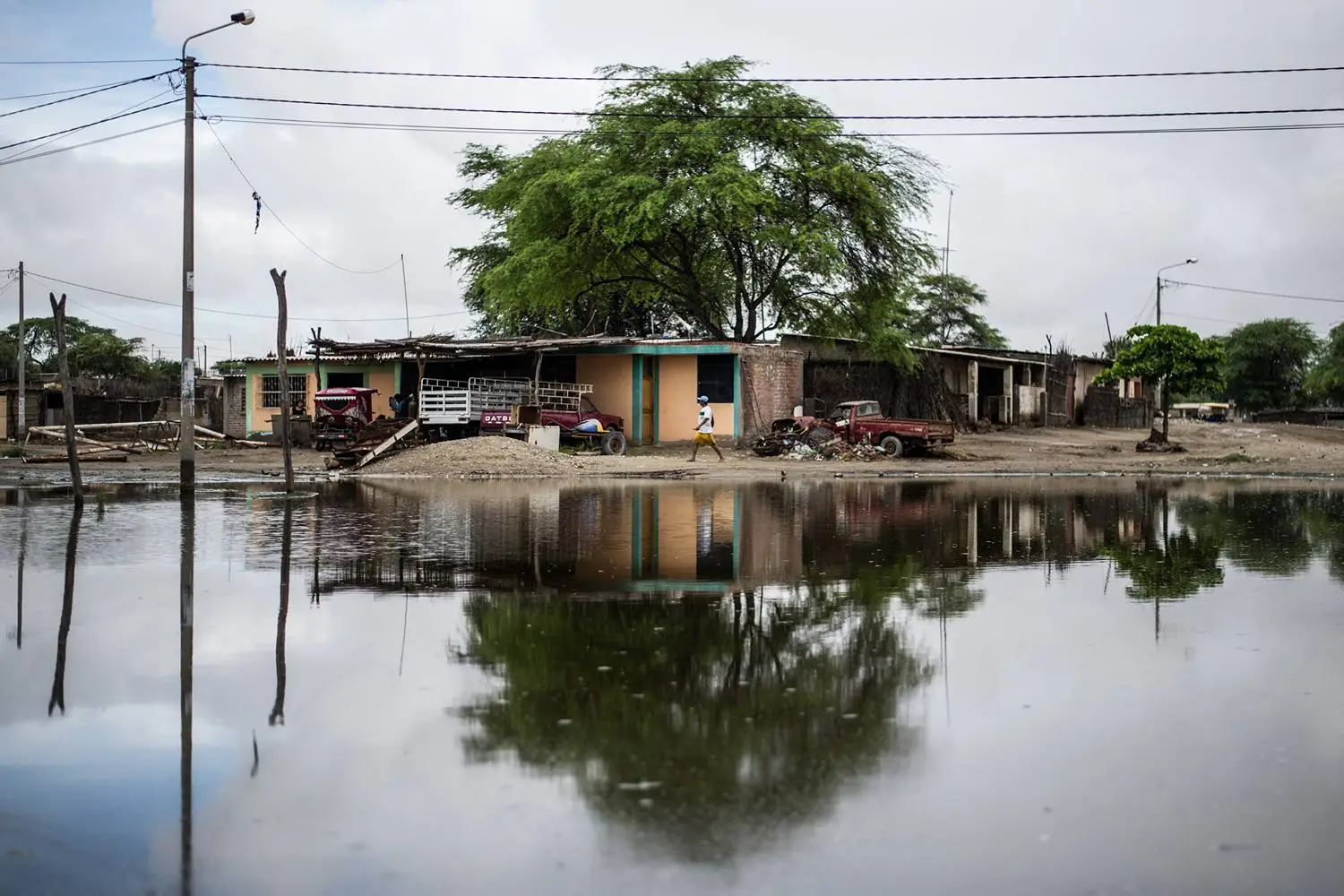
There have only been four other El Niños at this level, most recently between 2015 and 2016, according to Barker. That event fueled a brutal drought in South Africa and India—which should have been seeing a rainy season—at the same time that it contributed to harrowing flooding across South America, wreaking havoc on some farmers’ livelihoods and straining other communities.
Estimates of the average economic toll of the phenomenon have ranged from tens of billions of dollars to a few trillion dollars. Hendrix warned in a recent report for the think tank that this event could inflict a massive economic cost that disproportionately hits lower- and middle-income countries.
“If the intensity of El Niño winds up of similar magnitude to the last Super El Niño in 1997–98, the contemporaneous economic losses will be on the order of $686 billion,” Hendrix wrote. “Unless the international community and national-level policymakers start acting now, those losses could rise to $3.1 trillion over the next five years.”
Emerging-market economies are particularly worried. Anthony Nyong, the African Development Bank’s top climate official, told Reuters this month that the event threatens to take a $10 billion to $20 billion toll across heavily impacted African countries and drive up mass migration as food prices soar. “When these shocks happen, countries take two steps back,” Nyong said. “We don’t want our countries to slide into poverty.”
Some of the biggest risks are in the agricultural sector. Yet on a global level, impacts are highly uneven, with the weather phenomenon bringing moisture into some regions and throttling agricultural yields in others. From region to region, crop production impacts tend to offset each other.
This El Niño could be a boon for agricultural yields in the United States, Central Asia, and parts of East Africa and South America, according to a report by the Group on Earth Observations Global Agricultural Monitoring.
The sharpest pain will be felt at the regional level. Trouble looms for southern Africa, Central America, India, and Australia, the report said, with southern Africa—which will be entering its primary corn season at the same time that El Niño is expected to peak—facing some of the biggest risks. South Africa’s maize sector also suffered during the strong El Niño events of 1997-98 and 2015-16, with yields plunging by about 20 percent.
For those more vulnerable countries, analysts fear that the timing of this El Niño—which is striking as they are still grappling with the compounding economic fallout of the Trump administration’s trade wars and the war in the Middle East—is hitting governments at a time of considerable strain. That convergence could cut their bandwidth to prepare for upcoming climate shocks.
“If all these countries around the world are dealing with higher energy costs and higher demands for military spending, that’s just reducing the available fiscal space for responding to the challenges that will inevitably come from these kinds of shocks,” Hendrix said.
Aid agencies are sounding the alarm. Last month, the U.N. Food and Agriculture Organization and World Food Programme (WFP) issued a joint appeal for $202 million to help safeguard nearly 9 million people in high-risk countries from this event’s potential impact.
Across Latin America, governments are ramping up preparations to mitigate El Niño’s wide-ranging impacts. Local authorities in Ecuador are drafting contingency plans for massive flooding, while Brazil has beefed up its wildfire prevention and response effort with more than 4,600 new federal personnel.
The El Niño of 2015-16 triggered an immense humanitarian fallout. The event sparked more than $5 billion in humanitarian appeals across nearly two dozen countries, with more than 60 million people impacted, according to the U.N. Food and Agriculture Organization.
The impact has been enduring, said Richard Choularton, the director of the WFP’s Climate and Resilience Service. “In southern Africa, the El Niño event in 2015 impacted food security at its most severe peak in 2016 and 2017, but has left many communities struggling to recover since then,” he said.
