


Prime Minister Narendra Modi has promised to use technology to make India’s college exams airtight, but India’s student protesters are now more worried about arrests and other steps to suppress their movement.
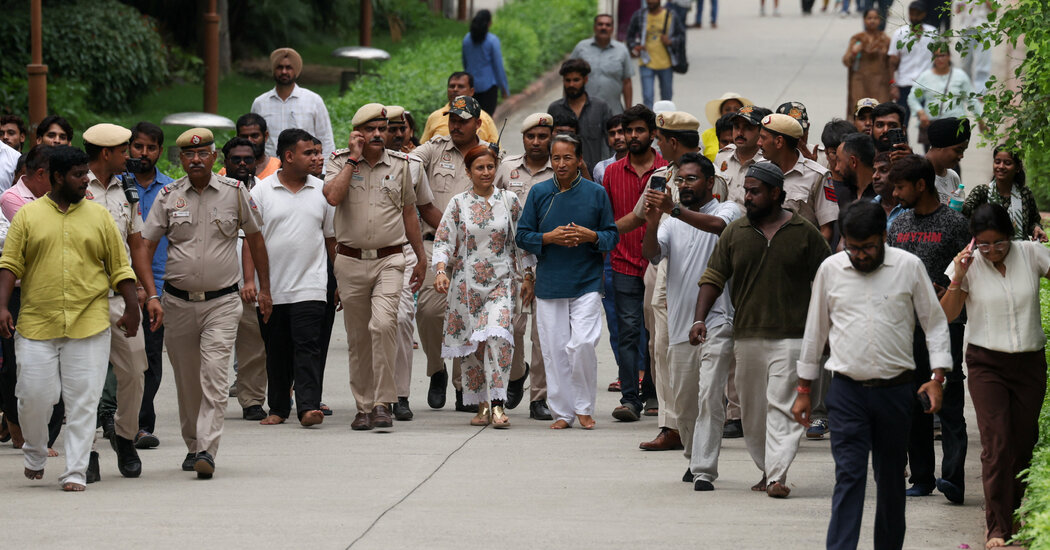
The site in New Delhi where thousands of young protesters braved security forces’ swinging batons and firing tear-gas shells — and who celebrated in triumph on Saturday night — had fallen silent. Gone were the barricades and scrawled slogans, leaving only a heavy police presence on the blocks that shook Mr. Modi like no other challenge in the past 12 years that he has been in power.
To some who joined the demonstrations, the empty roads around the site symbolized a rare victory won through direct public pressure. To others, it suggested a government that knew exactly when to step back, before the movement gathered even greater momentum.
Turning the page for a new week, Mr. Modi announced a high-profile committee to reform the way that exams are administered. The solution would be technological, he implied, and would address the specific complaints over a leak of exam questions that set the movement in motion in May.
But there were signs of a crackdown, too. Hundreds of protesters were arrested in parts of India controlled by Mr. Modi’s Bharatiya Janata Party and its allies, far from New Delhi. One of the promises made to get protesters to call off their action was that no punitive action would be taken against them. Any arrests happening in “these states is therefore a matter of grave concern,” one of the protesters’ spokesmen posted on Monday.
Questions remained over the extent of the victory by the movement, led by a pop-up group calling itself the Cockroach Janta Party.
Officially, their objectives were narrow, focusing on details of a botched standardized testing system and demanding the resignation of the education minister. For many, though, their goals came to seem as broad as the future of Indian democracy itself.
Ashcharya Dagur, a law student based in Delhi, said the outcome proved “that protests are not meaningless; this is a moment that feels bigger than all of us.” But she said the education minister’s resignation was “symbolic” and that changing ministers “would not fix the system.” (Mr. Modi immediately installed a right-wing figure from within his cabinet to the vacated post.)
Some of her fellow marchers were disappointed to see their momentum halted.
“This feels like damage control,” said Raj Kumar, a father of two young students, who had traveled 800 miles from the state of West Bengal to join the protest on Saturday, looking visibly dejected as others celebrated.
By Monday, Mr. Kumar was on the long train ride home. “These protests could have brought a much bigger outcome,” he said in a phone interview, noting the movement’s most prominent leaders were inexperienced. “People who say these protests are only about education and not politics don’t understand that the problems these students are facing today are the result of the politics of those in power.”
Abhijeet Dipke, the 30-year-old who founded the ‘Cockroach’ movement from Boston in May, and who swiftly became its face back in India, said in an interview on Saturday — less than two hours before the education minister resigned — that his group’s aims were bigger than the exam system, which had been plagued by industrial-scale cheating for years.
“If you look at the health care of India, if you look at the electoral malpractice that is happening in India,” he said, “it’s far, far more serious, and dangerous for the democracy.” Since declaring victory Saturday night, and saying he was being treatment for typhoid fever on Sunday, Mr. Dipke has mostly gone quiet.
The Indian government started announcing actions of its own. Taken together, they indicate Mr. Modi wants to offer high-profile technical reforms to the testing system — and ensure he will not be steamrolled by protesters again.
Taking to Instagram, the platform favored by the Cockroach movement, Mr. Modi announced a star-powered task force to root out dysfunction in the examination system. Featuring Nandan Nilekani, the billionaire tech entrepreneur who led the India’s homegrown digital identity and payments programs, the committee represents a step toward ensuring fairness in higher education’s grueling selection process.
Mr. Modi already promised that anyone caught subverting the exams will be punished severely. The much bigger obstacles to helping Gen-Z Indians who pin their hopes on the dream of test results, college admissions and rewarding employment, are left unanswered.
Elsewhere, there were signs of increased suppression. In West Bengal, the new state government installed by Mr. Modi’s party arrested 14 people for participating in a Cockroach-affiliated protest in Kolkata, with the state’s leader claiming they were supported by “Islamic fundamentalists.” In neighboring Bihar, according to a Cockroach spokesman hundreds of protesters were arrested, including an opposition politician’s son.
It was online where the Cockroaches outmaneuvered the Indian government, and now the government is playing catch-up. By Monday, mobile data networks that were shut down for nearly a week had been restored, but Indian newspapers reported that the police had directed social-media companies to take down posts offending Mr. Modi.
