


Unlock the White House Watch newsletter for free
Your guide to what Trump’s second term means for Washington, business and the world
The US paused strikes on Iran for a second consecutive night as mediators sought to prevent the warring parties returning to full-blown war following two weeks of escalatory tit-for-tat attacks.
The US military has not reported any air strikes against Iran since launching attacks overnight on Thursday, while Iranian forces have not mounted any assaults on American bases in the region since Friday.
The hostilities were the most intense since the warring parties agreed to a ceasefire in April. The fighting pushed oil prices to $100 a barrel this week for the first time in two months as the fighting upended an interim deal that the US and Iran signed last month to reopen the strait and extend the truce.
Neither party has commented on the pause. The US military said on Saturday that its naval blockade on Iranian ports remained in place.
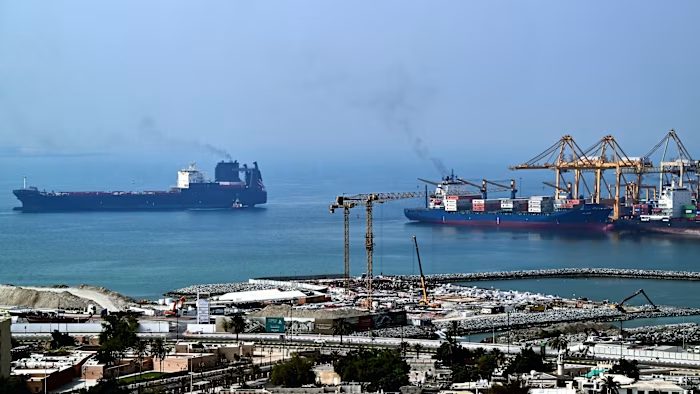
But the pause has coincided with an Omani delegation spending Friday and Saturday in Tehran in a bid to reach a provisional arrangement with Iran to manage the transit of shipping through the Strait of Hormuz, which has become the key battleground of the conflict.
Those talks have focused on how much shipping should be directed through a so-called southern corridor in the strait along the Omani coast and how much should transit through Iranian waters, people briefed on the talks said.
The hope is that an agreement, if reached, would allow ships to resume transiting the strait, which would then create the conditions for the US and Iran to return to talks on a final settlement to end the war. A diplomat briefed on the Omani-Iran negotiations said they were “moving in right direction” and “ongoing”.
Iran’s foreign ministry spokesperson Esmaeil Baghaei said the Omani delegation left Tehran on Saturday, while describing the talks as “constructive” and saying some “progress” had been made.
“Several rounds of talks were held between Iran and Oman at the level of deputy foreign ministers on Friday and Saturday,” he told local media on Sunday. “The two sides exchanged views on shared principles and operational mechanisms for the management of safe transit through the Strait of Hormuz, while respecting the sovereign rights of the two littoral states.”
However, Baghaei said there was no change in “the status of traffic through the strait”, which Iran declared it had closed during the latest escalation. He said talks were continuing.
The flare-up had erupted as the US and Iran battled for control of the strait, through which about a fifth of the world’s oil and gas passed before the war.
The two parties had signed a memorandum of understanding on June 17 that extended the April ceasefire by 60 days, during which Iran would gradually reopen the strait without charging ships fees. The MoU also laid out a framework for talks on a final settlement, including a deal on Iran’s nuclear programme.
The diplomatic process broke down after Iran began to attack ships that attempted to transit the strait along Oman’s coast — the route known as the southern corridor, where the US can provide air cover.
Tehran, which has sought to maintain control of the waterway, said that it was an “unauthorised” channel that violated the MoU.
The US responded by striking southern Iran, including targeting infrastructure such as bridges and ports. It also reimposed a naval blockade on Iranian ports and revoked a waiver that allowed Iran to sell oil.
Iran retaliated by firing barrages of missiles at US bases in Bahrain, Kuwait, Jordan, Saudi Arabia and Qatar. Two American soldiers were killed in an Iranian missile attack on a base in Jordan and a third is believed to have died in the assault. Another US serviceman was killed while trying to detonate an Iranian drone in northern Iraq.
US President Donald Trump warned on Thursday that he was “considering a massive attack. Bigger than ever before. I am close to making a decision. We are all set for it.”
On Friday, he said the US and Iran were in talks to negotiate an end to their conflict but repeated that he did not think Tehran was ready for a deal.
