


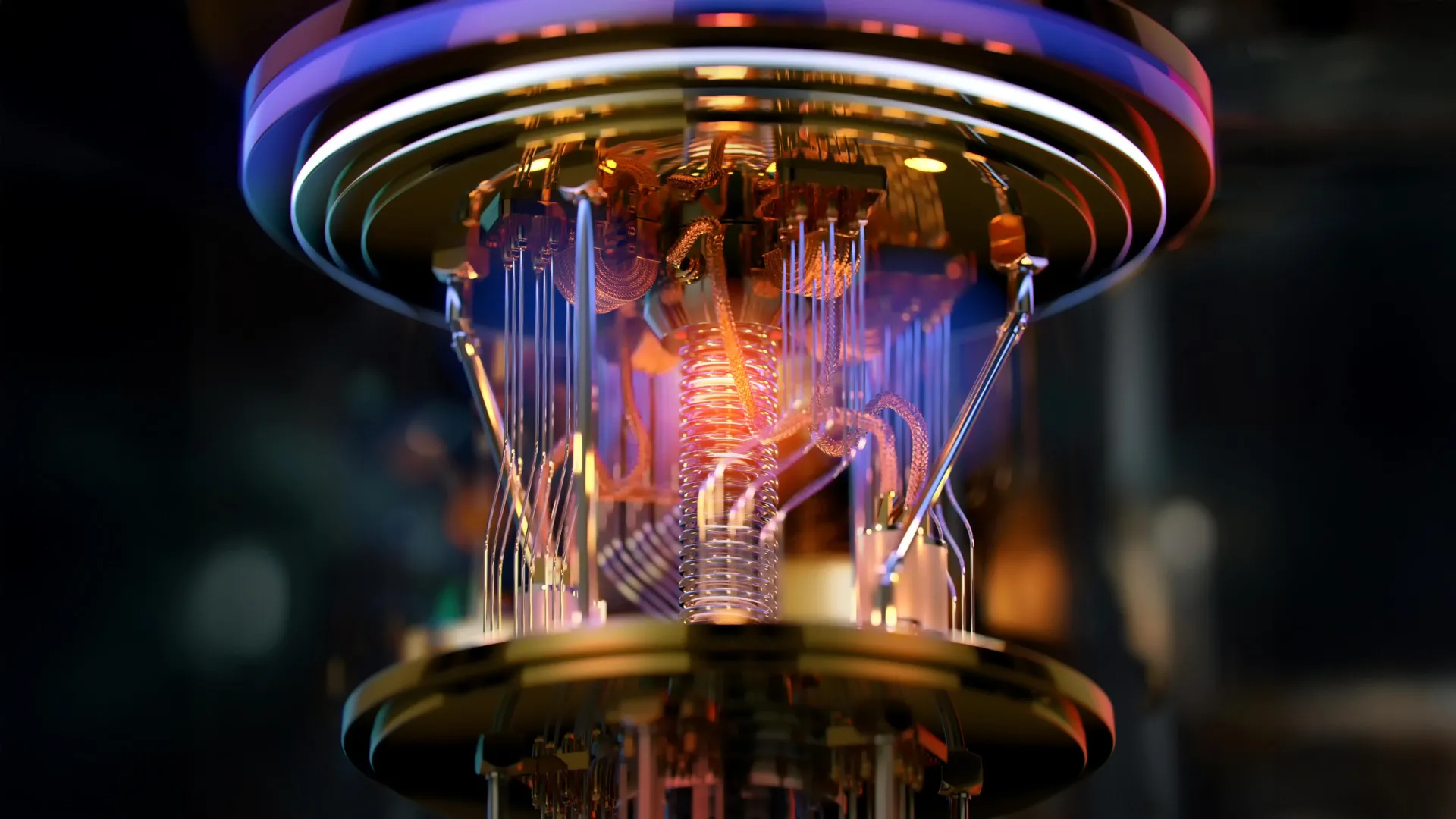
An IBM quantum computer has completed an extraordinarily complex computational task in just 15 minutes, while leading methods for simulating the calculation on conventional computers would require prohibitively long runtimes. Perhaps even more significantly, researchers were able to establish statistical confidence in the accuracy of the quantum computer’s results, addressing one of the biggest obstacles in the field.
The achievement, led by IBM and researchers from the University of Chicago, satisfies the fundamental criteria for quantum advantage. This milestone occurs when a quantum computer performs a computational task beyond the practical capabilities of leading classical computing methods while producing results that can be trusted.
In their new paper, “Sampling hard circuits with verifiably high fidelity,” the researchers demonstrated that both objectives could be achieved simultaneously using a novel design for encoded quantum circuits. The experiment represents one of the largest demonstrations of logical quantum computing to date. The researchers have also made their circuits and experimental results publicly available through the Quantum Advantage Tracker.
Solving Quantum Computing’s Verification Problem
Unlike conventional computers, which process information using bits that represent either zero or one, quantum computers rely on quantum bits, or qubits. These can exist in combinations of both states and interact through a phenomenon known as quantum entanglement. These properties allow quantum computers to approach certain computational problems in fundamentally different ways.
For years, scientists have tested the capabilities of quantum computers using a benchmark called random circuit sampling (RCS). This technique involves running a series of randomly selected quantum operations and generating samples from a complex probability distribution. As the circuits grow larger and more complicated, reproducing their output with a classical computer becomes increasingly difficult.
However, this approach creates a fundamental dilemma. If a computation is too difficult for a classical computer to reproduce, how can researchers establish that the quantum computer performed it correctly?
As computational complexity increases, independently verifying the results becomes progressively more difficult and eventually impractical without making strong assumptions about how accurately the quantum hardware operates.
To overcome this problem, the IBM and University of Chicago team developed a more structured alternative to random circuit sampling. The researchers mathematically demonstrated that their approach preserves the same computational hardness criteria as conventional RCS while introducing a structure that allows errors to be detected during the computation.
“Verification remains one of the biggest challenges in firmly establishing experimental quantum advantage,” said Bill Fefferman, Associate Professor at the University of Chicago. “This experiment develops techniques to better characterize the fidelity of hard quantum states under noise, increasing confidence that the quantum computer is solving a computationally hard problem.”
Soumik Ghosh, PhD student in Fefferman’s group at the University of Chicago, added, “Beyond strengthening experimental validation, advances in verification have the potential to unlock practical applications for the next generation of quantum computers.”
70 Logical Qubits and Tenfold Lower Error Rates
One of the greatest challenges in building powerful quantum computers is their extraordinary sensitivity to errors. Quantum information can be disrupted by environmental disturbances, imperfections in hardware, and inaccuracies in the operations used to manipulate qubits. As computations become longer and more complex, these errors can accumulate and undermine the reliability of the results.
Quantum error correction addresses this weakness by encoding quantum information across multiple physical qubits to create more reliable units known as logical qubits. This approach allows certain errors to be identified and, depending on the technique, corrected or accounted for without destroying the underlying quantum information.
In one of the largest known demonstrations of quantum error correction, the researchers performed computations using 70 protected logical qubits. The experiment involved 2,415 logical two-qubit operations and 468 logical “T gates.”
Quantum gates are the fundamental operations that manipulate quantum information, much like logic gates in conventional computers. Two-qubit gates allow qubits to interact, while T gates enable additional types of quantum operations needed for universal quantum computing. Together, these gate counts illustrate the considerable complexity of the experiment.
By encoding the quantum circuits, the researchers achieved effective logical error rates 10 times lower than the underlying physical error rates. This substantial reduction allowed the quantum computer to maintain remarkably high fidelity, a measure of how closely the actual quantum state matches the intended one, despite performing thousands of complex operations.
A New Era of Quantum Advantage
“We are now firmly in the quantum advantage era,” said Jay Gambetta, Director of IBM Research and IBM Fellow. “We have demonstrated a quantum computation beyond the practical reach of classical computers that establishes, with statistical confidence, a lower bound on how faithfully it was executed. This milestone gives scientists, developers, and businesses a new foundation for trusting quantum computers as they scale to problems far beyond what we can achieve classically.”
The researchers found that many leading classical simulation techniques would require impractically long periods to reproduce the computation. IBM’s quantum computer, by comparison, accomplished the task in approximately 15 minutes.
Although the experiment was designed to demonstrate quantum advantage rather than solve an immediate real-world problem, it addresses two essential requirements for making large-scale quantum computing practical: controlling errors and establishing confidence in computational results.
By demonstrating both capabilities in a computation beyond the practical reach of leading classical methods, the researchers have taken a significant step toward a future in which quantum computers could reliably tackle scientific and industrial problems that are currently out of reach.
