

Close Menu
NCIJ Network NCIJ Network
    What's Hot

    Did Trump invest $3M in Nvidia before it reinstated Jensen Huang?

    November 26, 2026

    Europe’s integrated power market fears growing political backlash

    November 26, 2026

    Scientists discover mysterious lakes more than a mile beneath the Red Sea

    November 26, 2026
    Facebook X (Twitter) Instagram
    Trending
    • Did Trump invest $3M in Nvidia before it reinstated Jensen Huang?
    • Europe’s integrated power market fears growing political backlash
    • Scientists discover mysterious lakes more than a mile beneath the Red Sea
    • The night watchmen guarding Malaysia’s critically endangered river terrapins
    • Do Wisconsin’s incoming government leaders have limited private-sector work experience?
    • Is the Russia-Ukraine War Spreading to Africa?
    • Macron threatens to stop negotiating EU budget after December – POLITICO
    • UK government set to publish new treaties agreed with EU
    • About
      • Our Team
      • Editorial Policy
      • Editorial Independence
      • International Support
    • Trust & Standards
      • AI Usage Policy
      • Conflict of Interest Policy
      • Corrections Policy
      • Ethics Policy
      • Fact-Checking Policy
      • Source Protection
    • Get Involved
      • Guide for Sources
      • Support Independent Journalism
    • Legal
      • Cookie Policy
      • Privacy Policy
      • Terms of Use
    Facebook X (Twitter) Instagram
    NCIJ Network NCIJ Network
    Thursday, November 26
    • Home
    • World
    • Ai
    • Business
    • Politics
    • Health
    • Crypto
    • Science
    • Technology
    • Cybersecurity
    • Defense & Security
    • Economy
    • Energy
    • Europe
    • More
      • Fact Check
      • Investigations
      • Opinion & Analysis
      • Environment
    NCIJ Network NCIJ Network
    Home»Science

    Scientists discover mysterious lakes more than a mile beneath the Red Sea

    NCIJ NETWNCIJ NETWORKBy NCIJ NETWNCIJ NETWORKNovember 26, 2026 Science No Comments3 Mins Read
    Share
    Facebook Twitter LinkedIn Pinterest Email

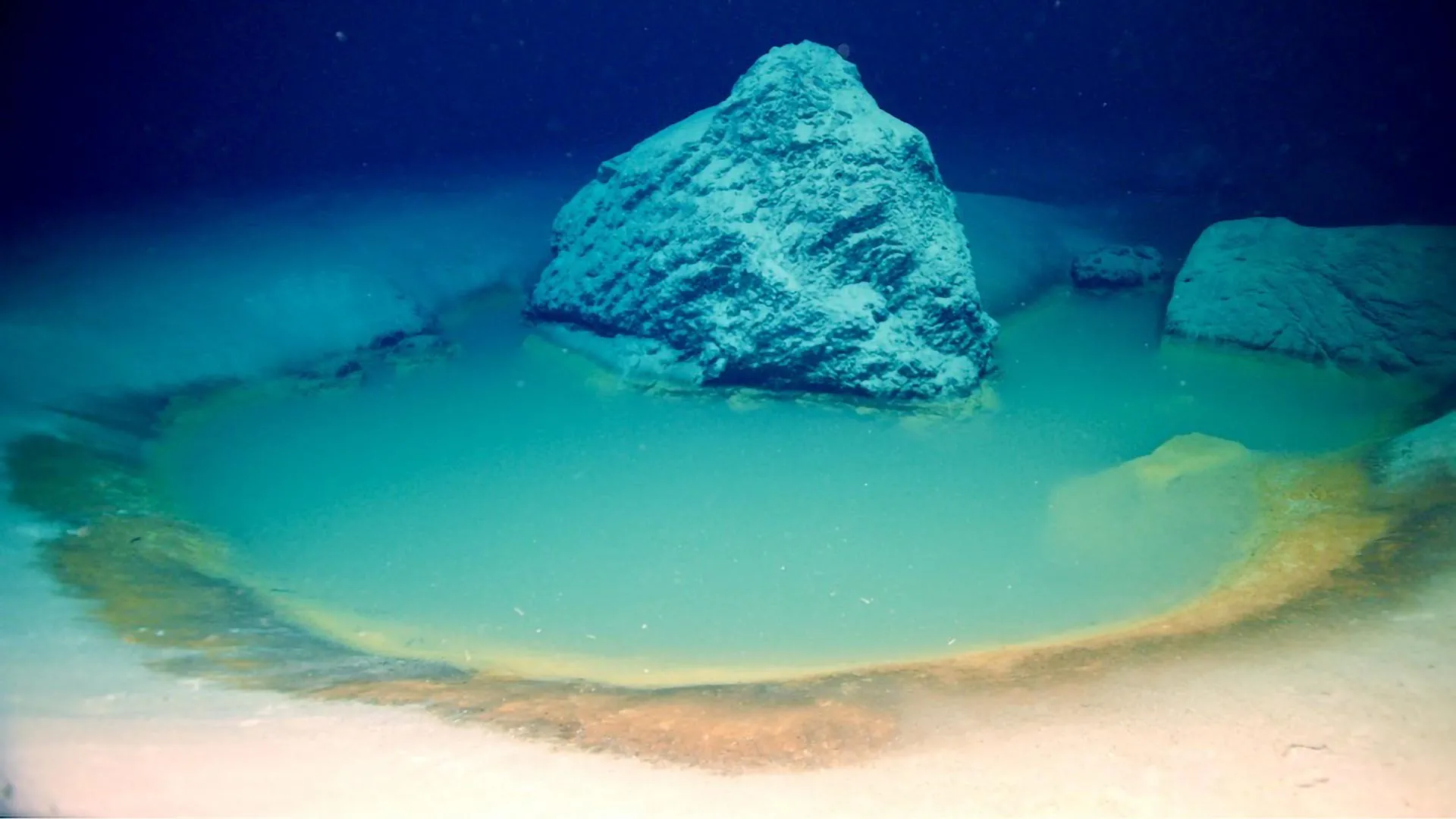
    More than a mile below the surface of the Red Sea, researchers from the University of Miami (UM) Rosenstiel School of Marine and Atmospheric Science discovered rare deep-sea brine pools in the Gulf of Aqaba, a northern extension of the Red Sea. These unusually salty underwater lakes could provide clues to how Earth’s oceans formed millions of years ago and help guide the search for life on other planets.

    The discovery was made by Sam Purkis, professor and chair of the UM Department of Marine Geosciences, and his colleagues in collaboration with OceanX. The researchers located the pools at a depth of more than one mile (1,770 meters) using a remotely operated underwater vehicle (ROV) deployed from the OceanXplorer, an advanced research vessel equipped to investigate some of the least accessible environments on Earth.

    “Until we understand the limits of life on Earth, it will be difficult to determine if alien planets can host any living beings,” said Purkis. “Our discovery of a rich community of microbes that survive in extreme environments can help trace the limits of life on Earth and can be applied to the search for life elsewhere in our solar system and beyond.”

    Life thrives in extreme underwater lakes

    Brine pools rank among the harshest environments on our planet. Their waters contain exceptionally high concentrations of salt, feature unusual chemical conditions, and are completely devoid of oxygen. Despite these seemingly inhospitable conditions, the pools support abundant microbial life. Previous research on microbes inhabiting Red Sea brine pools has even identified biologically active molecules with potential anticancer properties.

    The findings, published in Communications Earth & Environment, mark the first documented discovery of brine pools in the Gulf of Aqaba. Remarkably, the researchers nearly missed them.

    “We were very lucky,” said Purkis. “The discovery came in the last five minutes of the ten-hour ROV dive that we could dedicate to this project.”

    Hidden records of ancient tsunamis and earthquakes

    Beyond their biological significance, the pools serve as natural archives of the region’s geological history. Situated relatively close to the coastline, their extremely salty waters and absence of oxygen help preserve evidence of tsunamis, flash floods, and earthquakes that occurred in the Gulf of Aqaba thousands of years ago. Regional tectonic activity has produced numerous faults and fractures across the seabed in this part of the gulf.

    Earlier in 2022, Purkis and his colleagues uncovered evidence of a 500-year-old underwater landslide that likely generated a substantial tsunami. Understanding the region’s history of such events could have important implications for coastal development in Egypt and Saudi Arabia.

    The study, titled “Discovery of the deep-sea NEOM Brine Pools in the Gulf of Aqaba, Red Sea,” was published on June 27, 2022, in Communications Earth & Environment.

    The research team included Sam J. Purkis, Hannah Shernisky, Peter K. Swart, Arash Sharifi, Amanda Oehlert, Gaëlle Duchâtellier, James Klaus, Gregor P. Eberli, Larry Peterson, and Graham Kolodziej from the UM Rosenstiel School; Fabio Marchese and Francesca Benzoni from King Abdullah University of Science and Technology’s Red Sea Research Center; Giovanni Chimienti from the University of Bari Aldo Moro in Italy; Andrew Craig and Mattie Rodrigue from OceanX; Jürgen Titschack from MARUM — Center for Marine Environmental Sciences in Germany; and Ameer Abdulla from NEOM.

    NEOM, a company developing the Saudi Arabian coastline, provided funding for the four-week research expedition aboard the OceanXplorer.

    Watch the NEOM OceanX documentary about the discovery: https://youtu.be/bWNftnYDx9c

    Beneath discover lakes Mile mysterious Red Scientists Sea
    NCIJ NETWNCIJ NETWORK
    • Website

    Keep Reading

    US approves SpaceX plan to send a million data satellites to space

    Stanford scientists discover 3 hidden brain types behind ADHD and anxiety

    What is a thought made of? Why human consciousness may be beyond AI’s reach

    Physicists trap antimatter in a breakthrough that could explain why the universe exists

    Australia’s legless geckos evolved like snakes did

    NASA Enhances Supplier Program, Announces Mentor-Protégé Agreement

    Add A Comment
    Leave A Reply Cancel Reply

    Editors Picks

    Did Trump invest $3M in Nvidia before it reinstated Jensen Huang?

    November 26, 2026

    Europe’s integrated power market fears growing political backlash

    November 26, 2026

    Scientists discover mysterious lakes more than a mile beneath the Red Sea

    November 26, 2026

    The night watchmen guarding Malaysia’s critically endangered river terrapins

    November 26, 2026
    Latest Posts

    Iran-linked hackers blamed for cyber-attack that shut down UK power plant | Iran

    August 23, 2026

    Burning Questions Confront Wildland Firefighters in Maine and Across New England

    August 23, 2026

    Curiosity Blog, Sols 4982–4987: Back to Our Regularly Scheduled Programming

    August 23, 2026

    Subscribe to News

    Get the latest sports news from NewsSite about world, sports and politics.

    NCIJ Network is an independent digital news platform delivering trusted investigative journalism, European and global news, in-depth analysis, and fact-based reporting with accuracy, transparency, and integrity.

    Facebook X (Twitter) Instagram Pinterest YouTube

    Did Trump invest $3M in Nvidia before it reinstated Jensen Huang?

    November 26, 2026

    Europe’s integrated power market fears growing political backlash

    November 26, 2026

    Scientists discover mysterious lakes more than a mile beneath the Red Sea

    November 26, 2026

    Subscribe to Updates

    Get the latest creative news from FooBar about art, design and business.

    Type above and press Enter to search. Press Esc to cancel.