


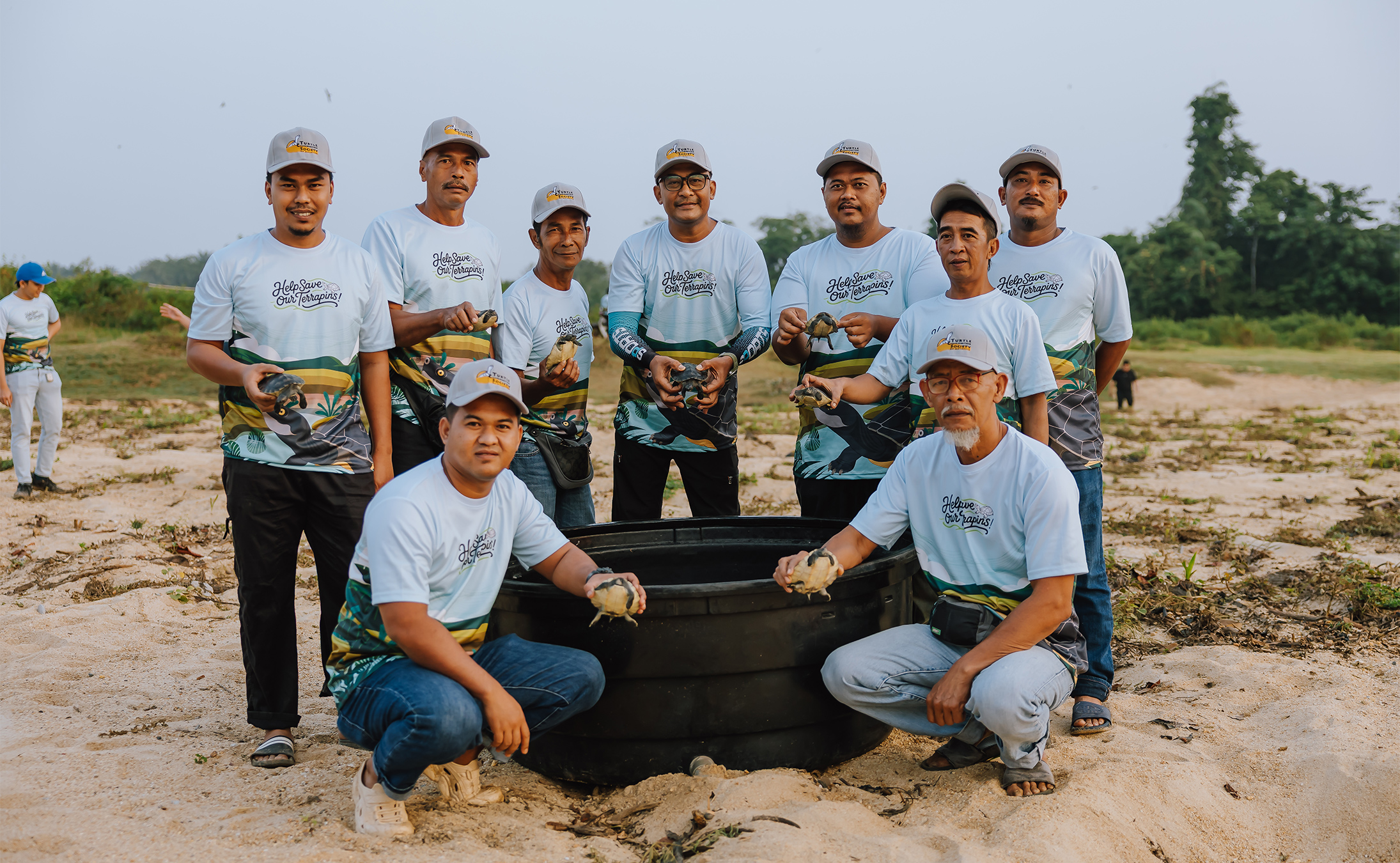
- In Malaysia’s Terengganu state, former turtle egg collectors now work to protect a critically endangered river terrapin as part of a program led by the Turtle Conservation Society of Malaysia.
- Since the program began in 2011, the program’s “Terrapin Guardians” have collected and incubated more than 13,000 eggs and released more than 8,200 young terrapins back into the river.
- In addition to egg gathering for consumption, Terengganu’s river terrapins are also threatened by natural predators like monitor lizards and sand mining, which destroys the sandbanks the turtles nest in.
KEMAMAN, Malaysia — As night settles over Kampung Pasir Gajah, a small team of men can be found sitting in the moonlight by the riverbank. They scroll on their phones, share a late meal, but their ears are tuned to the river.
These men call themselves the Terrapin Guardians, or Geng Tuntung in Malay, after tuntung, the local word for river turtles. During nesting season from January to March, they work nights from 10 p.m. until dawn along this stretch of river in Terengganu state, on the east coast of Peninsular Malaysia. They scan for tracks of a heavy shell on the sand — a sign that a southern river terrapin (Batagur affinis) has crawled out of the water to nest.
Samsul bin Hamid, 52, a factory production line worker, was once among the villagers who gathered by these riverbanks to harvest terrapin eggs as a seasonal delicacy. He stopped after learning more about the species through the Turtle Conservation Society of Malaysia (TCS).
“I learned the ways to track terrapins through friends. Back then, they would invite me to go egg collecting, and I would go. It’s just something we learned being part of the village,” he says.
Today, Samsul is one of 13 guardians, all of whom once harvested eggs and now work with TCS to secure nests before natural threats and other collectors find them. According to TCS data, the guardians have collected and incubated 13,224 eggs, and successfully released more than 8,200 young terrapins back into the river since the community-led conservation program began in 2011.
The southern river terrapin is listed as critically endangered on the IUCN Red List, meaning the species faces an extremely high risk of extinction in the wild. Once widespread across Southeast Asian river basins, much of its remaining wild population is found here in Peninsular Malaysia.
In 2010, all freshwater turtles and tortoises were declared fully protected species under Malaysia’s Wildlife Conservation Act.

Eggs were about traditions, not trade
Unlike wildlife trade driven by lucrative profits, terrapin eggs collected in Kampung Pasir Gajah were traditionally shared among neighbors and eaten at home. It’s a seasonal tradition — part of village life here, Samsul explains: “The villagers collect these eggs for their own consumption, we don’t sell them.”
Even if the villagers wanted to commercialize their harvest, the monetary incentive is slim. Chen Pelf Nyok, co-founder and executive director of TCS and affectionately known as the “mother of terrapins,” says that a typical clutch of 35 eggs could be shared among as many as 10 people.
“Each person would receive only three to four eggs. Even if they sold those eggs at 8-10 ringgit [$2-$2.5] each, they would only earn around 24-40 ringgit [$6-$10],” she says. “This is very different from commercial sea turtle egg trading, where a trader could potentially earn 350-500 ringgit [$86-$123] from a single clutch of green turtle eggs.”
Still, the change didn’t come easily. “It takes a lot of patience, relationship-building and mutual respect. We engage with local communities, explain why collecting and eating terrapin eggs is illegal in Malaysia, and encourage people to become part of the conservation solution rather than simply telling them to stop,” Pelf says.
Not everyone has stopped. Some villagers still wait by the riverbank to collect eggs for their own consumption. “There were some in the village that couldn’t accept us not eating the eggs anymore,” Samsul says. “But over time, more villagers grew curious about why the terrapins needed protecting.”
Samsul also frames the work in terms of his Muslim faith. “We have a role in protecting the terrapins. Caring for animals is a virtuous act in the eyes of religion,” he said.


A terrapin guardian’s day at work
When a guardian spots a nesting terrapin, they monitor and wait for the mother to nest. Then, the team weighs, measures, and microchips the female before securing her eggs. These eggs are brought back to the TCS hatchery, incubated for three months, and the hatchlings nursed until they’re ready to be released back into the wild.
Mohd Azriezal bin Mahad, 29, is a second-generation guardian. His late father, Pak Wazel, worked with TCS from the start in 2011, and Azriezal began observing at a young age what his father was doing before officially joining this year. He’s shy and a man of few words.
When asked how he feels about working with TCS, his response is simple. “I feel happy to continue my dad’s work,” he says in a quiet voice.
The guardians are also expanding their help to the wildlife department, lending their expertise in tracking and catching river terrapins in other parts of Malaysia.
Experts say the success of a community-based conservation project isn’t dependent on the number of hatchlings released, but whether changes in human behavior last.
“The most important contribution of community-based programs is their social impact,” Natalia Gallego-García of the Tortoise and Freshwater Turtle Specialist Group at the IUCN, the global wildlife conservation authority, says in an email. Referring to conservation programs in general, she says that, “They transform how local communities perceive and value a species, creating opportunities for education and fostering a deep sense of ownership.”

Threats to the terrapin’s habitat
Natural predators like monitor lizards can also wipe out terrapin nests. “Their sense of smell is extremely good, and they’re so quick to find the eggs. Maybe we should train them up — like K9 units, but our sniffer animals are monitor lizards,” Samsul says with a laugh.
Sand mining to supply construction companies is another significant threat.
“Sandbanks are not simply deposits of sand,” Ahmad Syazni Kamarudin, a professor and senior lecturer at Sultan Zainal Abidin University in Terengganu, who’s involved in research for the critically endangered painted terrapin (Batagur borneoensis), says in an email. “They are essential breeding infrastructure. Sand extraction alters riverbank stability, sediment distribution, and the specific sand moisture and temperature conditions required for successful egg incubation.”
Pelf says that since terrapins are a river-dependent species, the loss of their nesting sandbanks could undermine decades of conservation work. “Sand can be dredged from other parts of the Kemaman River or from other rivers. But terrapins cannot simply move to another river when their nesting habitat disappears,” she says.


TCS currently monitors six sandbanks along the river. Pelf and the guardians say they hope that one day, the terrapin nesting sandbanks can be formally protected to shield them from sand mining activities.
“Protecting these sandbanks legally would give terrapins the opportunity to complete their life cycle and reproduce in the wild. Without suitable nesting habitat, all our efforts to increase their numbers may ultimately be in vain,” she says.
River terrapins take roughly 15 to 20 years to mature. “For a critically endangered species with a relatively slow reproductive life cycle, the loss of suitable breeding habitats can have consequences extending over many generations,” Syazni says.
“We are investing in their future today, releasing young terrapins into the river with the hope that they will eventually return to nest,” Pelf says. “But when they mature, will there still be suitable sandbanks for them to lay their eggs?”

Banner image: The Terrapin Guardians, locally known as Geng Tuntung, are made up of former egg collectors who now work to protect the river terrapins. At left is Azriezal, with Samsul in the middle with glasses. Image courtesy of Turtle Conservation Society of Malaysia.
In Java’s hills, former bird hunters are rebuilding a songbird haven
Malaysia’s turtle egg buyback scheme saved thousands — but is it sustainable?
Citation:
Chen, P. N. (2017). Conservation of the Southern River Terrapin Batagur affinis (Reptilia: Testudines: Geoemydidae) in Malaysia: a case study involving local community participation. Journal of Threatened Taxa, 9(4), 10035. doi:10.11609/jott.3267.9.4.10035-10046
Cite this article
Ashley Yeong (2026). The night watchmen guarding Malaysia’s critically endangered river terrapins. Mongabay Conservation news. DOI: https://doi.org/10.66709/news-337059

