


The first thing renowned climatologist Daniel Swain did during his virtual office hours on Monday was set the record straight about California’s upcoming flood risk. This week, water levels along the state’s coast, bays and estuaries will be as high, if not higher, than they’ve ever been, he said.
“But this will not, I repeat, will not be because of extreme rainfall,” said Swain, a University of California Agriculture and Natural Resources weather and climate scientist who regularly hosts briefings to explain global warming’s effects on natural hazards.
Some news reports and government officials were blaming predicted record-breaking coastal flooding on extreme storms. San Francisco Mayor Daniel Lurie, for example, said the city would see rainfall “that this city had never seen before.” Others warned people living inland to prepare for severe flooding.
“None of that is accurate,” Swain said. “This is not being really driven by rain or a storm at all.”
These potentially record-high water levels are “almost exclusively” caused by the overlap between king tides “and the extreme thermal expansion from our extreme El Niño event,” he said.
King tides are naturally occurring, exceptionally high tides caused by the gravitational forces of the sun and moon. El Niño is also a natural phenomenon, happening roughly every two to seven years when warmer ocean waters spread across the central and eastern Pacific, affecting weather and climate patterns as stored heat escapes into the atmosphere.
But this El Niño is shaping up to be the strongest on record, making coastal ocean temperatures 10 to 15 degrees Fahrenheit warmer than normal. It has increased the height of waters off California’s coast by at least a foot, and in some cases, nearly two feet, Swain explained. And it’s persisted across many high-tide cycles.
“I just want to be really clear about what is and is not happening in California this week,” Swain said. “We’re going to see overlap between water levels that have been consistently running 12 to 20 inches above usual levels, not because of storms, not because of tides, but because of El Niño and climate change, the extreme thermal expansion of the water column.”
Coastal water levels are higher because the upper several hundred feet of the ocean are as much as 10 to 15 degrees warmer, and below-surface waters are about five or six degrees warmer, he said. “The water molecules are literally taking up more volume and therefore more space.”
He predicted that Humboldt Bay, about 260 miles north of San Francisco, will likely get the worst of a storm projected to hit California on Tuesday. “The ocean will be potentially at record levels with storm surge, thermal expansion from El Niño, king tides and heavy rain, all stacking on top of each other.”
The storm is likely to lose most of its punch by the time it reaches the Bay Area, he said, stressing that the flood risk is along the coast, not inland. “There’s almost no risk of inundation at all this week anywhere that’s about more than three or four feet above sea level.”
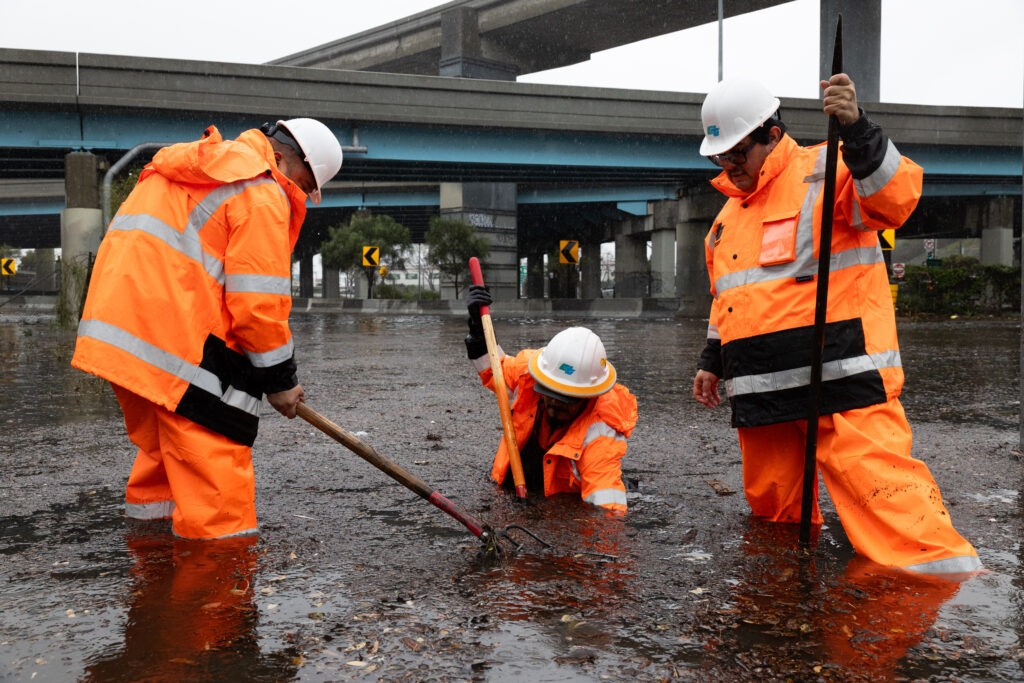
San Francisco authorities are preparing for the worst, after unusually heavy downpours last week caused disastrous flooding across the city.
“It is critical that everyone stays far away from the water, at the bay and ocean,” Lurie said in a press conference Monday. Public works crews are clearing storm drains, city crews are using specialized trucks to remove debris and sediment and the port has installed flood barriers and pumps along the Embarcadero, Lurie said, referring to the city’s eastern waterfront boulevard.
The Bay Area’s largest airports have ramped up efforts to manage floodwaters, which could overtop the lowest points of seawalls at the San Francisco Airport.
This story is funded by readers like you.
Our nonprofit newsroom provides award-winning climate coverage free of charge and advertising. We rely on donations from readers like you to keep going. Please donate now to support our work.
“SFO facilities staff and engineers have prepared ahead to address any flooding issues that might arise,” the airport said in a statement. Airport staff have deployed sandbags and portable flood barriers in addition to ensuring storm drains and pump stations are working. The Oakland airport recently raised its perimeter dike to adapt to sea level rise and expects “smooth and uninterrupted airport operations for Thanksgiving holiday travelers,” a release issued Monday said.
Researchers, community members and state agencies are concerned about how this unprecedented confluence of king tides and El Niño might affect thousands of toxic sites around the Bay Area, said Emma Lasky, a Ph.D. candidate at the University of California, Berkeley. Many researchers hope to use this opportunity to understand the potential for flood waters to move toxic chemicals offsite, said Lasky, who has started studying this possibility in historically contaminated low-lying areas of the East Bay.
By Tuesday morning, floodwaters had already inundated the Embarcadero pier and shut down several roads in Marin County, north of San Francisco.
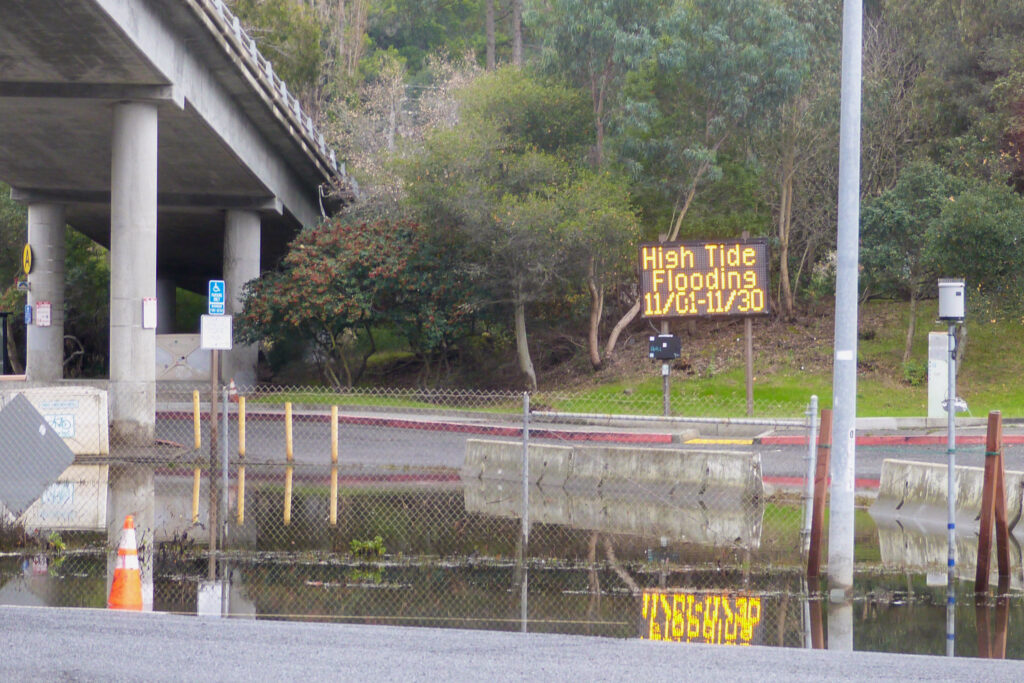
Flooding hits hardest in communities like Marin County’s Canal District that have waited the longest for investment in protection, said Zoe Siegel, senior director of Climate Resilience at the nonprofit Greenbelt Alliance. “These communities need to be first in line for adaptation funding and they need to help design it.”
An interactive map of flood risk reveals elevated water levels along California’s coast that have never been seen before, Swain said. “This is record-shatteringly extreme.”
Tides could be another six or seven inches higher at their peak than they were Monday, he said. And it’s just the start of the king tide season.
King tides will potentially be even more problematic in December and January because the water is so high that even incremental increases in tides could produce record-breaking coastal water levels, Swain said.
He has no doubt that human-caused global warming is making the difference between floods that break records and those that don’t.
He ticked off all the ways human-caused warming has affected risk: sea level rise, more dangerous king tides, extremely warm El Niño, super-high levels of water vapor in the air and record-breaking coastal ocean temperatures.
“It’s related to all of those things and more,” Swain said. “And we don’t hear about it as much as we should.”
About This Story
Perhaps you noticed: This story, like all the news we publish, is free to read. That’s because Inside Climate News is a 501c3 nonprofit organization. We do not charge a subscription fee, lock our news behind a paywall, or clutter our website with ads. We make our news on climate and the environment freely available to you and anyone who wants it.
That’s not all. We also share our news for free with scores of other media organizations around the country. Many of them can’t afford to do environmental journalism of their own. We’ve built bureaus from coast to coast to report local stories, collaborate with local newsrooms and co-publish articles so that this vital work is shared as widely as possible.
Two of us launched ICN in 2007. Six years later we earned a Pulitzer Prize for National Reporting, and now we run the oldest and largest dedicated climate newsroom in the nation. We tell the story in all its complexity. We hold polluters accountable. We expose environmental injustice. We debunk misinformation. We scrutinize solutions and inspire action.
Donations from readers like you fund every aspect of what we do. If you don’t already, will you support our ongoing work, our reporting on the biggest crisis facing our planet, and help us reach even more readers in more places?
Please take a moment to make a tax-deductible donation. Every one of them makes a difference.
Thank you,

Reporter, California
Liza Gross is a reporter for Inside Climate News based in Northern California. She is the author of The Science Writers’ Investigative Reporting Handbook and a contributor to The Science Writers’ Handbook, both funded by National Association of Science Writers’ Peggy Girshman Idea Grants. She has long covered science, conservation, agriculture, public and environmental health and justice with a focus on the misuse of science for private gain. Prior to joining ICN, she worked as a part-time magazine editor for the open-access journal PLOS Biology, a reporter for the Food & Environment Reporting Network and produced freelance stories for numerous national outlets, including The New York Times, The Washington Post, Discover and Mother Jones. Her work has won awards from the Association of Health Care Journalists, American Society of Journalists and Authors, Society of Professional Journalists NorCal and Association of Food Journalists.
